
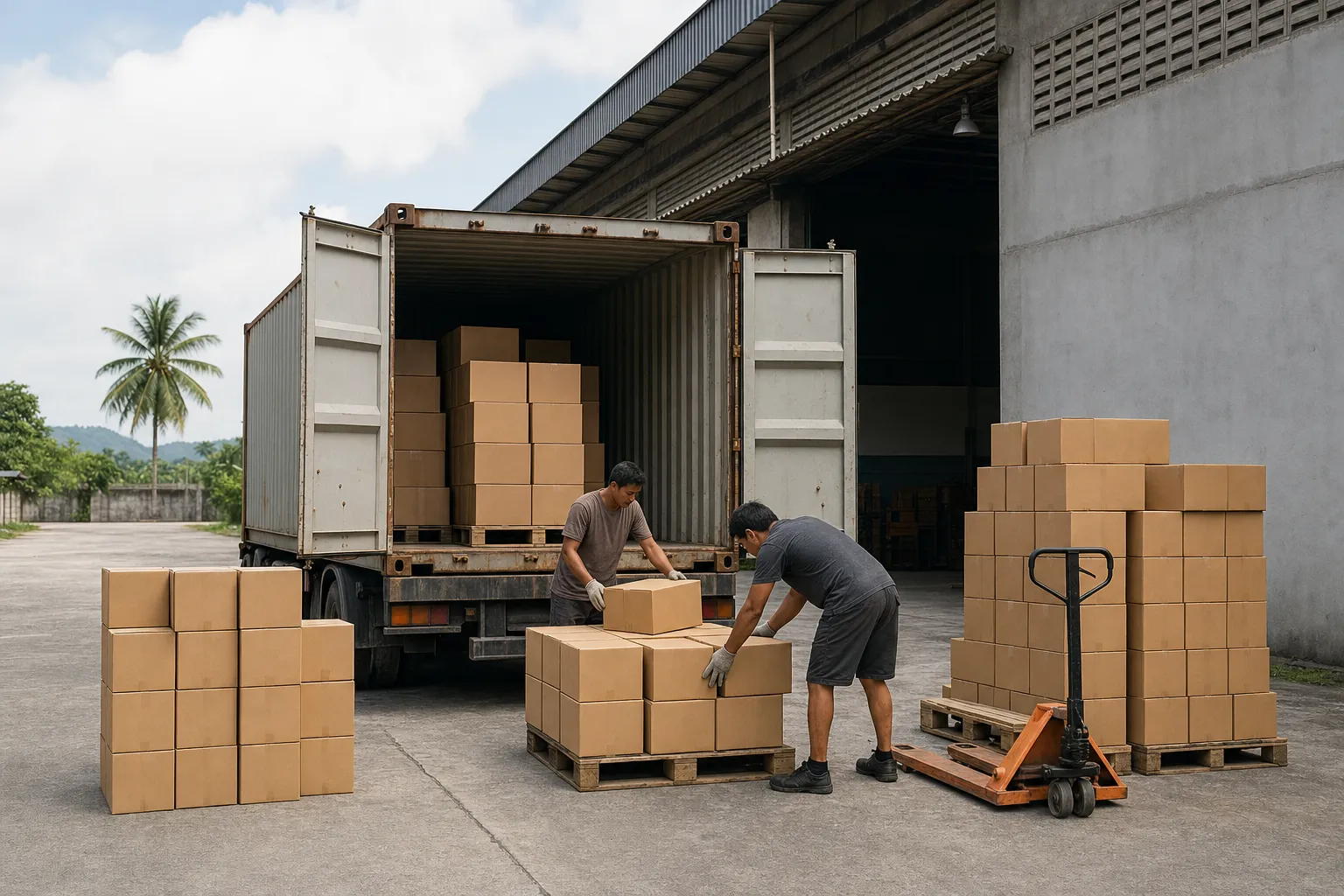
A consolidated container is one object at the border and a queue of separate shipments behind it. Deconsolidation is the operation that turns the first into the second: the box is opened at a container freight station, the cargo is counted and sorted back into the lots that several different owners shipped, and each lot then waits for its own release.
Most descriptions of the step stop at the physical act, because the physical act is simple. What is not simple is everything it depends on. The sort is driven by two documents that have to agree with each other, it is constrained by an import position that was fixed weeks earlier, and its clock starts the moment the doors open — whether or not anybody at the far end is ready.
A note on the word itself. Outside freight, deconsolidation is an accounting term for losing control of a subsidiary, and in political writing it describes institutions coming apart. Neither is meant here. In cargo the word has exactly one meaning, and it is the one below.
Nothing on this page is a quotation. No rate, tax figure, percentage or promised transit time appears in it. The situations described are hypothetical: they are not client cases and they are not quotations. What any particular facility does with your goods is settled by that facility's operating rules and by the customs authorities at each end — not by this page.
One container, many shipments
In an LCL arrangement a consolidator — an NVOCC, or a forwarder acting as one — books space in a container and sells it in pieces. Several shippers' cargo is stuffed at origin (that is the trade's word for loading), the container sails under a single transport document covering the whole box, and each shipper holds a different document covering its own lot alone.
At destination the arithmetic reverses. The container is discharged, moved to a container freight station, and stripped — devanned is the more common verb. Cartons come out one lot at a time, are counted against the documents they travelled under, and are placed in separate groups on the floor. From that moment the consolidated shipment no longer exists, and what exists instead is a set of separate consignments sharing a building and a timetable.
Three words get used as if they were interchangeable, and they are not. Devanning or stripping is the physical act of emptying the box. Deconsolidation is the commercial event: the point at which the container's cargo becomes individually releasable. A container freight station is the facility where both happen. Buyers say "deconsolidation" for all three, which is harmless in conversation and misleading when something goes wrong, because responsibility attaches to a different party at each of those three levels.
One further distinction is worth fixing early, because it changes the legal character of the operation rather than its appearance. If the entire container holds cargo for you and your own suppliers — a buyer's consolidation — the box clears as your import and the separation happens afterwards, at a warehouse you nominate. That is a cross-dock, not a customs operation. What this page describes is the other case, where the cargo in the box belongs to several importers who have never met. Which arrangement you are in is decided at booking, and it is the reason the difference between sharing a container and taking a whole one is a commercial question before it is a physical one.
Where the split happens, and under whose eye
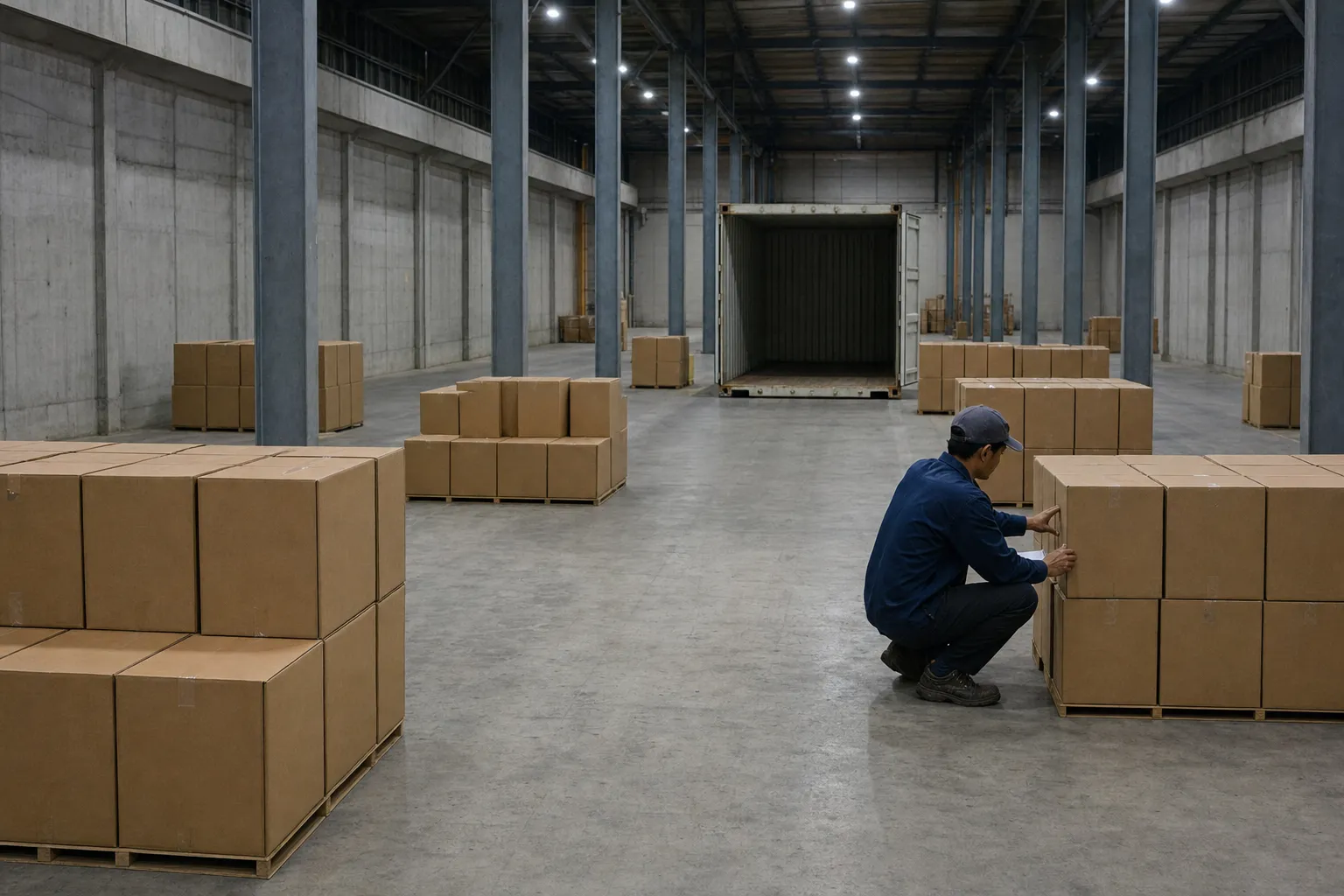
An LCL container is normally moved out of the terminal to a container freight station before it is opened, and the devanning happens there rather than at the quay. Whether a container is handed over at the quay or opened at a station is a booking model rather than an accident — the CFS and CY models that carriers describe are what decide it. The station itself may sit inside the port estate or inland; the inland version is what the trade usually calls a breakbulk warehouse. Wherever it sits, the facility works under customs supervision, and cargo does not leave it until a release exists. That single fact explains most of the impatience buyers feel at this stage: the container has arrived, and the goods have not.
Six things happen inside the hall, roughly in this order:
- The seal is checked and cut.
- The container is stripped.
- Each lot is tallied against the manifest and its house bill.
- Cartons that are damaged, re-taped or wet are set aside and photographed.
- Lots are segregated by consignee, and then by whatever clearance route each lot is on.
- Released lots are collected by the consignee's transport or loaded for delivery.
The tally is the moment of truth in that list. The count that comes out of the container is the count everyone will use from then on — for the claim, for the delivery note, for the final reckoning with the supplier. If the count disagrees with the packing list, the disagreement can be written down now, while the cartons are on the floor and still separable. The same disagreement discovered after collection is a dispute, and what a claim needs is evidence gathered at exactly this point.
The mirror image of this page is the origin building, and reading the two together is the fastest way to understand why the marks and the counts matter: inside a China consolidation warehouse describes the same six steps in reverse, where each lot is still cheap to correct.
Two bills, and only one of them is yours
A consolidated shipment travels under two layers of documentation, and the difference between them decides what the sort is actually sorting.
Master bill of lading | House bill of lading | |
|---|---|---|
Issued by | The ocean carrier, or its agent, to the consolidator that booked the space | The consolidator or forwarder to its own customer |
Covers | The whole container | One lot, one consignee |
Names | The contracting parties for the carriage of the box | You, or the entity you nominated |
Unlocks at destination | The container's movement and its release from the terminal | Your cargo's release from the station |
Issued by
Master bill of lading
The ocean carrier, or its agent, to the consolidator that booked the space
House bill of lading
The consolidator or forwarder to its own customer
Covers
Master bill of lading
The whole container
House bill of lading
One lot, one consignee
Names
Master bill of lading
The contracting parties for the carriage of the box
House bill of lading
You, or the entity you nominated
Unlocks at destination
Master bill of lading
The container's movement and its release from the terminal
House bill of lading
Your cargo's release from the station
The master bill describes the box. The house bill describes your cargo. The station sorts by the house bill, but the floor sorts by marks — and where those two disagree, a lot stops being a line on a tally sheet and becomes a question. A house bill naming two consignees, cartons marked for a shipment that is not on the bill, one supplier's cartons carrying another supplier's mark: each of these is cheap to fix in China and expensive to fix in a hall with forty other lots in it.
What a bill of lading is — a receipt for goods handed over, evidence of the contract of carriage and, in many systems, a document of title — is settled by the maritime law of the countries the shipment touches rather than by one rule that binds everyone; the UNCITRAL collection of transport texts indexes the conventions that sit behind those national rules. The practical consequence for a buyer is narrow and useful: the name on your house bill is the name the release will be built around, so it must be the entity that will hold the import position, not whoever happened to sign the purchase order.
The packing list is the third document in the set and the only one that enumerates cartons. If it lists forty cartons and the cartons carry no numbers, the station can count forty — and still cannot tell your forty from another buyer's forty in the same corner of the floor. Marks are how a count becomes an identity.

Clearing the box, or clearing the lots
This is the fork that decides who is exposed when something goes wrong, and it is usually invisible in a quotation.
Route one: the container is declared as one consignment. The consolidator, or its Indonesian counterpart, lodges a single declaration for the whole box. This is what many door-to-door LCL services do, and it is why the service can be sold as a single price to a buyer with no import entity in Indonesia. The consequence is not a formality: your goods were imported under someone else's identity. That may be exactly what you want, but what you hold afterwards is a commercial right to collect, not an import licence of your own.
Route two: each lot is declared by its own importer. Clearing the box releases nothing by itself here: a lot moves only when its own PIB is accepted, and a lot without an importer simply sits — in a building that is charging for the space.
Declared as one consignment | Declared lot by lot | |
|---|---|---|
Who lodges the declaration | The consolidator or its counterpart | Each importer, or a party acting for it |
Import identity used | The consolidator's arrangement | Yours |
What releases your cargo | House bill plus settlement of local charges | Your own accepted declaration |
What a problem in one lot does | Can hold the whole box | Holds that lot, and the shared operation around it |
Who lodges the declaration
Declared as one consignment
The consolidator or its counterpart
Declared lot by lot
Each importer, or a party acting for it
Import identity used
Declared as one consignment
The consolidator's arrangement
Declared lot by lot
Yours
What releases your cargo
Declared as one consignment
House bill plus settlement of local charges
Declared lot by lot
Your own accepted declaration
What a problem in one lot does
Declared as one consignment
Can hold the whole box
Declared lot by lot
Holds that lot, and the shared operation around it
Neither route is better in the abstract; they answer different questions. The one that fits a first shipment with no Indonesian entity is rarely the one that fits a buyer building a permanent import position, and the boundary between them is the subject of who may be the importer of record and of what the import declaration itself contains.
Whichever route applies, the route is not the only variable. Indonesian customs assigns consignments to channels, and a lot routed to the channel that involves examination is examined as a lot — while the rest of the floor waits for the shared operation around it to finish. How those channels differ is set out in green line and red line at Indonesian customs; what matters here is that the channel is not something a facility can influence on the day.
What actually goes wrong in the sort
The failure modes are few and repetitive. Most of them are visible in the first hour, and almost none of them can be fixed in that hour.
What you see | What caused it | Who carries it |
|---|---|---|
Cartons parked as unassigned | No marks, or marks that match nothing on the paperwork | The owner, in storage and delay |
A recount and a written discrepancy | Marks and packing list disagree | Whoever must now prove what was shipped |
Your lot waiting while another is examined | A shared container, one problematic lot | Everyone on the floor, unequally |
Damage found at devanning | Handling, stacking or the original packing | Decided by the evidence photographed there |
Cartons that cannot be found at all | Loose cargo, an open floor, no tally at the right moment | The consignee, unless the tally was witnessed |
Cartons parked as unassigned
What caused it
No marks, or marks that match nothing on the paperwork
Who carries it
The owner, in storage and delay
A recount and a written discrepancy
What caused it
Marks and packing list disagree
Who carries it
Whoever must now prove what was shipped
Your lot waiting while another is examined
What caused it
A shared container, one problematic lot
Who carries it
Everyone on the floor, unequally
Damage found at devanning
What caused it
Handling, stacking or the original packing
Who carries it
Decided by the evidence photographed there
Cartons that cannot be found at all
What caused it
Loose cargo, an open floor, no tally at the right moment
Who carries it
The consignee, unless the tally was witnessed
Two of those rows deserve a plain sentence each. A consolidated container is shared fate until each lot is released: the fastest way to be delayed by someone else's problem is to have no documents of your own ready when the doors open, and the only defence is to be releasable early and separately. And an open hall is not a sealed container — cargo that has been stripped is being handled by people, moved by equipment and stored in groups; a facility that cannot describe its own controls for unaccompanied cargo is a facility to ask harder questions about.
There is a structural asymmetry underneath all of this. Everything you can control was decided before the vessel arrived: the marks, the consignee, the packing list, the identity that will import, the delivery address, the person who may authorise release. By the time the container is open, you are managing a process rather than designing one.
The clock starts when the doors open
Two clocks run at this stage, and confusing them is one of the more expensive confusions in LCL.
The commercial clock belongs to the facility: a short free window, then storage that accrues for as long as the cargo occupies space. The equipment clock belongs to the carrier: the container has its own free time before demurrage or detention begins, and that charge attaches to the box, not to your cartons. A lot can be inside its facility's free window while the container's free time has already expired, and a buyer watching one clock will be surprised by a charge on the other.
No figure for either window belongs in an article, because both are set by tariffs and booking terms rather than by any rule of thumb. The useful generalisation is about shape rather than size: the free window is usually shorter than a buyer shipping LCL for the first time expects, it is fixed before the cargo arrives, and it is not negotiable on the day.
Three things stop the commercial clock, and all three are needed: an accepted declaration, settlement of the local charges, and a collection slot. Any one missing keeps it running. From discharge to collection an LCL lot is measured in days rather than hours, and the span depends on the port, the facility's queue and how early your declaration was accepted — which is why the planning that matters is done before the vessel berths, not after. The sequencing question on the Indonesian side is worked through in planning delivery after customs release, and the delivery itself has its own lead time that varies by destination.
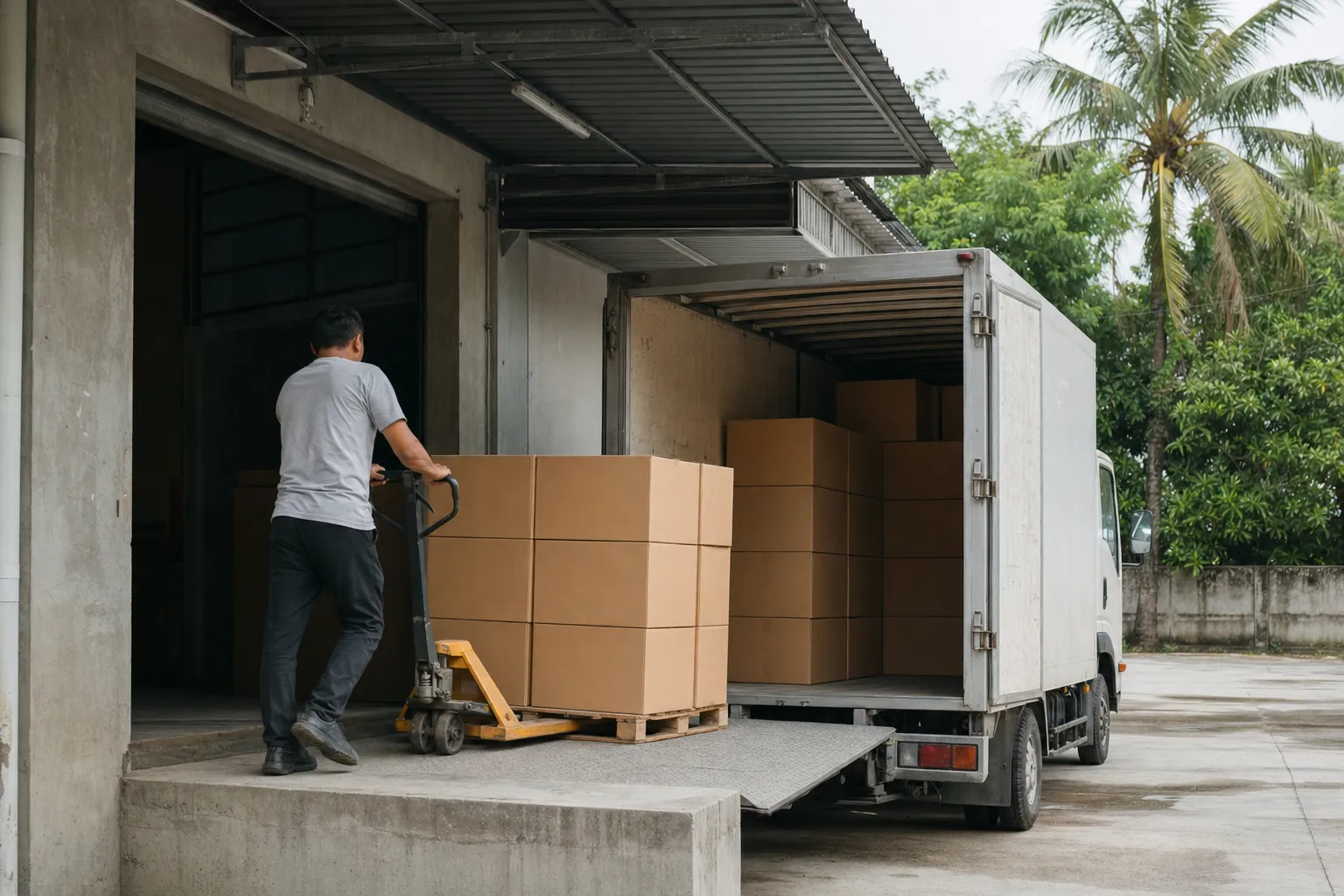
That last variable is bigger than it looks. A Jakarta delivery and a delivery two provinces away are not the same booking, and the difference is not only distance: it is the vehicle, the hours the receiving site will accept, and whether the address can take a truck that size at all. How those options change is set out in Jakarta delivery versus outside Jakarta.
What to specify before the container sails
Everything on this list is cheap in a booking confirmation and expensive in a warehouse. None of it is the forwarder's decision to make.
Specify | Because |
|---|---|
A marks scheme, and a packing list keyed to it | The floor sorts by marks; a count without marks is anonymous |
The consignee named on the house bill | That name is what the release will be built around |
Who may authorise release, and on what condition | Release authority is a decision, not a formality |
The delivery address and the hours it can receive | A truck that arrives at a closed gate costs the same as one that arrives |
Whether the lot is wanted palletised or loose | The choice changes handling at the station and at your gate |
Whether you want photographs at devanning, and of what | Evidence is gathered in the hall or not at all |
What should happen if your lot is not clear when the box is stripped | The default is that it waits, and waiting is charged |
A marks scheme, and a packing list keyed to it
Because
The floor sorts by marks; a count without marks is anonymous
The consignee named on the house bill
Because
That name is what the release will be built around
Who may authorise release, and on what condition
Because
Release authority is a decision, not a formality
The delivery address and the hours it can receive
Because
A truck that arrives at a closed gate costs the same as one that arrives
Whether the lot is wanted palletised or loose
Because
The choice changes handling at the station and at your gate
Whether you want photographs at devanning, and of what
Because
Evidence is gathered in the hall or not at all
What should happen if your lot is not clear when the box is stripped
Because
The default is that it waits, and waiting is charged
One question sits before the table rather than in it: whether the cargo should be combined at all. If the shipment is gathering lots from several suppliers, that decision has its own logic, which is worked through in consolidating cargo from multiple suppliers. The palletising question, meanwhile, is usually decided at origin and only discovered at destination, which is why packing and palletising belongs in this list even though it is not a warehouse instruction.
What we coordinate, and what stays with you
On the Indonesian side we coordinate the stages described above through partner facilities: a breakbulk warehouse used for devanning, sorting and onward delivery, and delivery itself in Jakarta or outside it. Those are service nodes in a partner network, not buildings we operate or own, and the devanning is performed by the facility that runs the hall under its own operating rules. Where a shipment needs its import declaration, that declaration is lodged by the importer or by a licensed party acting for it — we coordinate that work and we do not stand as the importer of record on a client's behalf.
Indonesia collects import documentation through its national single window, and the customs authority behind the process is the Directorate General of Customs and Excise; the documents a consignment is normally expected to carry are summarised by the US Commercial Service.
What stays with you is the part no coordinator can decide on your behalf: which entity imports, what the cartons carry by way of marks, and who is allowed to release your lot when it is ready.
The test of a good deconsolidation is not speed. It is that on the day the container is opened, your cargo is findable — a count, a mark, a bill and a release that all point at the same lot. Everything on this page is a way of arranging that before the ship sails. If you are planning a first LCL shipment into Indonesia, the warehousing and delivery section collects the rest of the chain, and what door-to-door shipping includes is the right place to check which of these stages your arrangement actually covers.