

A hypothetical, and a common one: a container is opened in a yard outside Jakarta at four in the afternoon. Eleven cartons of a twelve-carton line are sound. The twelfth is crushed along its lower edge, the tape split, and something inside moves when the pallet is lifted. The receiver has a phone, a packing list and a delivery receipt with a signature line still blank.
That is the hour in which a cargo damage claim is made or lost — not the hour in which the claim letter is written, three weeks later, when nobody remembers whether the carton was photographed before it was moved.
Nothing on this page is a quotation. No rate, tax figure, percentage, compensation amount or promised timeline appears in it, and every situation described is hypothetical: these are not client cases and they are not quotations. Whether a particular shipment gives rise to a claim, and what it is worth, is settled by the contract of carriage, the bill of lading and the insurer's policy — not by this page. Nor is this legal advice: carriage liability and time bars are decided under Indonesian law and by your own contract, and the statutory points below are stated as at November 2026 — confirm them with Indonesian counsel before you rely on them.
Three failures, three different claim files
The word "claim" hides three different arguments, and they fail for different reasons.
Damage is a condition argument. The cargo arrived, and it arrived altered: crushed, wet, bent, corroded, hot, contaminated. What has to be proved is the difference between the condition at handover and the condition at receipt, and the proof is almost entirely photographs, a survey, and the exception written on the delivery document.
Shortage is a counting argument. Something did not arrive. The pieces in the container do not match the pieces on the packing list, and no photograph of a carton can settle that — only a tally, a seal number and a comparison of documents can.
Non-delivery is a contract argument. The cargo did not arrive at all, or arrived so late that its value is gone. There is no crate to photograph. What matters is who holds the bill of lading, what the carrier contracted to do, and what happened to the goods between the two.
What went wrong | What the file has to establish | The document that usually carries it |
|---|---|---|
Damage | Condition changed between handover and receipt | Delivery receipt notation, photographs, survey report |
Shortage | Piece count fell between stuffing and devanning | Tally sheet, seal number, packing list |
Non-delivery | The carrier never delivered what it contracted to carry | Bill of lading, carrier's delivery record, written notice |
Damage
What the file has to establish
Condition changed between handover and receipt
The document that usually carries it
Delivery receipt notation, photographs, survey report
Shortage
What the file has to establish
Piece count fell between stuffing and devanning
The document that usually carries it
Tally sheet, seal number, packing list
Non-delivery
What the file has to establish
The carrier never delivered what it contracted to carry
The document that usually carries it
Bill of lading, carrier's delivery record, written notice
A shipper who files a damage claim for a shortage, or a shortage claim for goods that are simply sitting in a customs channel, spends the same effort and gets nowhere. The first decision is which of the three you actually have.
The claim is decided at the point of delivery
Almost every claim that dies, dies because of something that was not done in the first hour. The pattern repeats across carrier claim procedures, and it is worth taking in order.
Inspect before signing. A clean signature on a delivery receipt is treated as evidence that the goods arrived in good order, and at the bill-of-lading end that presumption is statutory: under Article 514 of the Indonesian Commercial Code, where the bill of lading does not state the condition of the goods, the carrier is deemed to have received them in apparent good order unless the contrary is proved. Both HMM's claim procedure and ONE's import cargo claims guidelines put the instruction in the imperative: note the loss or damage on the receipt before signing it. Once the receipt is clean, the burden shifts onto you for everything discovered later. The six steps are collected as a sheet at the end of this page, for the person who actually meets the truck.
Write a description, not a verdict. "Damaged" is not an exception. "Two of twelve cartons crushed on the lower right edge, strapping broken, contents audible when lifted" is. The specific version tells a claims handler, a surveyor and eventually a judge what was seen; the general version tells them only that somebody was unhappy. Vague safety phrases are worse than nothing. "Subject to inspection" tells the claims handler that nothing was inspected; it does not preserve an exception, and in practice it is read as the same thing as accepting the cargo.
Count every piece against the packing list. Shortage is decided by arithmetic, and the arithmetic has to happen while the cargo is still where it landed. A count taken after the cartons have been distributed to three sites is not a count.
Read the seal before breaking it. The seal number is the strongest single link between the container that was stuffed and the container that was opened. Photograph the seal in place, compare the number against the documents, and only then cut. If the seal is missing, mismatched or was replaced, that fact matters more than the damage inside.
Photograph the failure, not just the victim. The carton is the easy picture. The ones that decide cases are wider: the container interior, the voids where cargo should have been, the packaging as it was found, the position of the load, the floor, the water line, the delivery document itself with its handwritten exception. Photograph before anything is moved, and keep photographing as each layer is opened.
Ask for a joint survey, and do not assume it will happen. A joint survey — your surveyor and the carrier's, at the same time, on the same cargo — is the single most useful thing that can happen to a damaged consignment, because it removes the later argument about condition. Both carrier procedures describe it as something the claimant requests and the carrier may attend, subject to surveyor availability; ONE is explicit that a survey it orders serves its own interest and that a cargo interest should appoint its own surveyor. Request it in writing, with the address and the receiving contact, and if nobody comes, record that fact and document the cargo yourself.
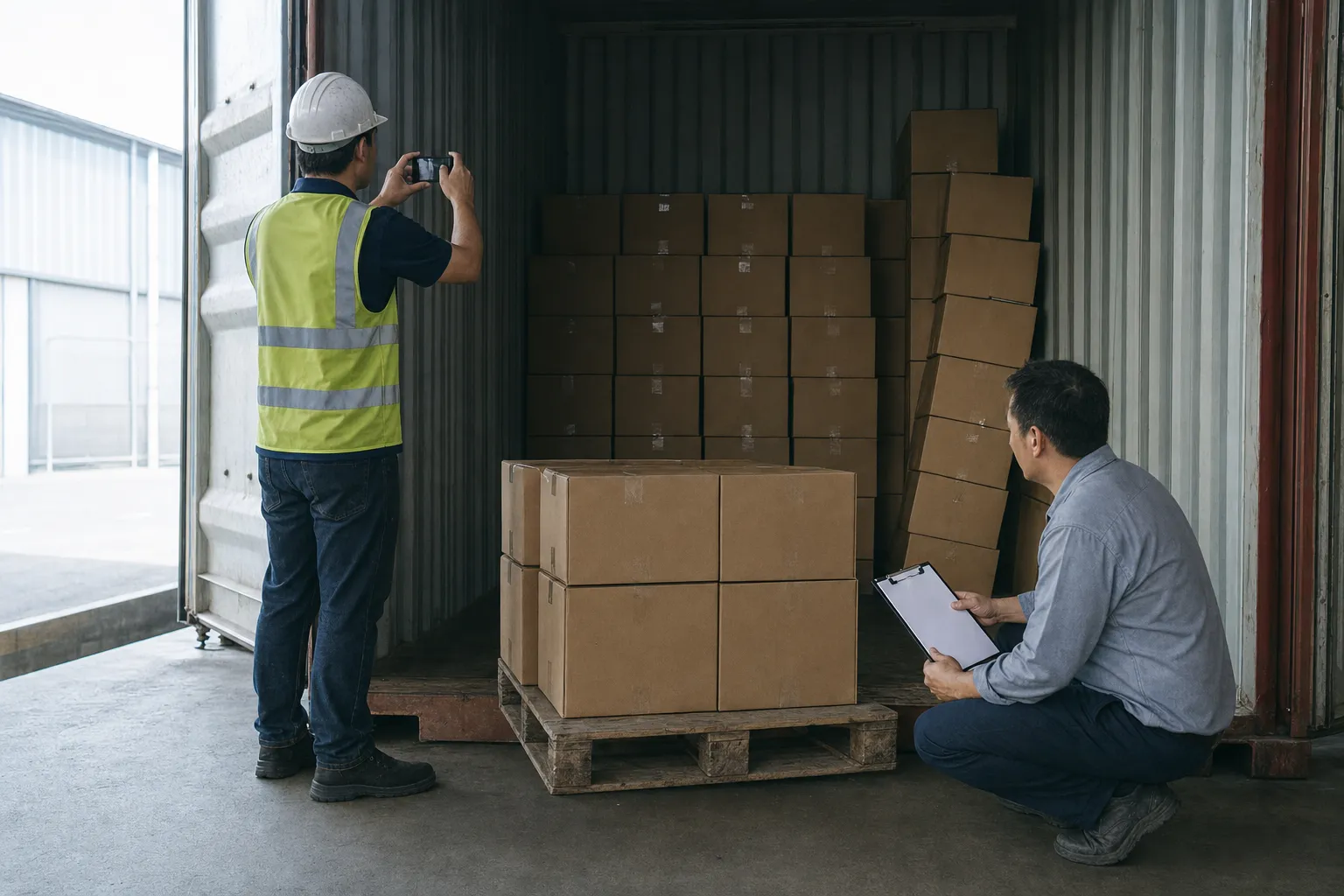
The same discipline applies at the origin end. Custody changes hands at the consolidation warehouse, and that is where the record of "as received" begins — see what happens inside a China consolidation warehouse.
What a cargo damage claim has to prove
Strip away the procedure and a cargo damage claim rests on three propositions, each with its own document:
- The carrier received the goods in good order. Normally the bill of lading, or a clean dock receipt where the handover happened at a warehouse. A bill of lading that says the contents, quantity or weight are unknown is a weak opening — more on that below.
- The goods were damaged when you received them. The delivery receipt with its exception, the tally, photographs, and the survey report if there was one.
- The loss has a value you can evidence. Commercial invoice, packing list with weights and piece counts, and proof that the goods were paid for. A repair estimate or a replacement quotation converts "damaged" into a figure.
Fail any one and the claim does not travel, whatever the photographs show. This is the part that surprises shippers: a phone full of images proves the second proposition beautifully and does nothing for the first or third.
Indonesia adds a wrinkle that is genuinely useful to the claimant. Under Article 468 of the Indonesian Commercial Code, the contract of carriage obliges the carrier to safeguard the goods from the time they are received until the time they are handed over, and to compensate for non-delivery or damage unless it proves that this was caused by a calamity that could not reasonably be prevented or avoided, by an inherent defect of the goods, or by the fault of the consignor. The burden is the carrier's, not yours: liability is presumed once the carrier has taken charge, so the party arguing that the loss was unavoidable, or caused by the goods themselves, has to establish it. But the presumption only engages once the claimant has shown what was handed over and what came back. The mechanism rewards a clean document trail and does nothing for a clean photograph.
Who the claim is actually against
The question shippers ask first — "who do I claim against?" — has no single answer, because a container of export cargo passes through several pairs of hands, and each stretch of the journey is governed by a different document.
Stage or contract | Who holds the cargo | The document that proves it, or names that party |
|---|---|---|
Origin warehouse or CFS (container freight station) | Consolidator, forwarder or their warehouse operator | Warehouse receipt, dock receipt, origin tally |
Ocean or air leg | The carrier named on the transport document — the cargo is on its ship or aircraft, under its bill or air waybill | Bill of lading or air waybill |
Indonesian customs control or temporary storage | The appointed warehouse operator, under customs supervision | PIB (import declaration) and SPPB (release), plus the warehouse receiving record or tally |
Destination warehouse or CFS | The deconsolidating warehouse operator | Devanning tally, warehouse receiving record |
Final delivery | The delivering vehicle's operator | Delivery receipt or proof of delivery |
Not a custody stage — the forwarder's own contract, running alongside the ocean leg | Nobody separately: if the issuer is an NVOCC (a forwarder that issues its own bill and carries under it) it is answerable for the leg as carrier, but the cargo is still on the ship named above | House bill of lading |
Not a custody stage — the value, not the cargo | Your insurer, under a separate contract | Cargo insurance policy |
Origin warehouse or CFS (container freight station)
Who holds the cargo
Consolidator, forwarder or their warehouse operator
The document that proves it, or names that party
Warehouse receipt, dock receipt, origin tally
Ocean or air leg
Who holds the cargo
The carrier named on the transport document — the cargo is on its ship or aircraft, under its bill or air waybill
The document that proves it, or names that party
Bill of lading or air waybill
Indonesian customs control or temporary storage
Who holds the cargo
The appointed warehouse operator, under customs supervision
The document that proves it, or names that party
PIB (import declaration) and SPPB (release), plus the warehouse receiving record or tally
Destination warehouse or CFS
Who holds the cargo
The deconsolidating warehouse operator
The document that proves it, or names that party
Devanning tally, warehouse receiving record
Final delivery
Who holds the cargo
The delivering vehicle's operator
The document that proves it, or names that party
Delivery receipt or proof of delivery
Not a custody stage — the forwarder's own contract, running alongside the ocean leg
Who holds the cargo
Nobody separately: if the issuer is an NVOCC (a forwarder that issues its own bill and carries under it) it is answerable for the leg as carrier, but the cargo is still on the ship named above
The document that proves it, or names that party
House bill of lading
Not a custody stage — the value, not the cargo
Who holds the cargo
Your insurer, under a separate contract
The document that proves it, or names that party
Cargo insurance policy
The house bill is the row that is not a leg. It is a second contract running alongside the ocean leg, and during that leg the cargo is on the carrier's ship under the master bill whatever the house bill names. Read it as the answer to "who is answerable to me for this leg", not as a record of who was holding the cargo.
Two things follow from that table.
You claim against whoever your contract names, and there may be two of them. A forwarder that issues its own house bill of lading is, for that contract, the carrier — and the ocean carrier underneath is a separate counterparty under its own bill. Filing against the wrong one consumes the notice window without producing a decision. Who is responsible for what across broker, forwarder, NVOCC and carrier is the map for this; the short version is that you read the document you were given, not the logo on the container.
Risk and claim are not the same thing. Under an Incoterm, risk passes at a defined point, and the party carrying the risk at the moment of loss is the party with the loss to recover. That is why the choice of Incoterm changes who files, and why a claim filed by the wrong party is usually answered with a request for the contract rather than a payment.
The evidence file, document by document
A claim file is not a folder of everything. It is a small set of documents, each of which answers one question. The lists published by carriers and insurers converge on the same core, and each item is there because its absence has defeated a real claim.
Document | What it proves | What breaks it |
|---|---|---|
Bill of lading or air waybill | The contract, the parties, and the cargo as declared at handover | A clause saying contents, quantity or weight are unknown |
Delivery receipt or proof of delivery, with the exception written on it | That the loss was visible at receipt and was not accepted | A clean signature; a vague "subject to inspection" |
Tally sheet or devanning record | The piece count at the moment of devanning, per shipper | A count taken after the cargo was distributed |
Photographs | Condition, before anything moved | Pictures taken after the cargo was re-stacked or wrapped |
Survey report | An independent statement of cause and extent | A survey commissioned only by one side, unchallenged |
Commercial invoice | The value of the goods | Retail or replacement pricing rather than the transaction value |
Packing list with weights | Which items, how many, how heavy | A packing list that does not match the invoice line by line |
Proof of payment or ownership | That the claimant actually bore the loss | A claim filed by a party without title to the goods |
Repair estimate or replacement quotation | The size of the loss, in money | An estimate produced after the goods were repaired |
Salvage receipt or destruction certificate | That the damaged goods were disposed of and no value was recovered | Goods sold or scrapped before the carrier could inspect |
Written notice and the correspondence around it | That the claim was made in time, to the right party | Notice given by phone, or to a party with no contract |
Subrogation letter | That the insurer, not the cargo owner, is now the claimant | A recovery attempt by an insurer without it |
Bill of lading or air waybill
What it proves
The contract, the parties, and the cargo as declared at handover
What breaks it
A clause saying contents, quantity or weight are unknown
Delivery receipt or proof of delivery, with the exception written on it
What it proves
That the loss was visible at receipt and was not accepted
What breaks it
A clean signature; a vague "subject to inspection"
Tally sheet or devanning record
What it proves
The piece count at the moment of devanning, per shipper
What breaks it
A count taken after the cargo was distributed
Photographs
What it proves
Condition, before anything moved
What breaks it
Pictures taken after the cargo was re-stacked or wrapped
Survey report
What it proves
An independent statement of cause and extent
What breaks it
A survey commissioned only by one side, unchallenged
Commercial invoice
What it proves
The value of the goods
What breaks it
Retail or replacement pricing rather than the transaction value
Packing list with weights
What it proves
Which items, how many, how heavy
What breaks it
A packing list that does not match the invoice line by line
Proof of payment or ownership
What it proves
That the claimant actually bore the loss
What breaks it
A claim filed by a party without title to the goods
Repair estimate or replacement quotation
What it proves
The size of the loss, in money
What breaks it
An estimate produced after the goods were repaired
Salvage receipt or destruction certificate
What it proves
That the damaged goods were disposed of and no value was recovered
What breaks it
Goods sold or scrapped before the carrier could inspect
Written notice and the correspondence around it
What it proves
That the claim was made in time, to the right party
What breaks it
Notice given by phone, or to a party with no contract
Subrogation letter
What it proves
That the insurer, not the cargo owner, is now the claimant
What breaks it
A recovery attempt by an insurer without it
Two obligations run through the whole file. Mitigate: damaged cargo has to be separated, stabilised, repacked or sold, and the cost of doing so is part of the claim, while the failure to do so reduces it. Preserve: the packaging, the damaged goods and the container should stay available for inspection until the claim is settled, which means resisting the urge to tidy the yard.
A file is also only read if it arrives from somebody entitled to submit it. UPS's cargo claims guidance states the rule in one line — the shipper, the consignee, or a third party with claim or title to the goods — and adds the practical consequence: insufficient documentation is treated as grounds for denial, not as a request for more.
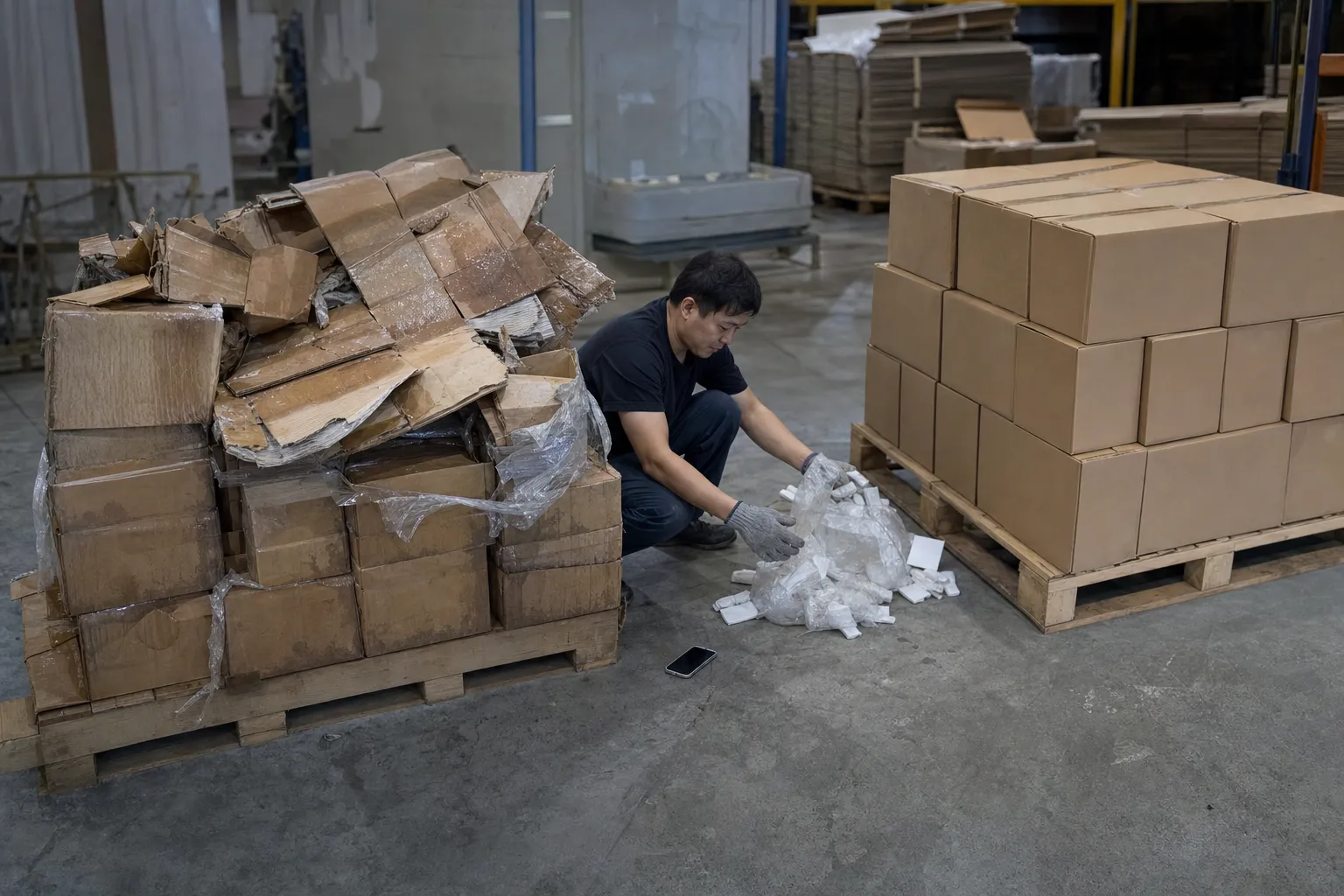
Segregating the affected pieces from the sound ones is the physical form of the evidence rule: it protects the survey, the count and the mitigation claim at the same time.
If the cargo is insured, the insurer's own documentation list is the one to build to, because the same file usually serves both recoveries. The IUMI guide to marine cargo insurance is a useful reference for what an underwriter expects, including the point that the delivery document should be claused so that it carries the protest rather than merely recording a signature.
Time windows: where claims are actually lost
This is the section where most English-language guides answer a question a shipper heading for Indonesia is not asking, because they describe a legal framework that does not apply.
Indonesia has not ratified the Hague Rules, the Hague-Visby Rules, the Hamburg Rules or the Rotterdam Rules. Cargo claims are resolved under Indonesian law — principally the Indonesian Commercial Code, the Civil Code and the Shipping Law — and the framework has features that matter operationally:
- The burden of the defense sits with the carrier. Under Article 468, liability is presumed from the moment the carrier takes charge until the goods are handed over, so the party arguing that the loss was unavoidable, or caused by the goods themselves, has to establish it.
- A bill of lading that declares contents, quantity or weight unknown gives the carrier a strong answer. Under Article 513, where the bill carries an "contents, condition, quantity or measurement unknown" clause, its statements on those points do not bind the carrier — unless it knew or ought to have known the nature and condition of the goods, or the goods were counted, weighed or measured in its presence. That last limb is the only one you can create yourself, and it is the reason to ask the carrier or its agent to tally what you hand over. The description on the document is therefore not paperwork; it is the foundation of the right to claim.
- The prescription period is one year, and it does not start when the cargo reaches your gate. Under Article 741 of the Commercial Code, the one-year period for claims against the carrier runs from the vessel's arrival — or, where the vessel never arrives at the place where the goods are to be handed over, from the commencement of the carriage. A customs hold, a survey or a settlement discussion does not pause it.
Those articles are the Commercial Code itself; for how they are applied in practice the two useful commentaries are ARMA Law's analysis of cargo claims under Indonesian shipping law and the Indonesia chapter of SSEK's shipping law guide. Neither is a substitute for reading your own contract.
The complication is that a bill of lading can import convention wording by agreement, even though the conventions are not in force in Indonesia. So the same shipment can be governed by two clocks at once: the statutory one-year prescription, and a much shorter contractual notice period written into the transport document. ONE's North America claims guideline states the pattern that appears in many ocean bills — written notice at or before delivery, or within three days where the loss is not apparent — and HMM's procedure states the same shape for damage that is not visible at the door. Neither document is your contract, and neither is written for a shipment bound for Jakarta: the window that binds an Indonesia-bound cargo is the one printed in your own bill of lading.
Practical translation: the statutory window is not the one that decides your case. The one that decides it is the notice requirement in your bill of lading, and the operational version of that requirement is "same day, in writing, with photographs". A cargo damage claim filed inside the prescription period but outside the contractual notice window is answered with the contract, not with a settlement.
Concealed damage deserves its own warning. If the cartons looked sound and the contents were broken, you are arguing that the damage happened in transit while the cargo was in someone else's custody, against a document that says you accepted it in good order. That argument is winnable, but only with evidence created immediately on discovery: the packaging as found, the position of the load, photographs at the moment of opening, and written notice to the counterparty the same day.
Shortage and total loss are not damage claims
Shortage looks like the easy case and is usually the harder one, because nothing is broken and everything depends on counting.
The chain that decides a shortage is short and unforgiving: seal number → container tally at devanning → piece count against the packing list and invoice line → a written exception at the point where the count changed. Break the chain anywhere and the answer becomes "the cartons were probably short-loaded", which is a conversation with your supplier, not with a carrier.
Consolidated cargo makes this sharper. When several suppliers' cartons travel in one container, the container-level count is the only count anyone witnesses, and the per-shipper split exists only on paper. That is why consolidating cargo from multiple suppliers is really a documentation exercise: the tally taken when each supplier's cartons were received is the only record that will let a shortage be attributed to a leg rather than to a supplier.
Total non-delivery is different again. There is no condition to inspect and no count to take; the question is whether the carrier delivered what it contracted to deliver, to the party entitled to receive it, and what the bill of lading says about that. It is a contract argument from beginning to end, which is why a non-delivery claim without the original transport document, or without the party holding title, tends to stall immediately.
And one case that is neither: a customs hold is not a loss. Cargo sitting in a red channel, waiting for a document, an appraisal or a permit, is still your cargo — the customs-control row in the chain above is a change of custodian, not a disappearance. Filing a claim for it wastes the notice window and damages the relationship with the party you will need when the goods are released. Why cargo gets held at Indonesian customs covers the release path; the claim file should stay closed until there is an actual loss to describe.
The same logic applies at the last mile. A consignment delivered to a site outside Jakarta changes vehicle, changes custodian and often changes who unloads, and the delivery receipt at that gate is the document that closes the chain — or opens the gap. The difference between a Jakarta delivery and an outside-Jakarta delivery is, among other things, a difference in who signs.
What insurance changes — and what it does not
A cargo insurance policy is a second, independent contract, and it changes the cash flow of a loss without changing the evidence.
What it changes. If the cargo is insured, the insurer is the counterparty for the value, and it will handle recovery against the carrier afterwards by subrogation. That is usually faster and less adversarial than pursuing a carrier directly, and it means the file you build is read by an underwriter rather than by a claims department defending a limitation clause. Notify the insurer early — before the cargo is moved, if possible — and expect it to appoint or approve a surveyor.
What it does not change. The insurer applies its own policy: insured value, exclusions, the duty to mitigate, the treatment of salvage, and its own notice requirements. It does not accept a claim just because a carrier might be liable, and it does not remove the obligation to document. A policy also cannot conjure evidence that was never created: an insurer facing a clean delivery receipt and no photographs is in the same position as the shipper.
Running both at once is normal, and it is not double recovery — the two claims have different tests, different clocks and different defendants. The comparison between carrier liability and insurance cover — which one responds to which kind of loss — is a separate question from this page.
What to fix before the next shipment
Everything above is reactive. Most of it can be made cheap in advance, because the evidence that decides a claim is created before the claim exists.
Describe the cargo properly on the transport document. Marks, numbers, kind of package, quantity, weight — the actual figures, not a generic commodity name. This is the line on the page that matters most: it is what makes the carrier's presumption of liability bite, and it is what a clause declaring the contents unknown takes away. There is one way to defeat that clause from your side: if the carrier, or its agent, counts, weighs or measures the cargo in front of you at receipt, the unknown clause stops protecting the carrier (art. 513). Ask for it, and write down that it happened.
Pack and mark for the argument you may have to make. A carton that survives handling is also a carton that can be identified after damage, and a pallet that can be photographed and counted is a pallet whose shortage can be proved. The practical standard is in packing and palletizing cargo for sea and air freight — including the marking that lets a stranger match a carton to an invoice line.
Write down who may sign, and who may not. A receiving clerk who signs a clean receipt to get the truck out of the gate has just destroyed the claim. Name the authority, put it in the delivery instructions, and give that person the receiving sheet below.
Photograph the delivery document itself. The written exception and the signature are the evidence; a photograph of the page, taken at the dock, ends most later disputes about what was written and when.
Open one file per bill of lading. One claim, one transport document, one set of documents, one counterparty, one notice date. Mixing two shipments into one claim letter is how a clean case becomes a correspondence exercise.
The receiving sheet mentioned above is short enough to print, and it belongs in the delivery instructions rather than in a folder:
Receiving sheet — hand this to whoever meets the truck. >1. Inspect the cargo before signing anything.2. Write the exception as a description of what you can see — how many pieces, where, what condition — not as the word "damaged".3. Count every piece against the packing list while the cargo is still where it landed.4. Photograph the seal, read the number and compare it with the documents before the seal is cut.5. Photograph the cargo, the container interior and the delivery document before anything is moved.6. Sign only what you have already written, and photograph the page you signed.
What we coordinate, and what we do not
Yanchao arranges and coordinates the movement: consolidation at origin, booking, the documents that travel with the cargo, and liaison with the parties who handle clearance and delivery on the Indonesian side. We publish no claims procedure of our own, because the procedure that governs a shipment comes from the contract, the carrier and the insurer, not from the forwarder. What we can do is coordinate: tell you which party holds the contract for each leg, help the written notice reach that party, assemble the documents you already hold, and keep the Indonesian-side contacts in play while a survey or a release is being arranged. The survey, the assessment and any payment are decided by the carrier, the surveyor and the insurer — not by us.
What we do not do is decide liability, set compensation, or stand in for the carrier or the insurer. The standard that applies to a particular shipment depends on the clearance route and on the contract for each leg, which is why a figure quoted in a chat message before the documents are read is worth very little. If your question is what a specific shipment is worth, the honest answer is that it belongs to the contract, the bill of lading and the insurer — and to the scope of the service you booked, which determines which party was holding the cargo when it went wrong.
The hour at the dock is cheap. Inspect, count, photograph, write the exception, ask for the survey, and keep the packaging. Everything after that is correspondence — and correspondence is decided by what the documents said before anyone started arguing.