
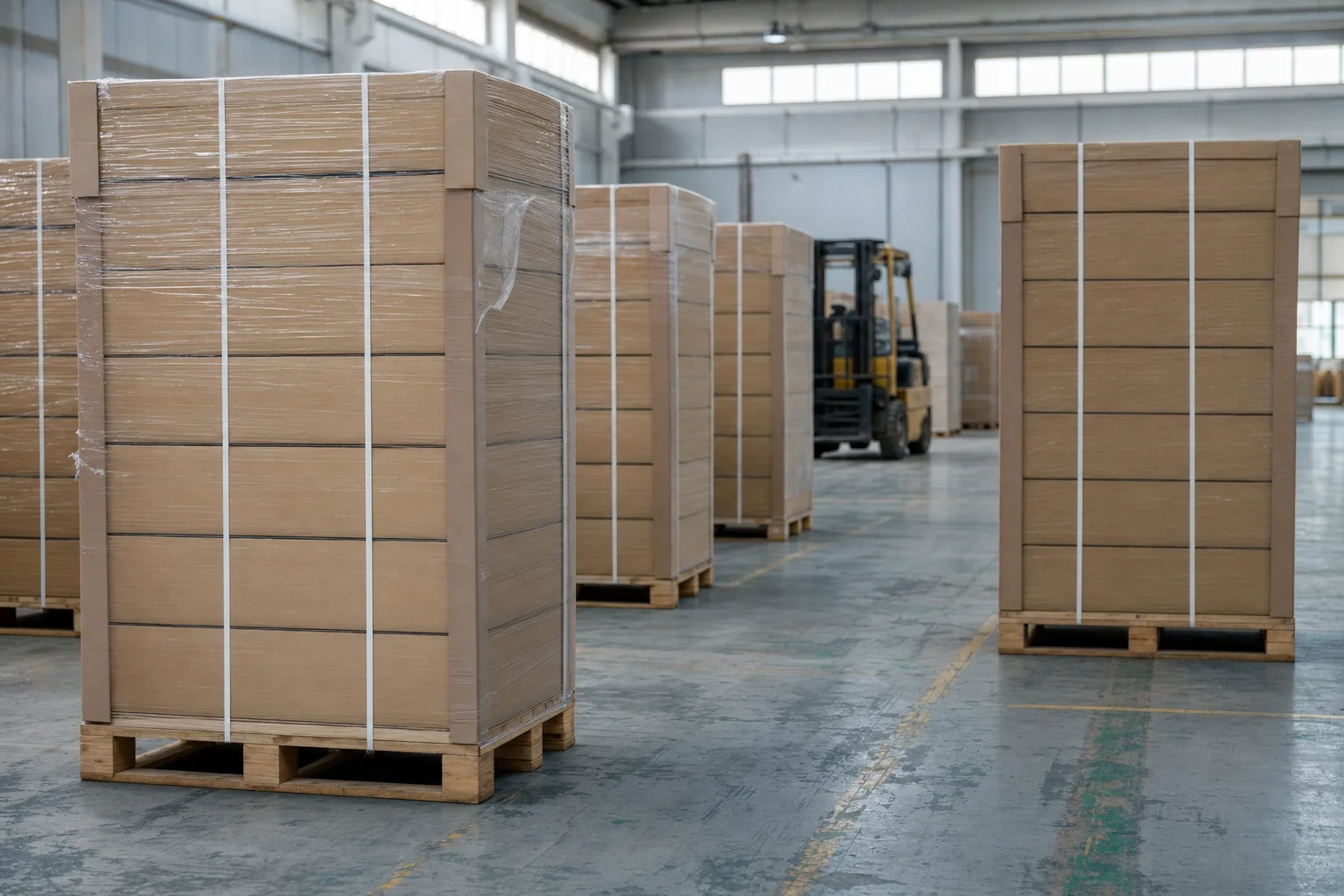
Palletizing freight is usually decided by a sentence nobody examines: someone at the buyer, the forwarder or the factory says palletize it, and forty cartons become one unit. That sentence changes three things at once — the volume you are billed on, what the cargo can survive, and what has to be true about the wood underneath it before a border will let it in. None of the three is explained at the moment the decision is made.
This page is about making that decision deliberately, for cargo leaving China for Indonesia by sea or by air. It is written for the person holding a supplier's packing list, not for a warehouse engineer: no materials science, no rate tables, and one honest answer you will not find on most freight pages — sometimes the right call is not to palletize at all.
Nothing on this page is a quotation. No rate, tax figure, percentage or promised transit time appears in it. The situations described are hypothetical: they are not client cases and they are not quotations. What happens to any particular consignment is decided by its own packing, its own documents and the authorities at each end.
The trade you are making, in three entries
Strip away the language and a pallet buys you three things.
It buys handling: a forklift move instead of forty carton lifts, at both ends, which matters most when the receiving site is a factory yard in Bekasi with one operator and no dock leveler. It buys stackability: cartons become a column that can carry a second tier, so the same floor area holds more cargo. And it buys a boundary: damage that happens inside a wrapped unit is inspectable and arguable in a way that damage to loose cartons rarely is. What makes it arguable is the bill of lading description and the piece count, which have to match the unit that was actually built.
You pay for all three in the same currency. The pallet deck is height you cannot fill, the footprint is floor you may not be able to use, the pallet's own weight joins your gross weight, and the wrap and banding are cargo as far as a measuring tape is concerned. On a tight LCL booking, a decision made to save two hours of unloading can add a stack height that costs more than the labor it saved. That is not an argument against pallets. It is an argument for doing the arithmetic before the factory starts building.
When palletizing freight earns its keep — and when hand-stacking wins
There is a version of this question that is easy: fragile, uniform cartons going to a site with a forklift want pallets, and nobody needs a framework to see it. The interesting question is not how to palletize but whether to — when does a pallet make a shipment worse?
Three situations, in practice.
The cartons are heavy and small. If a carton can be carried by one person and stacked eight high without deforming, palletizing converts cheap floor space into expensive air. You are buying handling you already had.
The consignee cannot receive a pallet. A shop-house in Surabaya, a market stall, a site with a hand truck and a narrow lane: the unit load has to be broken down at the door, and the pallet becomes waste the receiver has to dispose of. A pallet jack is the middle case, and the one most often missed — such a site can take a unit load but cannot unstack one, so a two-tier build is wasted there. Ask before you build.
The shipment is a part-container of mixed sizes. Palletizing forces every carton onto a rectangular grid. When a supplier's cartons are three different footprints, hand-stacking around them uses the container far better, and an experienced loading crew will do it without damaging the goods — provided the walls are built properly and braced.
The third handling option is worth knowing because almost nobody offers it: a slip sheet. A thin sheet of heavy board or plastic takes the place of a pallet deck, is pulled with a special attachment rather than forks, and adds a couple of centimeters instead of fifteen. It solves the height problem and the tare problem in one move. It does not solve the receiving-end problem, because most sites do not have the attachment. Use it when the volume is tight and both ends are equipped; skip it when you cannot confirm the equipment.
Hand-stacked in the container | On a pallet | On a slip sheet | |
|---|---|---|---|
Height added | None | Deck plus clearance under the load | A few centimeters |
Weight added | None | Pallet weight, per unit | Negligible |
Who unloads it | People, carton by carton | Anyone with a forklift | Only a site with a slip-sheet attachment |
Best fit | Dense cartons, mixed footprints, an FCL you load yourself | Uniform cartons, fragile goods, repeated handling, LCL moved through a warehouse | Volume-critical cargo where both ends are equipped |
Where it fails | Bottom tier crush on a long voyage; slow, labor-heavy unloading; nothing to hold a wall together if it is built badly | Lost cube; overhang damage; a broken pallet under a heavy load | Equipment mismatch at the receiving end |
Height added
Hand-stacked in the container
None
On a pallet
Deck plus clearance under the load
On a slip sheet
A few centimeters
Weight added
Hand-stacked in the container
None
On a pallet
Pallet weight, per unit
On a slip sheet
Negligible
Who unloads it
Hand-stacked in the container
People, carton by carton
On a pallet
Anyone with a forklift
On a slip sheet
Only a site with a slip-sheet attachment
Best fit
Hand-stacked in the container
Dense cartons, mixed footprints, an FCL you load yourself
On a pallet
Uniform cartons, fragile goods, repeated handling, LCL moved through a warehouse
On a slip sheet
Volume-critical cargo where both ends are equipped
Where it fails
Hand-stacked in the container
Bottom tier crush on a long voyage; slow, labor-heavy unloading; nothing to hold a wall together if it is built badly
On a pallet
Lost cube; overhang damage; a broken pallet under a heavy load
On a slip sheet
Equipment mismatch at the receiving end
The volume behind each of those columns is the number the shipment is quoted on, and it is the volume of the unit load — not of the goods inside it. That distinction is worth reading once in how CBM is measured before you decide, because the pallet height is inside the measurement and the carton size is not the whole story.
One pallet in a shared box is a different decision
Container loading changes the answer more than the cargo does.
In a full container you control the geometry. Twenty pallets that leave twenty centimeters of unusable strip along one wall are your twenty centimeters, and if hand-stacking gets another two tiers in, the saving is yours. In LCL, the unit load is the thing that travels: your cargo is handled at a consolidation warehouse, co-loaded with other shippers' cargo, and handled again at a destination warehouse before it reaches your consignee. Every one of those handlings is a chance to drop a carton, and a pallet is what converts four handlings into four forklift moves.
That is the practical rule: the more times your cargo changes hands, the more a pallet is worth, and LCL cargo changes hands more than FCL cargo does. The trade-off between the two modes, and where consolidation stops paying, is set out in FCL versus LCL.
The four pallet families that actually reach Indonesia
You will not usually get to choose the pallet. A Chinese factory buys pallets by the stack from a local supplier, and what arrives under your cargo is whatever was cheapest that month. You do get to specify, and specifying badly is expensive at the border rather than at the dock.
Most palletized cargo entering Indonesia travels on timber, and that is the family with the compliance tail attached.
Family | What it is | Use it when | The catch |
|---|---|---|---|
Heat-treated solid wood | Timber pallet, treated and stamped under the phytosanitary standard | The default for export; the wood option you will not have to argue about at an Indonesian port | The stamp must be present and legible, and it must be a real one from a registered producer |
Plastic | Molded or structural plastic, often pooled and returnable | Repeated shipments, food and pharma, anything where a stray splinter or a wet deck is a problem | Cost and return logistics; not every site takes pooled plastic; heavier than it looks |
Presswood / one-way | Compressed wood or board, nailed or molded, built to be used once | One-way LCL, awkward loads, destinations where returning a pallet is impossible | Lower load rating; inspect it before loading, not after |
No pallet at all | Floor-loaded cartons, or a slip sheet | Dense cargo, an FCL you load yourself, a consignee who cannot take a unit load | Nothing holds the wall together except the build itself |
Heat-treated solid wood
What it is
Timber pallet, treated and stamped under the phytosanitary standard
Use it when
The default for export; the wood option you will not have to argue about at an Indonesian port
The catch
The stamp must be present and legible, and it must be a real one from a registered producer
Plastic
What it is
Molded or structural plastic, often pooled and returnable
Use it when
Repeated shipments, food and pharma, anything where a stray splinter or a wet deck is a problem
The catch
Cost and return logistics; not every site takes pooled plastic; heavier than it looks
Presswood / one-way
What it is
Compressed wood or board, nailed or molded, built to be used once
Use it when
One-way LCL, awkward loads, destinations where returning a pallet is impossible
The catch
Lower load rating; inspect it before loading, not after
No pallet at all
What it is
Floor-loaded cartons, or a slip sheet
Use it when
Dense cargo, an FCL you load yourself, a consignee who cannot take a unit load
The catch
Nothing holds the wall together except the build itself
The compliance point is narrow but it is the one that stops shipments. Solid-wood packaging — pallets, crates, dunnage, the timber bracing inside a container — is regulated as a pathway for pests, and the international standard for it, ISPM 15, is published by the IPPC. The mechanism the standard relies on is simple: the wood is treated, and then it is marked with four elements — the IPPC symbol, the country code, the producer's registration code and a treatment code. The mark is the evidence. A treated pallet without a legible mark is, at a border, an unmarked pallet; a mark on wood that was never treated is worse, because it is a false statement.
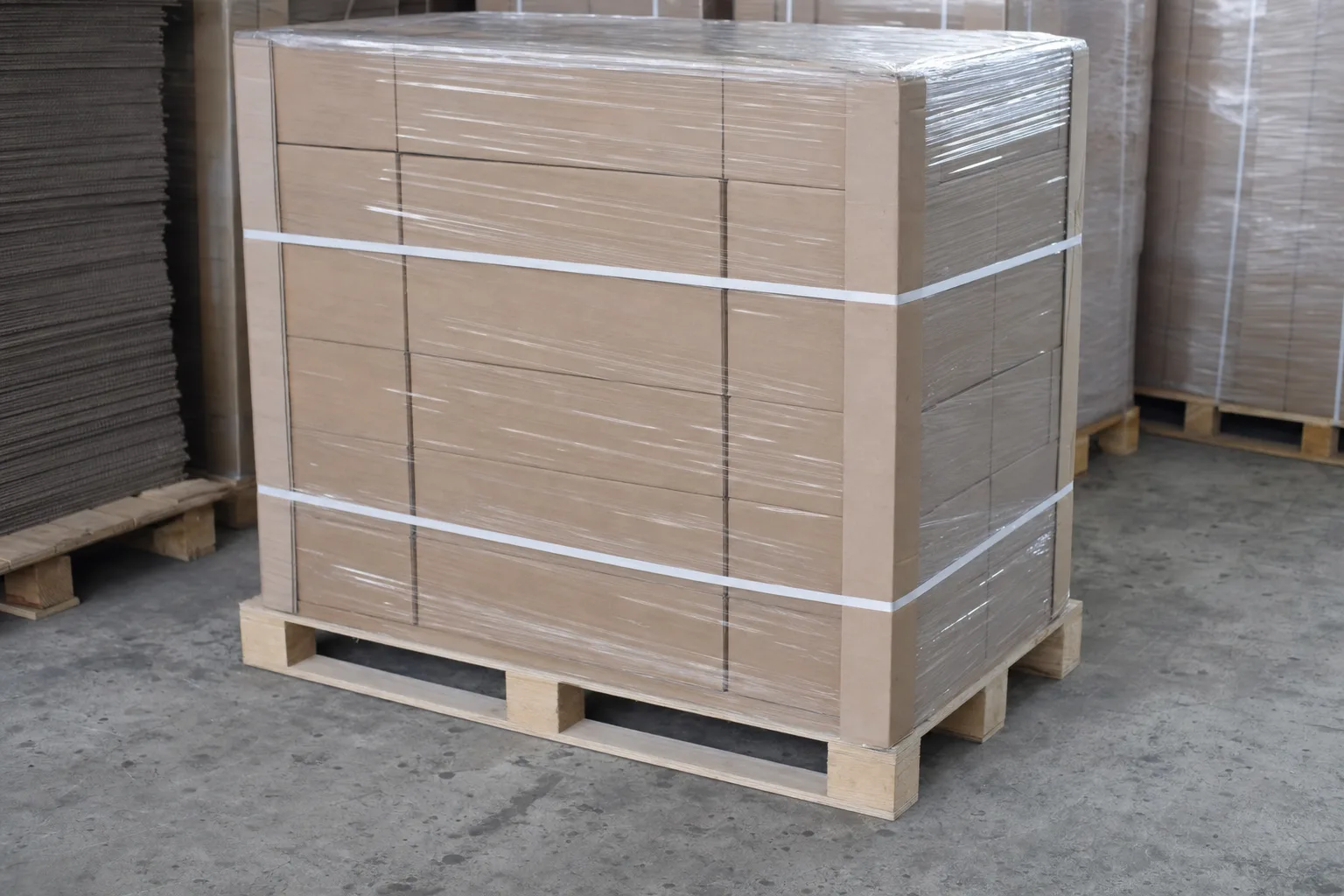
Illustrative image. Not a client shipment, not a quotation.
How the mark is read, which treatments qualify, and what happens when it is missing are outside this page — the marking rules and the failure modes are set out in ISPM 15 wood packaging: the mark is the proof. What matters here is the timing: the pallet has to be right before the cargo is built onto it, because you cannot restamp a loaded unit.
Load geometry: the five ways a palletized load fails before it ships
A pallet does not protect cargo. A well-built pallet does; a badly built one is a lever that concentrates force on the weakest carton in the stack. Five failures account for most of the damage, and all five are visible in the ten minutes before the wrap goes on.
Overhang. Cartons that extend past the deck edge look harmless and are not. The deck is the only thing carrying the load down to the floor, so an overhanging carton is unsupported at its outer edge, and that edge is what the next pallet, the container wall or a forklift mast meets first. Keep the load inside the footprint, corner to corner.
Weight distribution. A load weighted to one end of the deck, with nothing behind it, will bend the pallet and lean the stack. Heavy cartons go low and go across the deck, not on one end of it. The same logic applies to the container: a load that is heavy at one end and light at the other is a load that has to be braced harder.
Compression at the corners. Cartons carry load through their vertical edges, not through the middle of the face. A stack that is stepped or interlocked so the corners do not line up sends the load through the panels, and panels buckle. Column-stack when the cartons are strong enough; interlock only when you have to.
Wrap that holds the outside and nothing else. Stretch film is containment, not structure. Two turns around the middle of a stack holds the cartons that are already stable and does nothing for the ones at the top. Film from the deck up, overlapping, with the top layer captured — and where the load is heavy or tall, banding or strapping over corner boards, so the strap bites into the board and not into the carton.
No edge protection. Corner posts and edge boards are the cheapest part of the build and the first thing dropped. They are what stops a strap cutting through a carton and what spreads a side impact across the face instead of into one box.
Slip sheets, dunnage and air bags belong to the same conversation: they exist to stop movement, and movement is what turns a stable stack into a leaning one between the factory gate and the vessel. Cargo securement inside a container is not a packaging detail; it is a loading decision, and the international reference for it — the code of practice for packing cargo transport units, published by IMO, ILO and UNECE — treats the framing of the unit as the shipper's responsibility rather than the carrier's.
Stack height, the container door, and the tier that does not fit
Here is the arithmetic that decides more pallet counts than any load-planning software.
A standard dry container gives you roughly 2.35 m of internal width, and the width is rarely the problem. Height is, because the roof is not the constraint — the door is. Every box in the fleet loses something at the opening: a standard container's door is around eleven centimeters shorter than its interior, and a high-cube loses around twelve centimeters of the headroom its extra height bought.
Box | Internal height | Door opening height | Build height that clears the door |
|---|---|---|---|
20GP and 40GP | 2.39 m | 2.28 m | about 2.2 m, allowing clearance under the header |
40HQ (high-cube) | 2.70 m | 2.58 m | about 2.5 m, on the same allowance |
20GP and 40GP
Internal height
2.39 m
Door opening height
2.28 m
Build height that clears the door
about 2.2 m, allowing clearance under the header
40HQ (high-cube)
Internal height
2.70 m
Door opening height
2.58 m
Build height that clears the door
about 2.5 m, on the same allowance
Two consequences follow.
The first is a hard ceiling. A load built to 2.7 m does not pass a 2.58 m opening, and the fact that it would have sat inside the box is irrelevant. Height has to be designed to the door, not to the roof.
The second is subtler, and it is where two-tier builds go wrong. Two tiers of 1.2 m each, plus two decks at about 15 cm, is 2.7 m before anyone allows the clearance a forklift needs to place the top tier. A high-cube's opening is 2.58 m, so that stack does not go in; a standard container's interior is 2.39 m, so it was never going to. The tier you thought you were getting is the tier you lose — at the door, with the container already at the dock.
Footprint geometry decides the rest. Pallet sizes are not universal: the North American 48×40 inch pallet is the default in US freight pages and is not what a factory in Guangdong will hand you. Asian and ISO-style footprints — around 1.2 by 1.0 m, 1.2 by 0.8 m, or 1.1 by 1.1 m — are what you will actually see. A 1.2 m side plus a 1.0 m side fits the internal width; two 1.2 m sides do not, and a pallet that fits one way round may not fit rotated. Measure the pallet, not the catalog. The internal dimensions of the boxes themselves, and which one you should be booking, are covered in container types explained.
What palletizing does to the number you are charged on
Pallet height is not free, and it is not hidden either — it is simply counted somewhere the shipper does not look.
For sea freight, an LCL booking is charged on the volume of the unit as it was measured, which means the deck, the load, the wrap and any overhang all belong to the figure. A stack that grew from 1.2 m to 1.45 m because it went onto a pallet is billed at the larger volume, and the cartons inside it did not change. On dense cargo that hits a weight limit first, this is irrelevant. On light, bulky cargo it is the whole cost.
For air freight, the same height enters a different formula. Air charges the greater of actual weight and volumetric weight, and volumetric weight is derived from the dimensions of the build — including the pallet. A unit that is 10 cm taller than it needed to be is charged for the air above the cartons. The mechanics of that comparison, and where the two numbers cross, are in chargeable weight versus actual weight.
Two smaller entries belong on the same ledger. The pallet weight joins your gross weight — timber pallets are not light, and a container full of them is several hundred kilos of nothing. And the measured dimensions of the unit, not the carton dimensions on the packing list, are what any dispute about volume will turn on, so the measurement has to happen at the point where the unit exists.
None of this argues for a shorter pallet at the cost of a crushed load. It argues for building the load to the height the cargo needs and not to the height the pallet happened to be.
Air freight: the pallet is not yours to build
On a sea shipment, you or your supplier build the unit load and it stays built. On an air shipment the build usually happens again at the terminal, inside a contour you do not control.
Air cargo moves in unit load devices — ULDs — which are either pallets with a net and a contour, or closed containers. The contour is the shape the build has to fit, and on a lower deck it is low: a lower-deck build is roughly 1.6 m at its highest point, sloping at the edges. A pallet built for a container will not go into that contour, and rebuilding it at the terminal means unstacking and restacking cargo you already paid to build once. The reference point for what an air build has to satisfy is the airline's own ULD and loading rules, summarized through IATA's cargo program.
Three practical constraints follow.
Piece handling weight. Every piece has to be lifted by the equipment available at both airports. Once a single unit passes around a ton, the build is no longer a packing question — it needs equipment confirmed at both ends before anybody loads it, and a missed confirmation is a delay measured in days.
Oversize. Cargo that exceeds the contour does not travel as standard freight on a scheduled passenger-belly service. It needs a main-deck freighter, special loading, or a split. That is a different booking, not a heavier one.
No venting, no drying. An air build is wrapped and netted for a few hours, not a few weeks, so the moisture problem below does not apply the same way — but the wrap still has to let the unit be inspected, because security screening happens on the unit as presented.
Which mode and which build make sense for a given consignment is a comparison in its own right: sea freight or air freight to Indonesia sets out what each one is actually good at.
Weeks of humidity is a load test nobody scheduled
A stack that carries eight cartons in a warehouse does not necessarily carry eight cartons in a container on the water, and the reason is moisture rather than weight.
Container condensation — the drip crews call it container rain — happens when warm, humid air inside the box meets a steel roof that has cooled overnight. Water forms on the underside of the roof and then falls. It falls on the top tier first, and it keeps falling for as long as the day–night cycle keeps repeating, which on a China–Indonesia voyage is weeks.
The second effect is quieter and does more damage. Carton stacking strength is a dry-warehouse number: paper-based board loses compression strength as it takes up moisture, and a tropical sea crossing is a slow, warm, humid soak. A stack built to a comfortable safety margin in a dry inland warehouse arrives with that margin gone, and the bottom tier — which has been carrying every tier above it since loading — flattens. That is why the crushed lot at the far end usually has a tidy top and a squashed bottom.
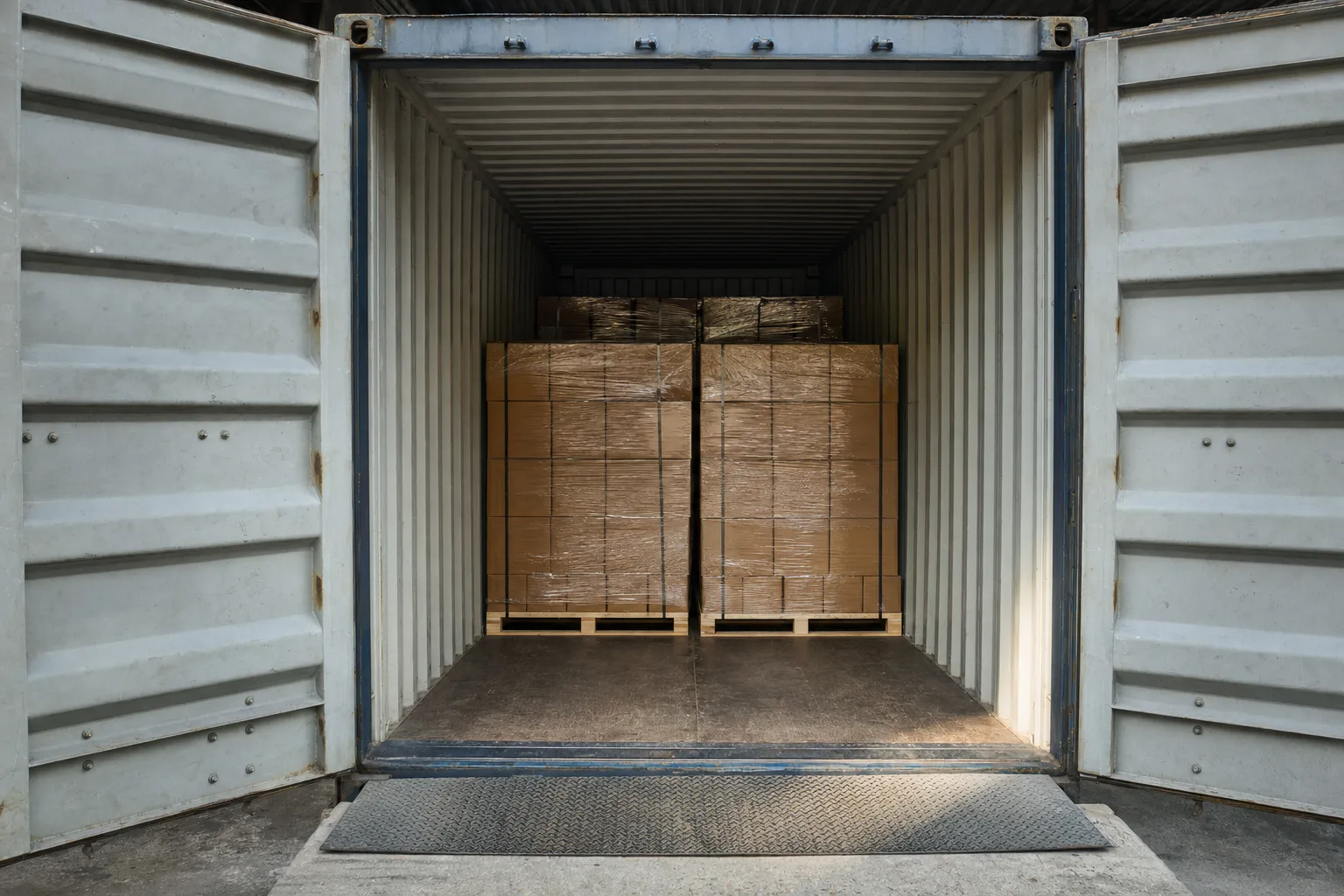
Illustrative image. A part-loaded box: space above the load and beside it, which has to be braced before the doors close. Not a client shipment, not a quotation.
What actually helps is unglamorous. Keep the load off the container floor, so a wet floor is not a wet carton. Leave the cartons dry before loading — cargo packed in the rain, or in a humid shed, arrives with the moisture already inside the film. Vent the unit rather than sealing it hermetically, so the moisture that does enter can leave. Use dunnage and bracing so the stack cannot move and rub. And where the cargo is moisture-sensitive, use a desiccant in a quantity set by the volume of the box, not by habit.
What to write in the packing instruction to your supplier
Export packing is decided at the factory, by people who will never see the container. Most packing damage is therefore a communication failure rather than a skill failure: the factory will build what it always builds unless somebody tells it otherwise, in writing, with a consequence attached.
The instruction that works is short and specific. Anything longer gets skimmed.
Line | What to write | What it prevents |
|---|---|---|
1 | Pallet footprint and type, stated in millimeters, and the maximum finished height including the pallet | A pallet that does not fit the container door, or a footprint that wastes the width |
2 | "Timber pallets must be heat-treated and marked under ISPM 15; the mark must be legible on two sides" | An unmarked pallet that becomes a border problem |
3 | Maximum gross weight per pallet and maximum cartons per layer | Overloaded decks and towers taller than the carton can carry |
4 | "Load within the pallet edge — no overhang in any direction" | Edge damage, and a measured width that no longer fits the plan |
5 | Stacking pattern: column or interlocked, with heavy cartons low and across the deck | Panels carrying load they cannot carry |
6 | Corner boards, banding pattern and film specification: film from the deck up, top layer captured | A wrapped middle and an unsecured top |
7 | "Cartons dry at loading; no packing during rain; desiccant per the agreed quantity" | Moisture sealed inside the unit before the voyage starts |
8 | Photographs of each finished unit, with the mark visible, sent before the truck leaves | Discovering the problem at the port, when nothing can be fixed |
1
What to write
Pallet footprint and type, stated in millimeters, and the maximum finished height including the pallet
What it prevents
A pallet that does not fit the container door, or a footprint that wastes the width
2
What to write
"Timber pallets must be heat-treated and marked under ISPM 15; the mark must be legible on two sides"
What it prevents
An unmarked pallet that becomes a border problem
3
What to write
Maximum gross weight per pallet and maximum cartons per layer
What it prevents
Overloaded decks and towers taller than the carton can carry
4
What to write
"Load within the pallet edge — no overhang in any direction"
What it prevents
Edge damage, and a measured width that no longer fits the plan
5
What to write
Stacking pattern: column or interlocked, with heavy cartons low and across the deck
What it prevents
Panels carrying load they cannot carry
6
What to write
Corner boards, banding pattern and film specification: film from the deck up, top layer captured
What it prevents
A wrapped middle and an unsecured top
7
What to write
"Cartons dry at loading; no packing during rain; desiccant per the agreed quantity"
What it prevents
Moisture sealed inside the unit before the voyage starts
8
What to write
Photographs of each finished unit, with the mark visible, sent before the truck leaves
What it prevents
Discovering the problem at the port, when nothing can be fixed
Line eight is the one worth arguing for. A photograph of a finished, marked, wrapped pallet, taken at the factory, is the only cheap evidence you will ever have that the load was built as instructed — and the only way to raise a problem while it can still be solved in hours rather than weeks.
The loading checklist: what to verify before the doors close
The last ten minutes before a container is sealed are the last ten minutes anything can be changed. Whatever the paperwork says, these are the things to look at.
- Count the units, then count the cartons inside them. A pallet count that reconciles against the packing list is not the same as a carton count that does.
- Measure the tallest unit, including the pallet, against the door opening — not against the roof.
- Check the overhang on all four sides of every pallet. Nothing past the deck edge.
- Check the marks on any solid-wood packaging, on two sides, and photograph them.
- Weigh the load as loaded, and compare it with the declared gross weight before the doors close.
- Look at the bottom tier of every stack. If it is already deforming on the dock, it will not survive the voyage.
- Confirm the bracing: no gaps to the walls or the doors that the load can move into, dunnage or air bags where there are.
- Confirm the film and straps are intact after loading, not only after building. Forklifts remove film.
- Photograph the finished stow from the doors before closing, and again with the doors closed and sealed.
- Check the unit load against the container's own limits before you commit the weight — the point at which cargo stops being ordinary and starts being a permit question is set out in overweight and oversized cargo.
- Send the stow photographs and the final unit count to whoever is booking the shipment, on the day, not at the end of the week.
If any of those eleven raises a question, the answer is not to load it and hope. It is to rebuild the one unit, or to rebook, while both are still possible.
What we coordinate, and what we do not
Building loads well is a coordination problem before it is a packaging problem: the pallet has to be right at the factory, the height has to be right for the container, the measurement has to be right for the booking, and the photographs have to reach someone who can act on them.
Yanchao coordinates that chain for China–Indonesia shipments — consolidation and receiving at origin, container loading through partner facilities rather than facilities we own, and the air and sea bookings around it. On the Indonesian side we coordinate clearance and delivery through the licensed parties who perform them; we do not lodge declarations and we are not the importer of record. What a specific consignment can and cannot do is settled case by case, by its packing, its documents and the authorities at each end — never by a page like this one.
If you are at the point where the pallets are being built and the container is being booked, the useful next step is a packing instruction and a measurement, not a price. Start with what we do in warehousing and bonded logistics.