
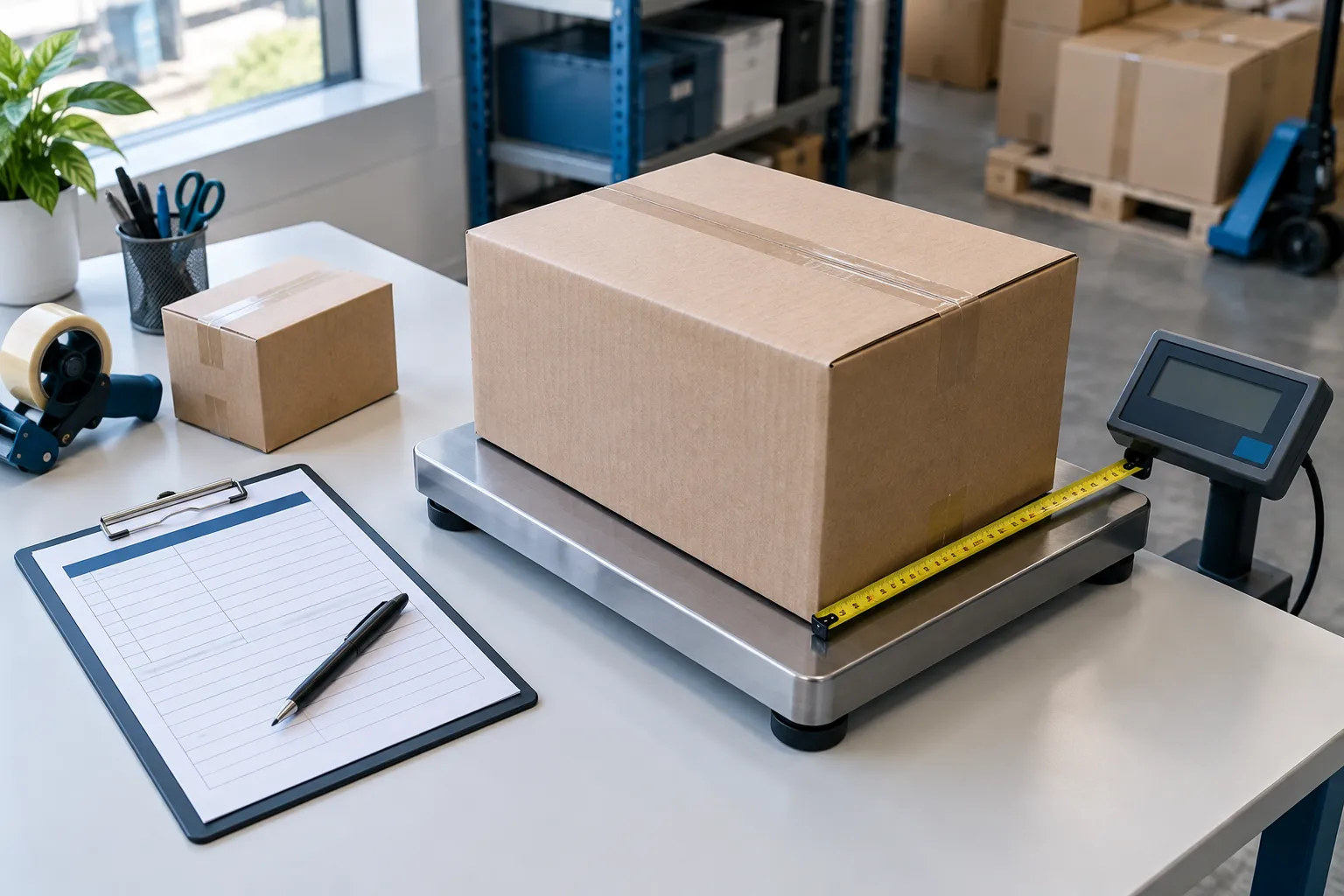
CBM stands for cubic metre, a unit of volume used to describe the space a shipment occupies. One CBM is the volume of a cube measuring one metre on each side. For a rectangular package, calculate CBM by multiplying its external length, width and height in metres.
You may see the same unit written as m³ on a packing list or freight quotation. It describes volume, not the number of products inside a box or their weight.
For a shipment from China to Indonesia, start with the dimensions of the goods as they will actually travel. A correct calculation using unfinished packaging can still give you the wrong figure for an enquiry.
How to calculate CBM for cartons
Use one unit consistently across all three dimensions:
Your measurements | Formula for one rectangular package |
|---|---|
Metres | Length × width × height |
Centimetres | Length × width × height ÷ 1,000,000 |
Inches | Length × width × height × 0.000016387064 |
Feet | Length × width × height × 0.028316846592 |
Metres
Formula for one rectangular package
Length × width × height
Centimetres
Formula for one rectangular package
Length × width × height ÷ 1,000,000
Inches
Formula for one rectangular package
Length × width × height × 0.000016387064
Feet
Formula for one rectangular package
Length × width × height × 0.028316846592
The answer is in cubic metres. When measuring in centimetres, dividing by 100 is not enough: you are converting three dimensions, so the divisor is 100 × 100 × 100.
Identical cartons
Suppose one packed carton measures 60 × 40 × 30 cm. Its volume is:
60 × 40 × 30 ÷ 1,000,000 = 0.072 CBM
If you have 20 cartons with those same external dimensions:
0.072 × 20 = 1.44 CBM
These are illustrative measurements, not a customer shipment. Multiply by the number of shipping cartons, not by the number of products packed inside them.
Cartons of different sizes
Group the cartons by their dimensions, calculate each group's subtotal, then add the subtotals. Here is a separate hypothetical order:
Carton group | Quantity | Outer dimensions, cm | CBM per carton | Group CBM |
|---|---|---|---|---|
A | 10 | 60 × 40 × 30 | 0.072 | 0.720 |
B | 6 | 50 × 40 × 40 | 0.080 | 0.480 |
Total | 16 | — | — | 1.200 |
A
Quantity
10
Outer dimensions, cm
60 × 40 × 30
CBM per carton
0.072
Group CBM
0.720
B
Quantity
6
Outer dimensions, cm
50 × 40 × 40
CBM per carton
0.080
Group CBM
0.480
Total
Quantity
16
Outer dimensions, cm
—
CBM per carton
—
Group CBM
1.200
Do not average the lengths, widths and heights across different carton sizes and multiply those averages. That can produce a different answer from adding the actual package volumes.
A CBM calculator can do the arithmetic, but it cannot tell whether your supplier entered product dimensions, inner-box dimensions or the finished shipping dimensions. That distinction becomes especially important when the cartons go onto pallets.
Measure the shipment after packing
Ask the supplier which packaging stage its CBM figure describes: loose cartons, packed crates or completed pallets. If a warehouse will add packaging later, treat the earlier figure as provisional and request an updated measurement after that work.
Why palletising changes the number
Return to the hypothetical 20 cartons totalling 1.44 CBM. Suppose they are arranged on two pallets, each with final external dimensions of 120 × 80 × 105 cm, including the pallet base and the complete load.
The finished pallet volume is:
1.20 × 0.80 × 1.05 × 2 = 2.016 CBM
That is 0.576 CBM, or 40%, more than the sum of the loose carton volumes. The products have not increased in number; the final shipping units occupy more space because of the pallet bases and the arrangement of the cartons.
If the shipment travels as those two intact pallets, report two pallets at the finished dimensions, together with the carton count. Do not add 1.44 CBM of cartons to 2.016 CBM of loaded pallets: that would count the same goods twice.
The 40% change applies only to these example measurements. It is not a standard pallet allowance, and it does not mean the total freight bill rises by 40%.
Irregular shapes and non-stackable loads
For an irregular package, record its maximum external length, width and height and provide a photograph. FedEx's parcel-measurement guidance describes measuring an oddly shaped parcel as the smallest box it would fit inside. Use that as a measurement starting point, then confirm the proposed freight service's acceptance and rating rules.
Also state whether another load can safely be placed on top. Stackability does not change the mathematical volume, but it is a separate handling and space constraint. Reporting CBM alone does not communicate it.
CBM, gross weight and chargeable weight
Keep these three measurements separate:
- CBM: the shipment's volume in cubic metres.
- Gross weight: its actual weight, including its packaging.
- Chargeable weight or quantity: the figure the provider uses with the quoted rate, under that service's pricing rules.
You cannot convert CBM into actual kilograms without knowing the load's density. Two equal-sized crates can contain very different weights.
Why people say “1 CBM is 167 kg”
That is shorthand for a particular volumetric-weight calculation, not a physical conversion. DHL's chargeable-weight guide illustrates air freight using dimensions in centimetres divided by 6,000, while noting that carriers can use different density ratios.
With that divisor, one cubic metre gives:
1,000,000 ÷ 6,000 = approximately 166.67 kg of volumetric weight
If the actual gross weight is 90 kg, the volume-based figure is higher. If the actual gross weight is 220 kg, the actual weight is higher. The applicable chargeable weight also depends on the service's rounding and minimum rules. Ask which divisor applies rather than assuming that every air or express service uses 6,000.
How sea freight uses volume
Less-than-container-load (LCL) quotations can use a weight-or-measure basis. For example, Maersk's LCL terms compare gross volume with gross weight using a one-CBM-to-1,000-kg convention when rating in weight-and-measure units.
Under that convention, a shipment measuring 1.2 CBM and weighing 1,800 kg would be assessed on the higher numerical quantity: 1.8 weight-and-measure units, before any applicable minimum or rounding. Its physical volume remains 1.2 CBM. This illustrates those terms; it is not a statement of YANCHAO's tariff.
For full-container-load (FCL) freight, the main transport is generally quoted per container. CBM helps assess the load, but dividing a container rate by its nominal cubic capacity does not give a reliable rate for a smaller shipment.
Check the measurements before accepting a quote
Send the package-level figures alongside the total. “About two CBM” gives a quotation team less to check than “two pallets, each 120 × 80 × 105 cm, total 2.016 CBM.”
Before booking, work through four checks:
- Confirm the packing stage. Will the goods travel in the form that was measured, or is palletising or crating still to come?
- Reconcile the count. Every shipping unit should appear once. Cartons inside an already measured crate or pallet must not be added again.
- Keep the measured detail. Preserve the dimensions and calculated subtotals. Ask the provider how it rounds measurements and applies minimum charges.
- Record changes. If the warehouse reports different dimensions, request the package breakdown and supporting measurements before comparing totals.
Do not reduce protective packaging simply to reach a smaller CBM number. Discuss any proposed change with the supplier and freight provider so that cargo protection and handling remain suitable.
CBM questions buyers ask
How much does shipping one CBM cost?
There is no price attached to the unit itself. A quote needs the route, cargo details, gross weight, dates and required service scope. Ask whether collection, origin handling, destination handling and final delivery are included, and which other charges may apply.
Does 20 CBM mean I need a 20-foot container?
No. CBM describes volume; “20-foot” describes a container size. Equipment selection also needs individual package dimensions, weight, loading access and stacking arrangements. A total volume alone cannot prove that a particular load will fit.
Is a smaller CBM always cheaper?
Not necessarily. Reducing volume may help when volume drives the charge, but actual weight, minimum charges, packaging work and other quoted costs can change the result. Request a revised quotation for the proposed packing arrangement.
Send dimensions that can be checked
For a China–Indonesia enquiry, send a packing list showing package type, quantity, outer length × width × height with units, and gross weight. Add the calculated CBM, photographs of unusual pieces and any stacking restrictions.
Include the product description, collection and delivery addresses, cargo-ready date and required delivery date. Mark estimates clearly and update them once packing is complete.
With those details prepared, explore YANCHAO's China–Indonesia freight options to continue planning the shipment.