
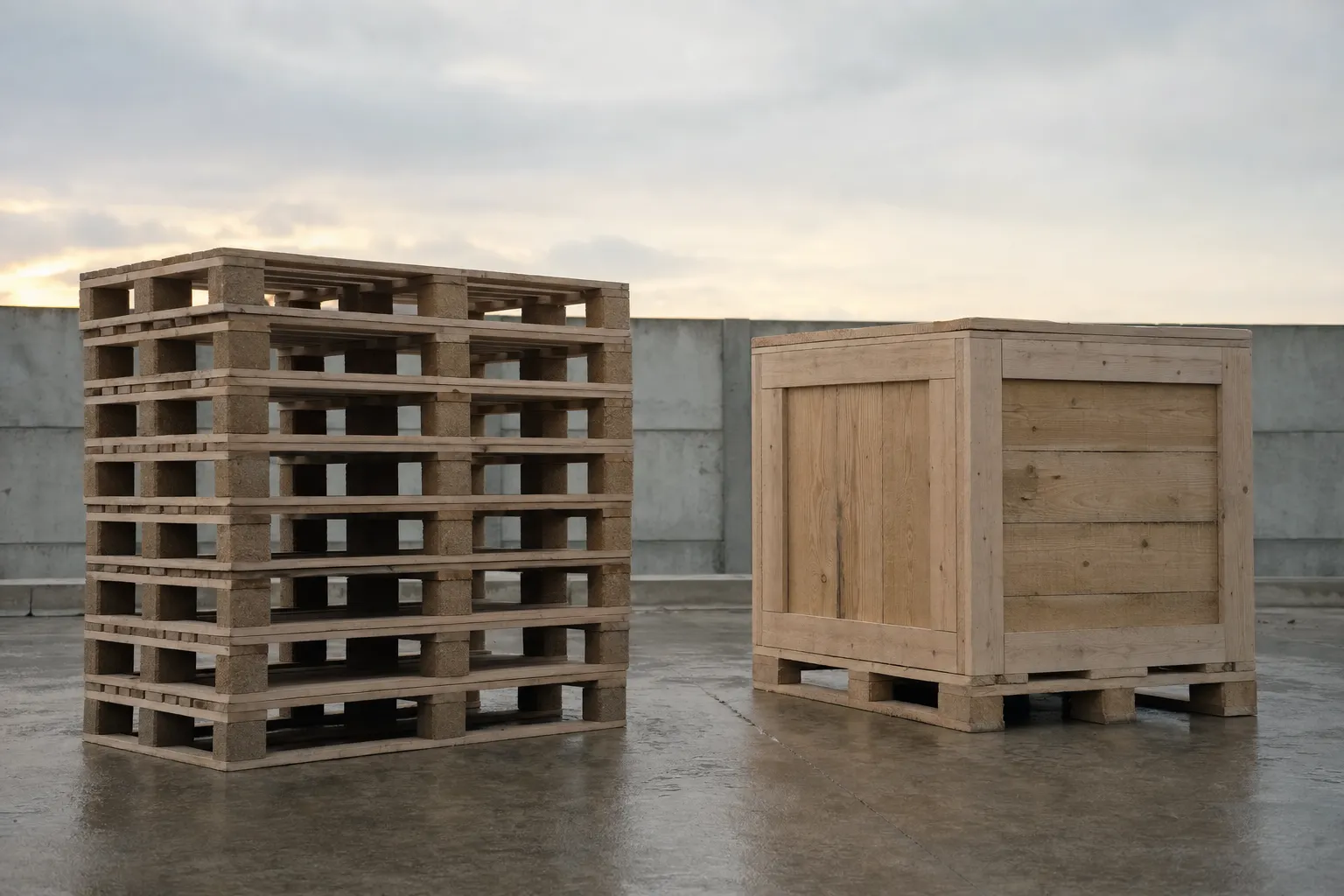
ISPM 15 is not a document you obtain. It is a mark burned or stamped onto a piece of wood — and that wood is the only part of your cargo inspected as a living risk. Everything else follows, including why compliant pallets so often stop being compliant between the mill and the vessel.
The question arrives second-hand: an invoice mentions a fumigation certificate, a quotation form asks whether the cargo includes raw-wood packaging. Two questions about one object, with answers that are not interchangeable.
This article prints no rate, no tax figure, no percentage and no currency amount, and promises no timeline for a treatment, a clearance or a release. No example is a client case and no figure is a quotation. Nothing here is legal advice. Whether a particular unit complies, and what a border does when it does not, are determinations made by the national plant protection organisation of the importing country.
What ISPM 15 regulates, and what it leaves alone
The scope is narrow: wood packaging material made from raw wood — crates, boxes, packing cases, dunnage, pallets, cable drums, spools. Then the sentence shippers miss: such packaging "can be present in almost any imported consignment, including consignments that would not normally be subject to phytosanitary inspection" (ISPM 15, Regulation of wood packaging material in international trade).
The requirement attaches to the wood, not the goods: a consignment of machinery is not a plant product, the crate around it is.
In scope — treated and marked | Out of scope — exempt by construction |
|---|---|
Pallets, pallet collars, skids | Thin wood, 6 mm or less |
Crates, boxes, cases, bins | Plywood, particle board, oriented strand board, veneer |
Cable drums, reels, load boards | Wine and spirit barrels heated in manufacture |
Dunnage — timber that blocks a load | Gift boxes of processed wood |
Sawdust, shavings, wood wool | |
Wood fixed to freight vehicles and containers |
Pallets, pallet collars, skids
Out of scope — exempt by construction
Thin wood, 6 mm or less
Crates, boxes, cases, bins
Out of scope — exempt by construction
Plywood, particle board, oriented strand board, veneer
Cable drums, reels, load boards
Out of scope — exempt by construction
Wine and spirit barrels heated in manufacture
Dunnage — timber that blocks a load
Out of scope — exempt by construction
Gift boxes of processed wood
Out of scope — exempt by construction
Sawdust, shavings, wood wool
Out of scope — exempt by construction
Wood fixed to freight vehicles and containers
The exemptions are four arguments, not one: wood too thin to shelter anything (6 mm); material manufactured rather than sawn (plywood, particle board, OSB, veneer); processed wood materials excluded by their form (sawdust, shavings, wood wool, processed gift boxes); and wood that never leaves the vehicle or container it is fixed to. A plywood crate needs no mark; one reinforced with sawn lumber does.
The standard also says what it is not: its measures are "not intended to provide ongoing protection". A treated pallet is protected at the moment of treatment, not afterwards.
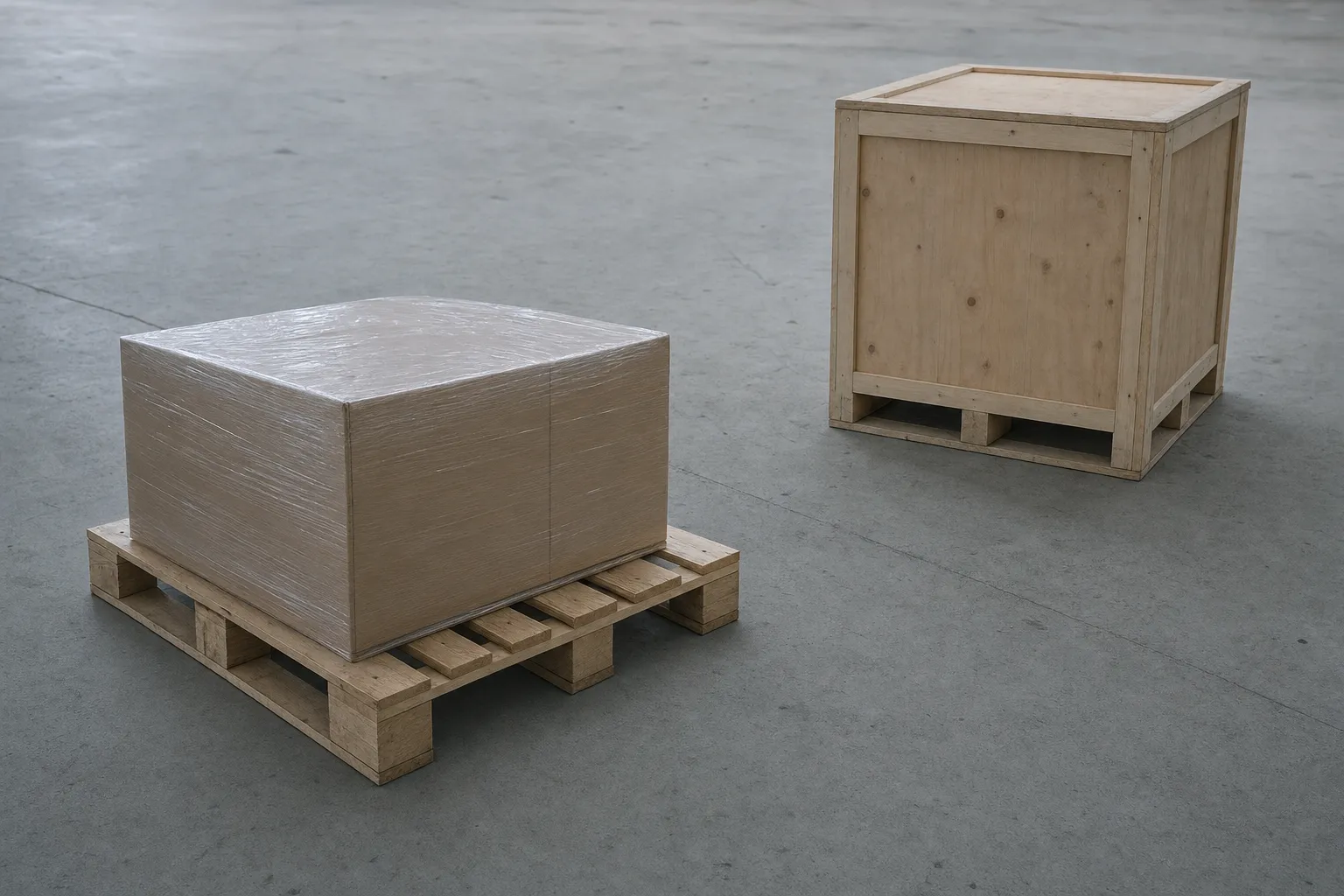
Because the requirement attaches to packaging, it is caught — or missed — when the file is read against the cargo. That is what a pre-shipment cargo review is for, and packaging is the item nobody photographs.
The mark is the certificate — and four elements have to be inside the border
No separate "ISPM 15 certificate" travels with a compliant pallet. The IPPC mark on the wood is the attestation: applying it "renders the use of a phytosanitary certificate unnecessary", because it indicates the accepted measures were applied.
Element | What it says | Who assigns it |
|---|---|---|
IPPC symbol | Certified under the Plant Protection Convention | Use authorised by the national plant protection organisation (NPPO) |
Country code | Where the wood was treated | ISO 3166-1 |
Producer / treatment provider code | Which accredited operator built or treated it | The NPPO, as a unique number |
Treatment code | HT, DH, MB or SF | Annex 1 of the standard |
IPPC symbol
What it says
Certified under the Plant Protection Convention
Who assigns it
Use authorised by the national plant protection organisation (NPPO)
Country code
What it says
Where the wood was treated
Who assigns it
ISO 3166-1
Producer / treatment provider code
What it says
Which accredited operator built or treated it
Who assigns it
The NPPO, as a unique number
Treatment code
What it says
HT, DH, MB or SF
Who assigns it
Annex 1 of the standard
Those four are a traceability chain: wood, country, operator, treatment. The number points at one accredited provider the NPPO supervises — which is why a stencil may be used to apply the mark, but a number you are not authorised to hold may not be applied by whoever happens to be packing the container.
The mark is a physical object too, with conditions an inspector reads at a glance:
- Legible without a visual aid, durable and not transferable — not flaking paint, a peeling sticker, a label over the grain.
- Visible when in use, preferably on two opposite sides.
- Rectangular, inside a border line, symbol and codes separated by a vertical line, nothing else inside it.
- Not hand drawn; red and orange are best avoided, because those colours mark dangerous goods.
Each can be broken by someone who has never heard of the standard.
Crated machinery makes this sharp: there the crate is part of the load-bearing design — see importing machinery and production equipment.
Four codes, four treatments, two hard limits
The last element is a code, and there are four. Each names a treatment with its own parameter; the two fumigants also bar wood above a cross-section limit.
Code | Treatment | Parameter | The limit |
|---|---|---|---|
HT | Heat treated in a steam or dry-kiln chamber | 56 °C for at least 30 continuous minutes through the profile, core included | Bark off before or after |
DH | Dielectric — microwave, radio frequency | 60 °C for 1 continuous minute through the profile, surface included | Surface is usually coldest; thick wood needs bidirectional application |
MB | Methyl bromide fumigation | NPPO-approved schedule reaching the required concentration-time product over 24 hours | Barred on wood over 20 cm in cross-section at its smallest dimension; bark off first |
SF | Sulphuryl fluoride fumigation | NPPO-approved schedule over 24 or 48 hours | Same cross-section bar; wet wood excluded; at least 20 °C throughout |
HT
Treatment
Heat treated in a steam or dry-kiln chamber
Parameter
56 °C for at least 30 continuous minutes through the profile, core included
The limit
Bark off before or after
DH
Treatment
Dielectric — microwave, radio frequency
Parameter
60 °C for 1 continuous minute through the profile, surface included
The limit
Surface is usually coldest; thick wood needs bidirectional application
MB
Treatment
Methyl bromide fumigation
Parameter
NPPO-approved schedule reaching the required concentration-time product over 24 hours
The limit
Barred on wood over 20 cm in cross-section at its smallest dimension; bark off first
SF
Treatment
Sulphuryl fluoride fumigation
Parameter
NPPO-approved schedule over 24 or 48 hours
The limit
Same cross-section bar; wet wood excluded; at least 20 °C throughout
Methyl bromide survives in the standard because some situations have no alternative, with a standing recommendation to replace or reduce it. The consequence for a shipper is plain: MB carries the most conditions, so a supplier offering it by default is not offering the easier route.
Two things the code cannot tell you: whether the treatment was done correctly, and whether the unit is still the one treated.
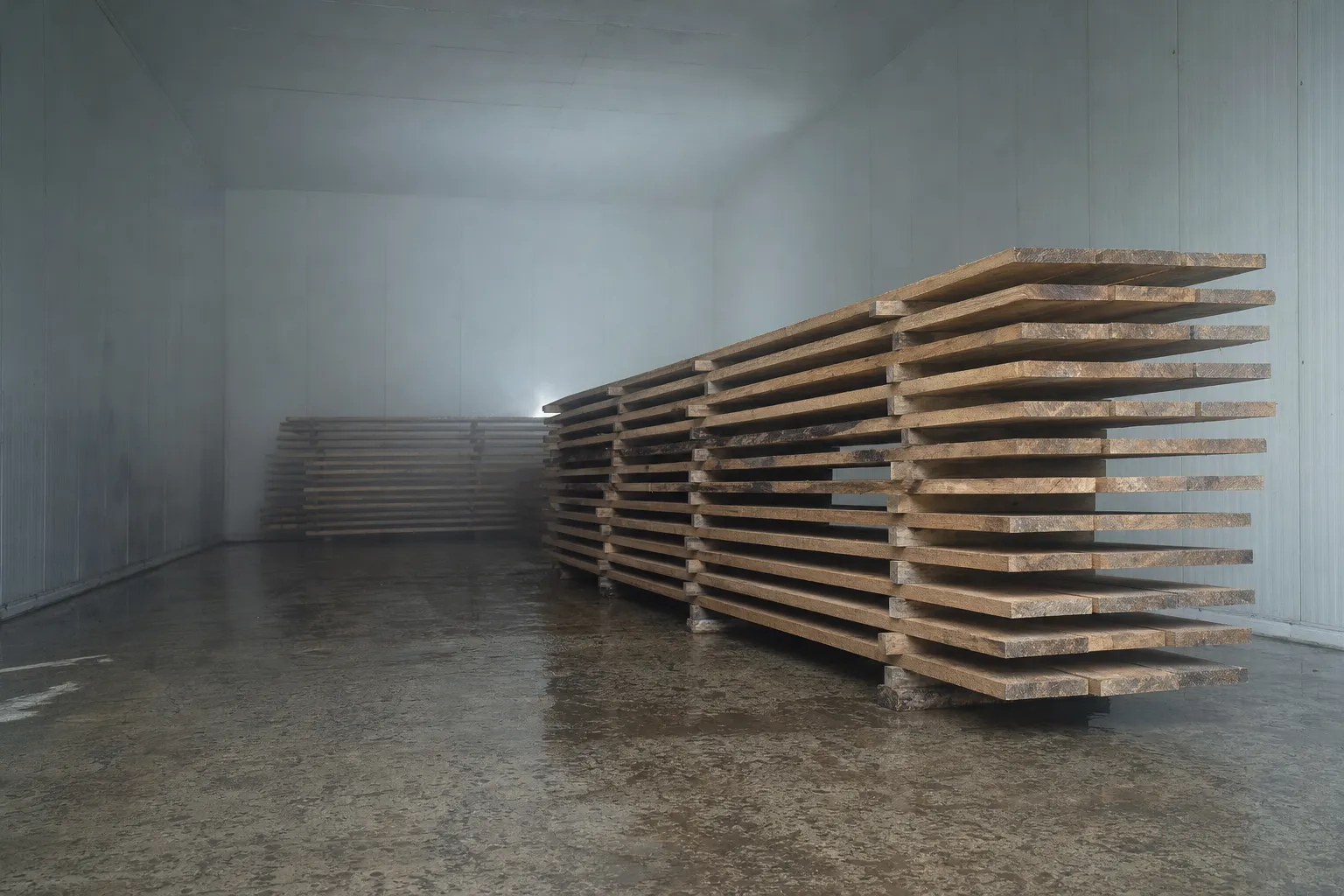
Blocking for dense cargo is read at the last minute, because it is bought by the load rather than the unit — see importing steel products into Indonesia.
Debarked wood is a requirement, not a detail
The rule that surprises people who have read only the mark: irrespective of treatment, the wood must be debarked. The standard tolerates small, visually separate pieces of bark — under 3 cm wide, or wider with a surface area under 50 square centimetres.
The reason is not aesthetic: bark holds moisture and shelter while treated lumber waits to be built, and can carry the pests treatment aims at. For methyl bromide and sulphuryl fluoride it must come off before treatment; for heat treatment, before or after.
The mark does not record debarking, because debarking is assumed. A unit can carry a correct mark and still fail on bark — and the check takes a thumbnail.
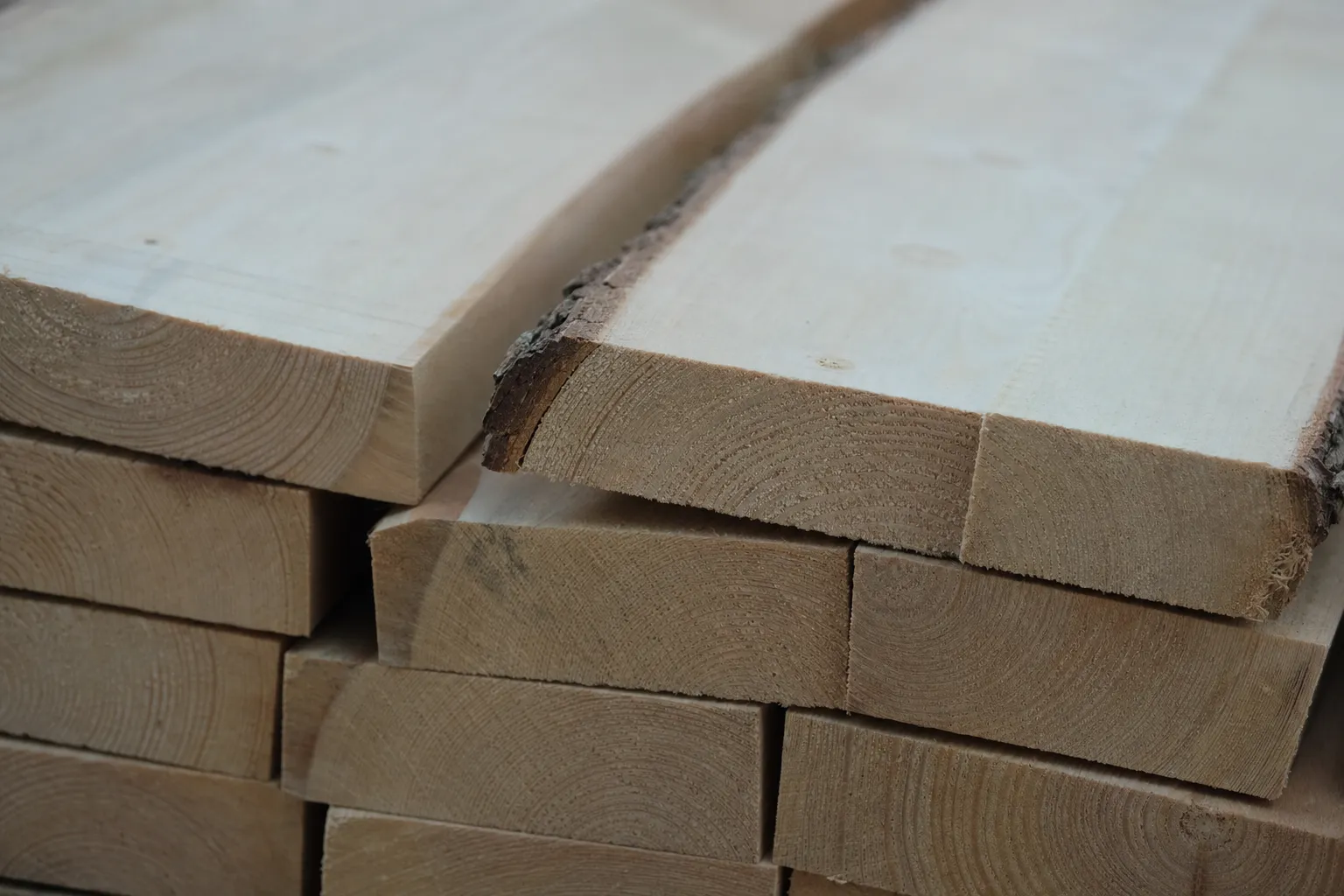
Australia's agriculture department puts the two side by side: bark tolerance plus an approved treatment by a certified provider, the mark as evidence of the second (DAFF, ISPM 15). Both, not either.
Where compliance actually breaks: six failures after the mill
Every failure has the same shape: the unit was compliant when it left the treatment provider, something happened afterwards, and the mark survived a change that compliance did not.
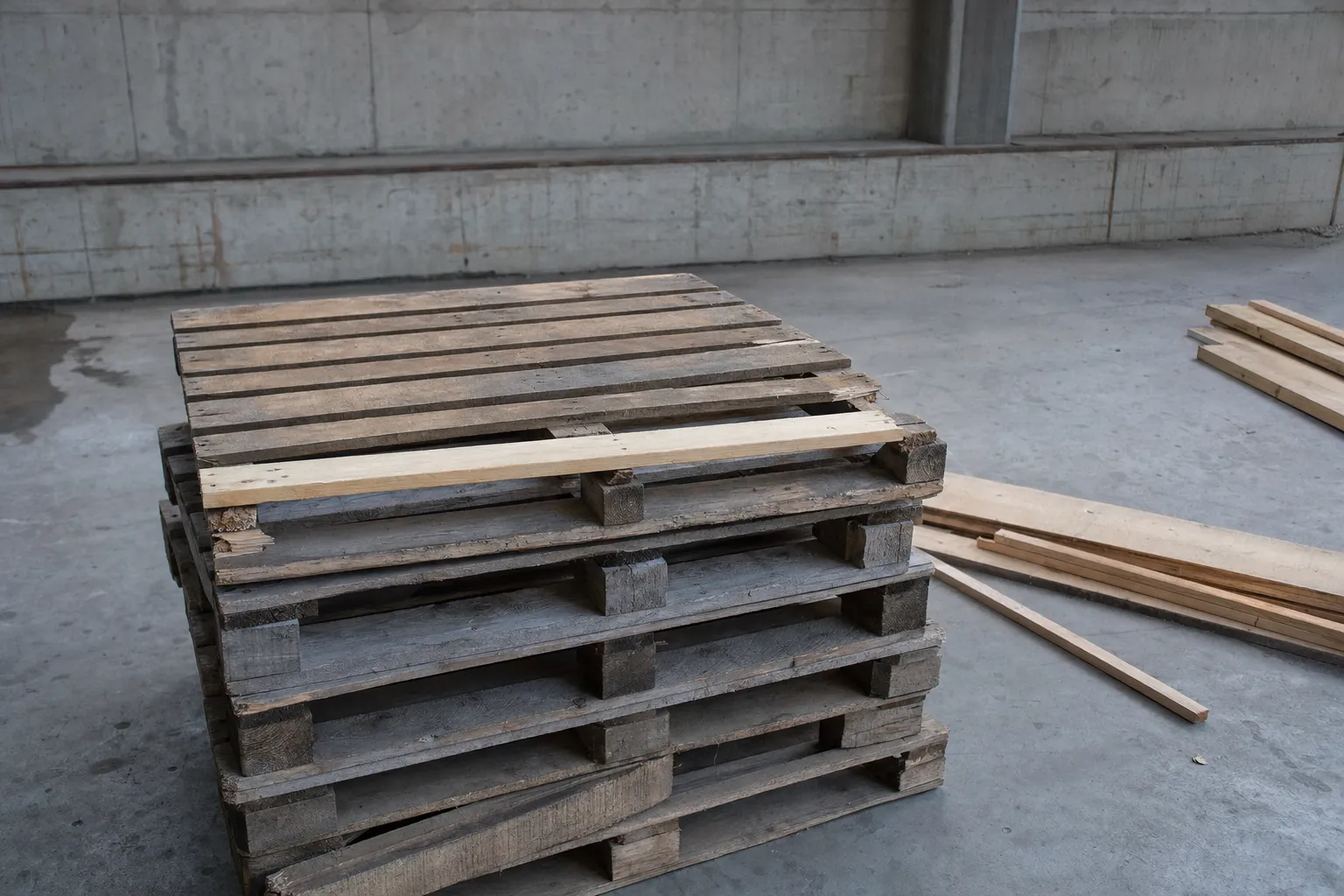
1. The repaired unit. A board splits, someone nails a new one across the gap, and the pallet returns to service with its original mark. Repair wood must be treated wood carrying its own mark — or processed wood material, which needs no mark at all. Several marks on one unit are not in themselves a non-compliance — the standard says so explicitly — but where they leave the origin unreadable the unit is hard to clear on sight, and the practical answer is re-treatment or withdrawal before it ships.
2. The rebuilt unit. A unit whose components are largely replaced — the standard's guide is about one third, the line between repair and remanufacture — is no longer the unit that was treated: the old mark must be obliterated, then the unit re-treated and re-marked. Skipping it gives the chain's most misleading object: new wood, old mark.
3. The re-used unit. Re-use is legitimate: a marked unit, not since repaired or altered, needs no re-treatment for its service life. But there is no ongoing protection — a pallet left on wet ground can be re-infested while its mark stays perfect.
4. The crate built at the loading site. The crates arrive compliant; the last is too small, so it is built on the loading-bay floor from whatever sawn lumber is at hand. Untreated, unmarked, and the first thing an inspector sees.
5. The dunnage cut on the dock. Dunnage is in scope and the highest-risk item in it, because it is cut to length at the last moment. Marks are applied along the timber at short intervals so a cut piece still carries one, or reapplied after cutting by an authorised shipper; pieces too small to carry all four elements should not be used.
6. The unit whose mark died. Painted over, wrapped over, scuffed until the country code is unreadable, touched up with a stencil carrying someone else's number. The mark is the only evidence there is; unreadable, the evidence is gone.
The last two recur on over-sized loads, where packaging is improvised around a shape rather than specified for a product — loads where lashing and blocking are already a design exercise, as in overweight and oversized cargo.
What the border does with a unit that fails
The importing country's plant protection organisation decides, not the carrier or the forwarder. The United States is explicit: the importer must ensure all wood packaging entering or transiting is pest-free, debarked, treated and marked, and shipments containing non-compliant material will not be allowed to enter (USDA APHIS). The same page describes the Emergency Action Notification that follows a finding, and its corrective actions.
Australia is blunter about where the cost lands: packaging found non-compliant "will be sent for treatment, export or destruction at the importer's expense" (DAFF, ISPM 15).
Two things follow, whatever the destination. The options are not a negotiation: treatment, re-export or destruction, chosen by the authority while the consignment waits — the mechanics are in why cargo gets held at Indonesian customs, the channel in green line versus red line. The party who answers is the importer on the entry — on the Indonesian side, the importer of record and the clearance party acting for it; we coordinate with them, and do not declare in our own name.
The cheapest fix is therefore at origin: re-marking a pallet in a loading bay takes hours, while the same problem at destination is a hold on a late consignment.
Fumigation certificate, ISPM 15 mark, phytosanitary certificate: three instruments, three objects
Three documents get called "the wood certificate"; they attach to different things.
Instrument | Attaches to | Issued by | What it can and cannot do |
|---|---|---|---|
Fumigation certificate | A treatment event — this gas, enclosure, batch | The treatment provider, as a record | Proves a fumigation happened. It does not mark a unit, and is not what an inspector reads |
ISPM 15 mark | One unit of wood packaging | An operator accredited under the NPPO | Certifies that unit was treated, and makes a phytosanitary certificate unnecessary |
Phytosanitary certificate | A consignment of plants or plant products | The exporting NPPO | Attests that consignment's phytosanitary status — consignment-level, not packaging-level |
Fumigation certificate
Attaches to
A treatment event — this gas, enclosure, batch
Issued by
The treatment provider, as a record
What it can and cannot do
Proves a fumigation happened. It does not mark a unit, and is not what an inspector reads
ISPM 15 mark
Attaches to
One unit of wood packaging
Issued by
An operator accredited under the NPPO
What it can and cannot do
Certifies that unit was treated, and makes a phytosanitary certificate unnecessary
Phytosanitary certificate
Attaches to
A consignment of plants or plant products
Issued by
The exporting NPPO
What it can and cannot do
Attests that consignment's phytosanitary status — consignment-level, not packaging-level
So: if someone asks for a fumigation certificate for your pallets, the question underneath is whether the wood is marked, and by whom. A certificate for a chamber fumigation says nothing about the pallet built afterwards from other lumber.
The declaration is a fourth document with a fourth object — the entry, which must agree with every other paper in the file, as described in what is a PIB. Packaging rarely gets a declaration rejected; it gets a container held after acceptance.
What to fix in the booking file before the cargo is packed
Six actions, all cheap, all at origin.
- Put it in the contract, not an email. APHIS advises importers to include ISPM 15 compliance in the contract and to require the exporter to inspect wood packaging for pests before use (APHIS). A clause naming the standard and the codes is enforceable; "supplier will ensure compliance" is not.
- Specify by unit, not by treatment. Name pallets, crates, skids and blocking, and require each to be debarked, treated and marked — the ISPM 15 requirements applied per unit. "Fumigation" alone leaves the dunnage outside it.
- Ask for the provider's number. The code points at one accredited operator. If the supplier cannot say which number will appear on the wood, nobody can trace the treatment afterwards.
- Photograph the units at loading. Two opposite sides, mark legible, before the wrap goes on — the only evidence if the question comes at destination.
- Buy dunnage as a specified item. Cut-to-length blocking should arrive treated and marked, so the piece cut on the dock still carries a complete mark.
- Say it in the enquiry. Whether the cargo includes raw-wood packaging changes what has to be arranged before the container is packed — one of the first questions this company asks at quotation.
None of it needs a specialist: it needs the packaging treated as cargo rather than as wrapping.
Where we sit
We coordinate. On the Indonesian import side we do not declare in our own name, do not act as importer of record, and do not hold or issue any plant-health approval — those belong to the Indonesian party entitled to them. On the China–Indonesia lane we read the file against the cargo before it is packed, flag packaging that will not survive the border while it can still be re-treated, and sequence treatment against the loading date.
Yanchao Logistics works the China–Indonesia route — the freight, and the documentation and customs clearance coordination that goes with it. If a shipment is coming, send the goods description, the packaging you intend to use and the intended importing entity through our contact page; we respond within two hours on working days, and a preliminary quotation normally follows within 48 hours once the documents are complete. Shipments involving unclear packaging, restricted goods or project cargo are confirmed after review.
Photographs here are illustrative: generic unmarked pallets, crates, boards and timber, not client cargo, facilities or personnel, and no ownership of any vessel, container, terminal or warehouse is claimed. No mark shown in any photograph is a real IPPC mark. Examples are neither client cases nor quotations.