

Somewhere between your suppliers' gates and the container terminal there is a building your cargo enters as separate deliveries and leaves as one shipment. Most buyers see it twice: once as an address they forward to five factories, and once as a line in a tracking update that reads arrived at consolidation warehouse.
What happens in between is not a mystery, and it is not storage with a nicer name. Before anything is loaded, four things are done to your cargo: it is received against documents, it is measured, it is made loadable, and it is declared. Each of those produces a fact — a count, a dimension, a mark, a declared quantity — and every one of those facts outlives the shipment. They decide what you are charged on, what a carrier will accept, and what can still be argued about when a carton is missing at the far end.
That is the useful way to read the building. Not as a stage on a journey, but as the last place where four separate kinds of error are still cheap.
Nothing on this page is a quotation. No rate, tax figure, percentage or promised transit time appears in it. The situations described are hypothetical: they are not client cases and they are not quotations. What any particular facility is able to do for your goods is settled by that facility's own operating rules and by the customs authorities at each end — not by this page.
Three buildings answer to this name
The phrase is used for at least three different things, and the confusion is not academic: it decides which questions are worth asking.
The first is a parcel hub. If you buy from a marketplace and the tracking says your order reached a consolidation warehouse, that building collects individual parcels from many buyers and releases them as one outbound consignment. Its business is per-parcel handling and consumer tracking. Nothing about it applies to palletised freight, and the questions it answers are where is my parcel and why has it stopped moving.
The second is warehouse-network consolidation, a supply-chain term for closing several distribution centres and running one. It is a facilities and inventory decision taken over years. It has no shipment in it at all.
The third — the subject here — is a freight consolidation facility at origin. Several suppliers' cargo is delivered to one point in China, held briefly, prepared, and released as a single export shipment that one set of documents describes. You may hear it called a CFS, a container freight station, or an LCL consolidation warehouse; in a buyer-consolidation arrangement the cargo belongs to one buyer even though it arrives from many factories.
The distinction that matters commercially: only the third building produces a document set. A parcel hub produces tracking. A network consolidation produces a lease. The origin consolidation facility produces the packing list, the measured volume, the loading sequence, and the packing and measurement record the export declaration is filed from. The declaration itself is lodged by the shipper or by a licensed declarant acting for it, not by the building on its own account — which is why the four steps below are the ones that cost money when they go wrong.
If your question is instead what a door-to-door arrangement does and does not include around this stage, that boundary is drawn in what door-to-door shipping actually covers; this article stays inside the building.
The gate: cargo is received against documents
Receiving starts before the truck arrives. A facility that is doing this properly already holds four things for each expected delivery: the reference it was booked under, the packing list the supplier committed to, the supplier's identity and code, and the window in which the delivery was promised.
At the gate, the check is a comparison, not an impression. Four records are made for every inbound lot:
Record | Why it exists |
|---|---|
Carton or pallet count | The only figure that can be reconciled against the supplier's packing list and, later, against a claim |
Gross weight | Compared with the declared weight; also what a carrier's equipment and a container plan are built around |
Packed dimensions | Including pallet footprint and overhang — the input to billed volume, not the carton size printed on the box |
Visible outer condition | Crushed corners, water staining, re-taped cartons, strapping that has been cut |
Carton or pallet count
Why it exists
The only figure that can be reconciled against the supplier's packing list and, later, against a claim
Gross weight
Why it exists
Compared with the declared weight; also what a carrier's equipment and a container plan are built around
Packed dimensions
Why it exists
Including pallet footprint and overhang — the input to billed volume, not the carton size printed on the box
Visible outer condition
Why it exists
Crushed corners, water staining, re-taped cartons, strapping that has been cut
Two more things belong in the record even though they are words rather than numbers: which supplier the lot came from, and which shipment it belongs to. Without those two, a consolidated lot becomes anonymous the moment the second truck unloads, and every later shortage turns into an argument about whose cartons were whose.

Then comes the part buyers underestimate. A receiving check can end in four ways, and only one of them is silent:
- The delivery matches the documents, and the cargo is staged.
- The delivery is short or over, and the count is recorded as delivered rather than as declared.
- The cartons are unmarked, wrongly marked, or marked for a different shipment.
- The delivery arrives outside its window — early, which competes for space that was not planned, or late, which is the expensive one.
A facility can document all four. It cannot decide any of them for you. The decision — accept, hold, rework, or return to the supplier — belongs to whoever holds the commercial relationship, and if nobody is reachable when the truck is at the dock, the default is that the cargo is accepted as it stands and the discrepancy is written down. That signed record is what a later claim is argued from. A receiving report accepted without a decision is not a neutral document; it is the version of events that will be used.
This is also where photographs start to matter. A photo of staged cartons with a date proves that the cargo existed, how many units were visible, and what the outer packaging looked like at that hour. It does not prove what is inside, and no photo report should be read as if it did.
The tape measure changes the bill, not the goods
Of the four steps, this is the one missing from almost every published description of a consolidation warehouse, and it is the one that changes what you pay.
Suppliers measure their own cartons, usually before they are stacked, strapped or palletised. The facility measures the cargo as it will actually travel: the pallet footprint including any overhang, the true height of a stack, the weight on a scale rather than a figure copied from an invoice. The difference between those two measurements is not dishonesty on either side. It is the difference between a carton and a shipment.
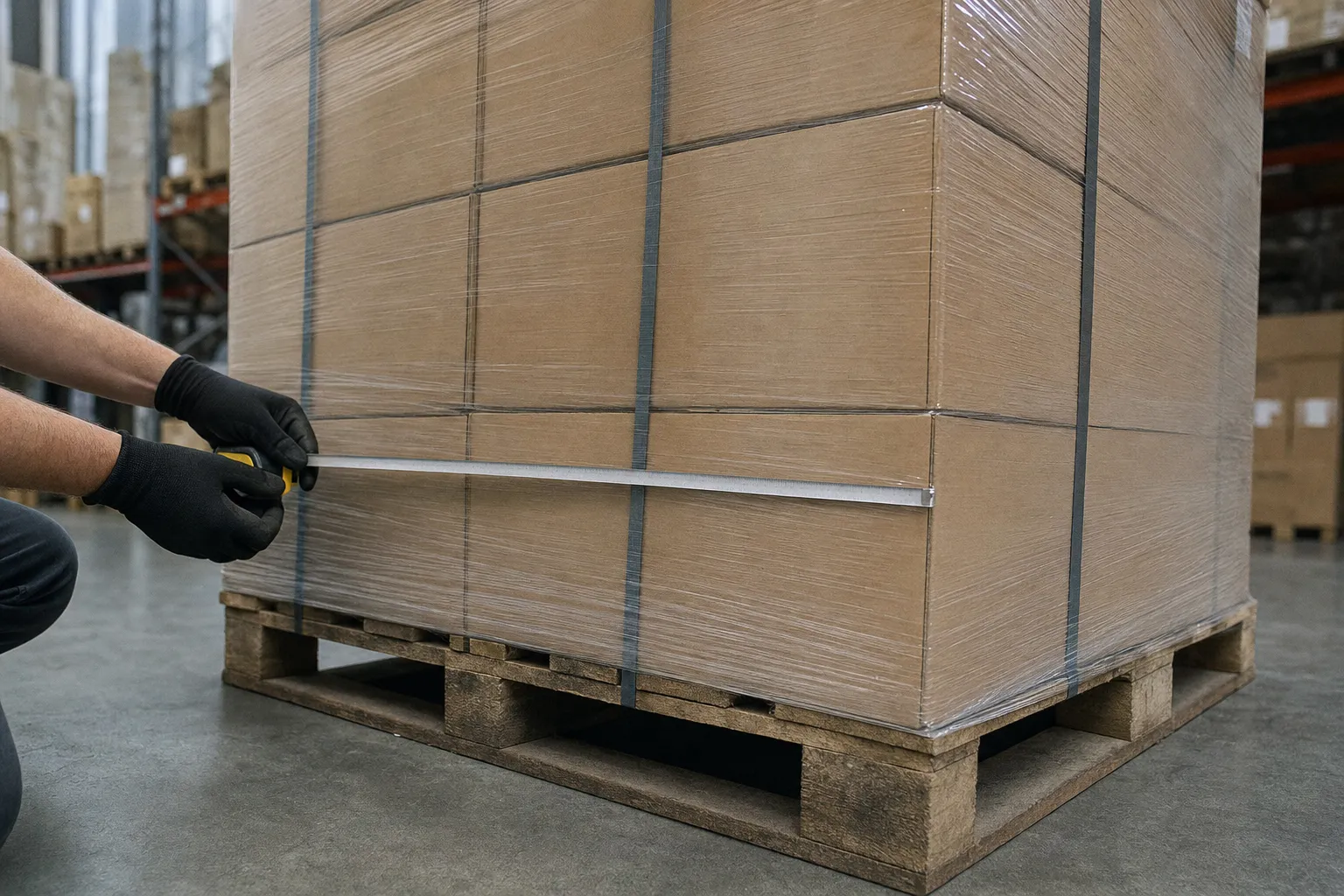
The measured figure then does two jobs. It sets the volume the freight is quoted against, and it decides whether the cargo moves as LCL inside shared container space or justifies a container of its own. Where a service charges on weight as well as volume, the same measurement feeds the chargeable figure — the greater of actual weight and volumetric weight — but that is a billing convention, not a second measurement. Both jobs are quantity questions, not price questions — but a buyer who has been comparing quotations built on supplier-declared carton sizes will see the change as if it were a price increase, when what actually happened is that the estimate was replaced by a measurement.
How volume is calculated, and why a pallet's overhang counts, is set out in what CBM actually measures. The practical point for this article is narrower: the measurement is taken once, at the point where the cargo is still separable, and it is the number everyone downstream will use. Two moves are worth making before that happens.
First, ask the facility to send you the measurement record when it is taken, not with the invoice. If the figure moves, you want to know while the pallet can still be rebuilt rather than after the container has sailed. Second, if a supplier's cartons are being consolidated with others, ask whether the volume quoted to you is the individual lot as measured or a share of the combined load — the two can differ once pallets from several suppliers are stacked together to fill a container efficiently.
The measurement is also the reason restacking exists as a service. Cartons that were packed for a truck ride can usually be made smaller as a stack, and a stack that is squared to its pallet and wrapped tightly takes up less billable space than the same cartons sitting as they arrived. That is a real saving and it is achieved before loading, by geometry rather than by negotiation.
Making the cargo loadable
Between measurement and the container there is a set of physical adjustments whose only purpose is to let the cargo survive being handled as freight. Where the arrangement includes handling, they run in roughly this order.
Repacking and reinforcement. Factory cartons are built for a lorry ride within one country. An export container involves stacking, compression over weeks, and repeated lifting. Replacing a weak master carton, adding edge protection, re-strapping a pallet that was secured with tape — none of it improves the product, and none of it is a quality intervention. It only stops a carton from arriving as loose units.
Marks and labels. Shipping marks identify the shipment to people who have never seen your purchase order; they are how a carton is matched to a lot at the far end after a container has been unloaded. Where destination labelling or barcode requirements apply, they are applied here, because this is the last point at which a carton can be picked up and turned around by hand.
Palletising, or deliberately not. A pallet is a decision about load, not a platform. Weight goes low and even, cartons that cannot bear load never sit under others, heights stay within what the destination can handle, and the finished pallet is wrapped and strapped so it arrives as one object rather than as a pile. Floor-loading — no pallets at all, cartons stacked to a container loading plan — can use the container's volume more completely, and it is the right answer for some cargo and the wrong one for cargo that will be handled unit by unit at the far end. The choice is made before loading day, with the destination's unloading arrangements in view. Changing it during loading means rebuilding the container.

Wood. Where timber is used — pallets, crates, dunnage, bracing — the treatment mark is the proof that the wood is acceptable, and a pallet without the correct mark can hold an entire container at a border. The standard behind the mark, and what an inspector actually looks for, is covered in ISPM 15 wood packaging: the mark is the proof; the underlying rule is published by the IPPC. This is worth checking at the point the pallet is built, because it cannot be fixed once the container is sealed.
The through-line: none of this makes the cargo better. It makes the cargo loadable — a category the supplier never had to think about, and the facility thinks about for every lot.
The declaration and the cut-off
Two deadlines govern the end of the building's work, and they are not the same deadline.
The first is documentary. An export declaration describes the goods as they physically are: what they are, how many, how heavy, what they are worth, and how they are classified. The facility's receiving record and measurement are the physical evidence that declaration rests on. When the declared quantity and the counted quantity disagree, the honest resolution happens here, while the cargo is on the floor and can be re-counted. Once the container is loaded and sealed, the only remaining options are to declare what the documents say and hope, or to stop the shipment.
The declaration side of the Chinese border is a public process with published requirements — the General Administration of Customs is the authority — and the point for a buyer is not the procedure but the dependency: the documents have to describe the cargo, and the cargo was measured here.
The second deadline is physical, and it belongs to the carrier: the cut-off. A container has a time by which it must be stuffed, sealed and delivered to the terminal, and documents have a time by which they must be lodged. Miss either and the cargo does not travel on the departure it was booked for. It waits — occupying space in a facility that is not designed to be a warehouse — and the schedule downstream moves with it.
That is why a late supplier is expensive in a way that is hard to see from the factory's side. The factory sees a delivery that is a few days late. The consolidation facility sees cargo that has arrived after the only departure it could have joined.

There is an Indonesia-side dependency at this same point, and it is the one most often discovered too late. What travels is described by a transport document — a bill of lading. What a bill of lading does, as a receipt for the goods handed over, as evidence of the contract of carriage and, in many systems, as a document of title, is settled by the maritime law of the countries the shipment touches and by long-standing trade custom, not by one international rule that binds everyone; the UNCITRAL collection of transport texts indexes the carriage conventions that sit behind those national rules. What happens at the Indonesian border is driven by who is importing and under what licence position. That position has to be settled before loading, because the manifest, the transport document and the import declaration are all built around the same importer identity. If the identity changes after the container is on the water, documents have to be corrected rather than filled in.
We coordinate that side; we do not act as the importer of record and we do not hold a licence on a client's behalf. How the Indonesian import declaration itself is structured is explained in what a PIB actually is. What matters inside the building is only this: a shipment cannot be loaded correctly for a border position that has not been decided yet.
What the building cannot see
The most useful thing a buyer can know about a consolidation facility is where its competence ends. Five limits are worth stating plainly, because each one is routinely assumed away.
It sees cartons, not products. A receiving check counts, weighs, measures and looks at the outside of packages. That is not an inspection. A carton can be perfectly sound and full of the wrong item, and no amount of warehouse diligence will catch it. If what you need is a verdict on what is inside, that is a different scope with a different method — the kind of pre-shipment review described in pre-shipment inspection: what gets checked, and it should be arranged as such rather than assumed from a receiving report.
It records, it does not decide. Short delivery, damaged carton, wrong marks: the facility can document all of it to a standard that will survive a dispute. It has no standing to accept a commercial settlement, to reject a supplier's goods on your behalf, or to agree who pays for rework. Those decisions need someone with authority, reachable at the moment the truck is unloading.
It cannot make a late supplier early. Storage does not buy schedule. Once a lot misses the cut-off, the facility's only remaining contribution is to keep the cargo safe and correctly recorded until the next departure.
Possession is not title. Cargo sitting in a consolidation facility is in someone's custody, not in their ownership — and custody is what a damage claim is actually about. This is also why the handling scope should be in writing: what is covered when the facility is holding your goods is a contractual question, and it is answered by the terms of the arrangement, not by the fact that the building is large and busy.
It cannot make a restricted product admissible. Whether a product may be imported at all is decided by the importer's licence position and by the checks run at the Indonesian border — a separate question from whether the cargo is packed well. Indonesia collects import documentation through its national single window, and the admission question is answered there and by the authorities behind it, not on a warehouse floor. A facility that spots the problem has done you a favour; it cannot solve it.
Five decisions to make before the first carton arrives
Everything above converges on a short list. None of these are the facility's decisions to make, and all of them are cheap to make in writing before day one and expensive to improvise at the dock.
Decision | What it settles | What goes wrong without it |
|---|---|---|
The receiving instruction | What suppliers print on the carton and write on the delivery note, and which reference they quote | Cartons arrive unidentifiable and get counted as an anonymous lot |
The discrepancy rule | Who is called when a count is short or a carton is damaged, and what the default is if nobody answers | Cargo is accepted as delivered, and the record becomes the version of events |
The handling scope | Whether repacking, relabelling, restacking or palletising is included, and who authorises rework | Work is either not done, or done and then disputed |
The measurement basis | Whether the figure quoted to you is your lot as measured or a share of a combined load | An estimate is compared against a measurement and read as a price rise |
The treatment of early and late cargo | What happens to a delivery that arrives before its window or after the cut-off | Space is consumed unplanned, or cargo waits for a departure it cannot join |
The receiving instruction
What it settles
What suppliers print on the carton and write on the delivery note, and which reference they quote
What goes wrong without it
Cartons arrive unidentifiable and get counted as an anonymous lot
The discrepancy rule
What it settles
Who is called when a count is short or a carton is damaged, and what the default is if nobody answers
What goes wrong without it
Cargo is accepted as delivered, and the record becomes the version of events
The handling scope
What it settles
Whether repacking, relabelling, restacking or palletising is included, and who authorises rework
What goes wrong without it
Work is either not done, or done and then disputed
The measurement basis
What it settles
Whether the figure quoted to you is your lot as measured or a share of a combined load
What goes wrong without it
An estimate is compared against a measurement and read as a price rise
The treatment of early and late cargo
What it settles
What happens to a delivery that arrives before its window or after the cut-off
What goes wrong without it
Space is consumed unplanned, or cargo waits for a departure it cannot join
Two of these are worth a longer conversation than the others. The discrepancy rule is the one that decides whether a shortage becomes a documented fact or an argument, and the treatment of late cargo is the one that decides whether a missed supplier delivery costs you a departure. Where a shipment is being split across several departures, the sequencing question that sits behind that second decision is set out in splitting a project into shipments.
Reading the updates you get
Two kinds of update come out of this stage, and they prove different things.
The inventory position answers is my cargo here, and how much of it. It is a count against a record: this supplier, this many cartons, this weight, this status. It is the same information the facility uses to build the loading plan, which is why it is worth reconciling early rather than at invoice time — a discrepancy that is visible while cargo is still on the floor is a correction, and the same discrepancy discovered after loading is a claim.
The photograph answers what did it look like. A dated image of staged pallets, of a marked carton, of an open container being loaded, is evidence of condition and presence at a moment. It is not evidence of contents, and a sequence of tidy photos is not a quality report.
The useful habit is to decide in advance which of the two you want and how often. A buyer receiving a photo per delivery and a count per week is being told something specific. A buyer receiving a photo whenever something looks interesting is being told very little — and will not find out until the shortage.
Where this sits in the shipment you are planning
The building is one node in a chain, and its output is the input to everything after it: the measured volume becomes the freight basis, the loading plan becomes the container's contents, the receiving record becomes the evidence behind the declaration, and the declaration becomes the document set that travels.
Whether the cargo should be combined at all is a prior question, and a different one — it is decided on release dates, declaration compatibility and whether combining changes the mode, which is what consolidating cargo from multiple suppliers works through. This article assumes that decision has been made and the cargo is on its way to a floor.
For China-to-Indonesia cargo we coordinate receiving, basic handling, consolidation dispatch, an inventory position and photo updates through a consolidation node in Nansha, Guangzhou, which runs to roughly five thousand square metres of operating space. It is a service node in our partner network, not a building we own, and the same is true of the Indonesian end — the receiving, sorting and delivery stages there are coordinated through partner facilities rather than operated by us. Section-level context for how those stages fit together, including the article set for this cluster, is on the warehousing and delivery index.
If you are about to send supplier cargo into a consolidation facility for Indonesia, the useful first message is short: the supplier list, their cargo-ready dates, and any packing or labelling specification you have committed to. That is enough to confirm whether the receiving window you have been given is achievable, and to say so before the first truck is at the gate.