
An NVOCC is a common carrier that owns no ships: it contracts to carry your cargo, issues its own bill of lading and answers for the cargo as a carrier, while buying space on vessels operated by someone else. A freight forwarder arranges that carriage as your agent. A broker covers two jobs under one word: a freight broker introduces your cargo to capacity, a customs broker is licensed to prepare and file the entry in the importer's name. A carrier operates the vessel. Four titles, four different promises — and only the paperwork tells you which one you are holding.
That distinction sounds academic until a crate arrives cracked and every company involved is technically correct. The forwarder says it only arranged. The NVOCC says the damage happened after discharge. The terminal says the cargo left in good order. The carrier says its contract was never with you. None of them is lying, and you are still the party without a remedy.
The reason is simple. These four words are not ranks in a chain of command, and they are not quality labels either. They describe what a company is allowed to promise, what document it signs, and therefore what it owes when something goes wrong. Get the document wrong at the booking stage and you spend the claim stage arguing about vocabulary.
This article prints no freight rate, no duty figure, no tax amount and no percentage, and it promises no clearance or delivery date. Every scenario is illustrative — not a client case and not a quotation. Nothing here is customs, tax or legal advice, and nothing here makes us the importer of record: on the Indonesian side we assist and coordinate with the licensed importer and the broker it appoints.
Four titles, four different promises
Ask each of the four what it has promised you and the answers do not overlap as much as the industry's vocabulary suggests.
The carrier promises to move the box from one port to another on a named vessel, and it promises that in a contract of carriage. The NVOCC promises the same thing — a port-to-port move — but it performs that promise by buying space from the carrier rather than by operating a ship. The forwarder promises to arrange: to book, to document, to coordinate, and to act on your instruction with reasonable care. The broker splits in two: a freight broker promises an introduction to a truck; a customs broker promises to prepare and file the entry in the importer's name.
The confusion starts because these roles are held by the same companies. The US Commercial Service puts it plainly: most freight forwarders are also non-vessel operating common carriers, and both are licensed and regulated as ocean transportation intermediaries by the Federal Maritime Commission (trade.gov). So a single invoice can come from a company that is your agent for one line of it and your carrier for another.
That is not a loophole. It is the normal shape of the industry. But it means the question "are you a forwarder or an NVOCC?" is the wrong question, because the honest answer is often "both, depending on which line you are reading". The question that produces a usable answer is narrower: for this shipment, which document carries your name?
An NVOCC is a carrier that owns no ships
The full name — non vessel operating common carrier — is long for such a simple arrangement. The company commits to carry your cargo by sea. It does not own or operate the vessel that will physically do it. Instead it holds space with one or more vessel-operating carriers — through a service contract or on the spot market — and resells that space to shippers under its own transport document.
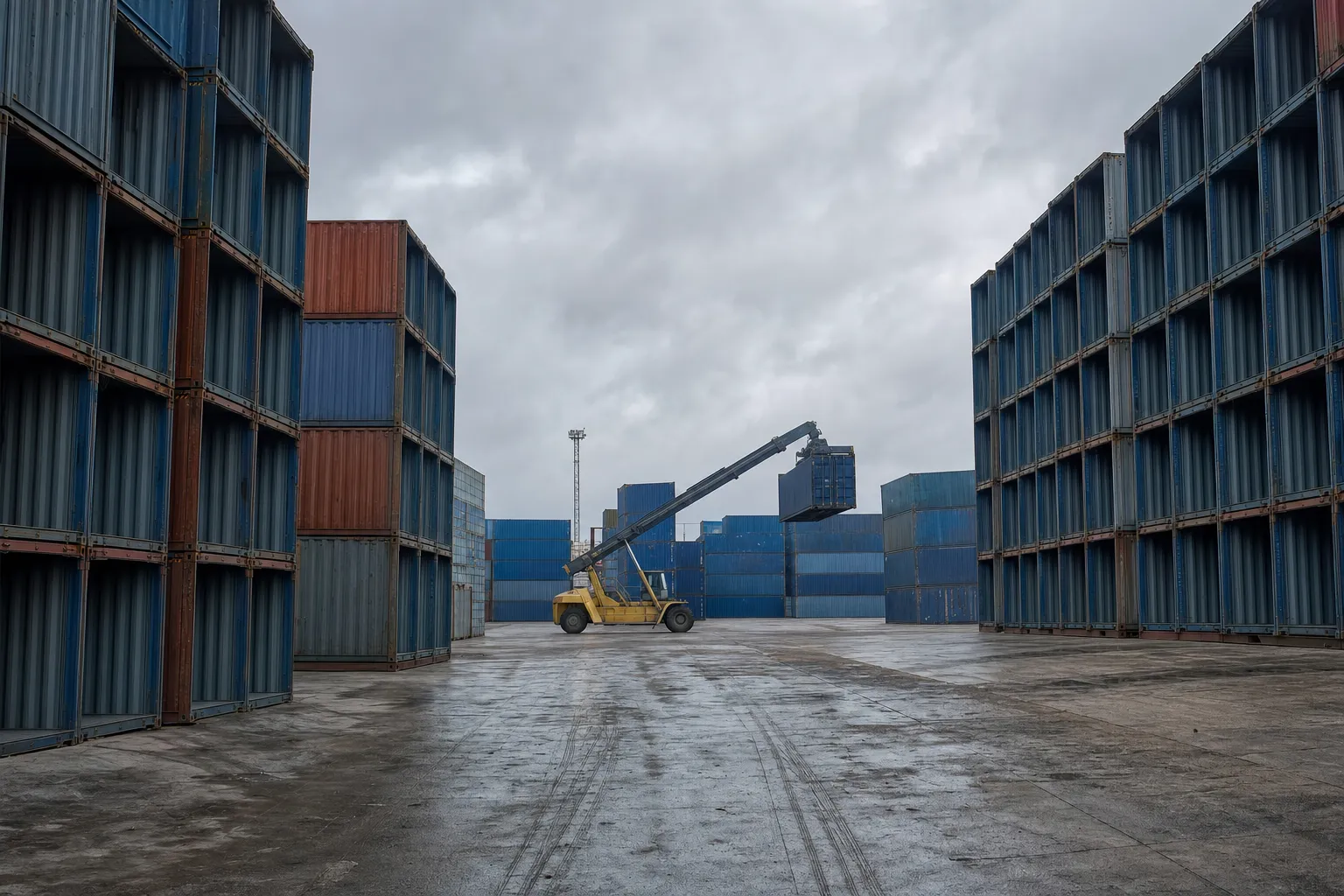
Illustrative: a shared terminal yard — none of the containers in it belong to the company that sold the space.
The document is the part that matters. The ocean carrier issues a master bill of lading to the NVOCC, naming the NVOCC as the customer. The NVOCC issues a house bill of lading to you. Two documents, two contracts, and the one in your hand names the NVOCC as the party that contracted to carry.
Toward you, then, the NVOCC stands where a carrier stands. What it owes for loss or damage is set by the terms of the bill of lading you hold and by the convention that applies to that carriage — not by the quotation, not by the email chain, and not by how large the company is. This is the practical difference between an NVOCC and a pure forwarder, and it is why the distinction survives despite the two roles sitting under one roof so often.
Licensing is where most guides stop, and it is worth knowing what a licence actually certifies. In the United States, the Federal Maritime Commission licenses ocean transportation intermediaries and requires them to be bonded or to show other evidence of financial responsibility; foreign NVOCCs register rather than license, and the commission publishes both a register and a list of non-compliant operators (FMC licensing, non-compliant NVOCCs). A licence certifies that a company met an entry test in one jurisdiction. It does not certify that the company is competent, solvent next year, or insured for your cargo.
So use the register the way you would use a company search: check it yourself, on the regulator's own site, on the day you sign, and check the entity name rather than the trading name on the email signature. Where a jurisdiction publishes no register, you cannot check — and that changes what you rely on instead: the bill of lading and the insurance become the only protections you have.
A forwarder is an agent — until it signs something
The forwarder's role is easier to describe and harder to pin down, because it is defined by the instruction rather than by the mode. The US Commercial Service describes international freight forwarders as agents for exporters, able to move cargo "dock-to-door", and lists the work as including arranging and tracking freight, arranging inland transport, preparing shipping and export documents, booking cargo space, negotiating freight charges, consolidating cargo and arranging insurance.
Read that list again and notice what is missing: none of it is a promise about the cargo's condition. An agent owes you care, disclosure and obedience to your instruction. It does not owe you the carrier's performance, and it cannot make the sea calm.
The role changes the moment the forwarder stops arranging and starts contracting. Three signals do it:
- It books space in its own name rather than as your named agent.
- It issues a bill of lading, or a forwarder's cargo receipt that functions like one.
- Its trading conditions declare that it contracts as principal for a defined part of the move.
Any one of those turns a line item from agency into carriage, and with carriage comes carrier-like exposure for that leg. This is the single most useful thing to understand about the NVOCC vs freight forwarder question, because it means the answer is not a property of the company. It is a property of the transaction. The same forwarder can be your agent on the export declaration, the contracting party on the ocean leg, and a coordinator for the truck at the other end.
If you are still shortlisting partners, the questions that separate an assessor from an order-taker belong in how to choose a freight forwarder rather than here. What matters at this stage is narrower: ask for the trading conditions, and read the clause that says in what capacity the company acts.
Two different jobs share the word broker
"Broker" is the most misleading of the four words, because English uses it for two jobs that share almost nothing except the absence of assets. The freight forwarder vs broker question that sends most people to a search engine usually starts here, with two words that describe an arranger and an introducer rather than two grades of the same job.
A freight broker — in the sense used in road transport — matches a shipper's cargo to available truck capacity and is paid for making that match. It does not take possession of the goods, it does not usually issue a transport document, and it is not the party you pursue for damage that happened on the water. On a domestic leg it can be exactly the right tool: someone who knows which vehicles are empty and where. On an ocean move it is an introduction, not a contract of carriage. The freight broker vs freight forwarder comparison that fills the search results is mostly a North American trucking question, and it is worth reading with that in mind.
A customs broker is a different animal. It is licensed to prepare and file an import declaration on the importer's behalf, and it works inside the importer's legal position: the entry is made in the importer's name, against the importer's registration, with the importer carrying the consequences of an error. That is why the customs broker vs freight forwarder question has to be asked separately from the freight question — they are answered by different documents, and often by different companies.
Broker type | What it does | Document it produces | Where liability sits |
|---|---|---|---|
Freight broker | Matches cargo to available truck capacity | Usually none of its own | With the operator that takes the goods |
Customs broker | Prepares and files the import declaration | The entry, in the importer's name | With the importer of record who signs it |
Freight broker
What it does
Matches cargo to available truck capacity
Document it produces
Usually none of its own
Where liability sits
With the operator that takes the goods
Customs broker
What it does
Prepares and files the import declaration
Document it produces
The entry, in the importer's name
Where liability sits
With the importer of record who signs it
On the Indonesian side, that local broker is strongly encouraged rather than compulsory. The US Commercial Service advises exporters to work with experienced local customs brokers who know the formats and electronic systems (Indonesia import requirements); an importer that holds its own customs access can in principle file in its own name, but in practice the declaration almost always goes through a broker, and the entity that appears on the declaration is the one the border treats as the importer. That entity is not us and does not become us by handling your freight: on the Indonesian side we assist and coordinate, and the importer of record stays a separate decision with its own consequences.
A one-line test separates the two brokers: ask who is named as importer on the declaration. If the answer is you, your broker is working inside your liability. If the answer is a third party you have never met, you are importing through someone else's record, and the freight contract in front of you says nothing about that arrangement.
The carrier is the only party that actually moves the box
Most shippers never test the freight forwarder vs carrier distinction until a claim arrives. The vessel-operating carrier owns or operates the ship, controls the space, and issues the master bill of lading. Its customer, on an NVOCC booking, is the NVOCC — not you. That single sentence explains most of the frustration that follows a damage claim, because it means the company with the ship is often not the company with your contract.
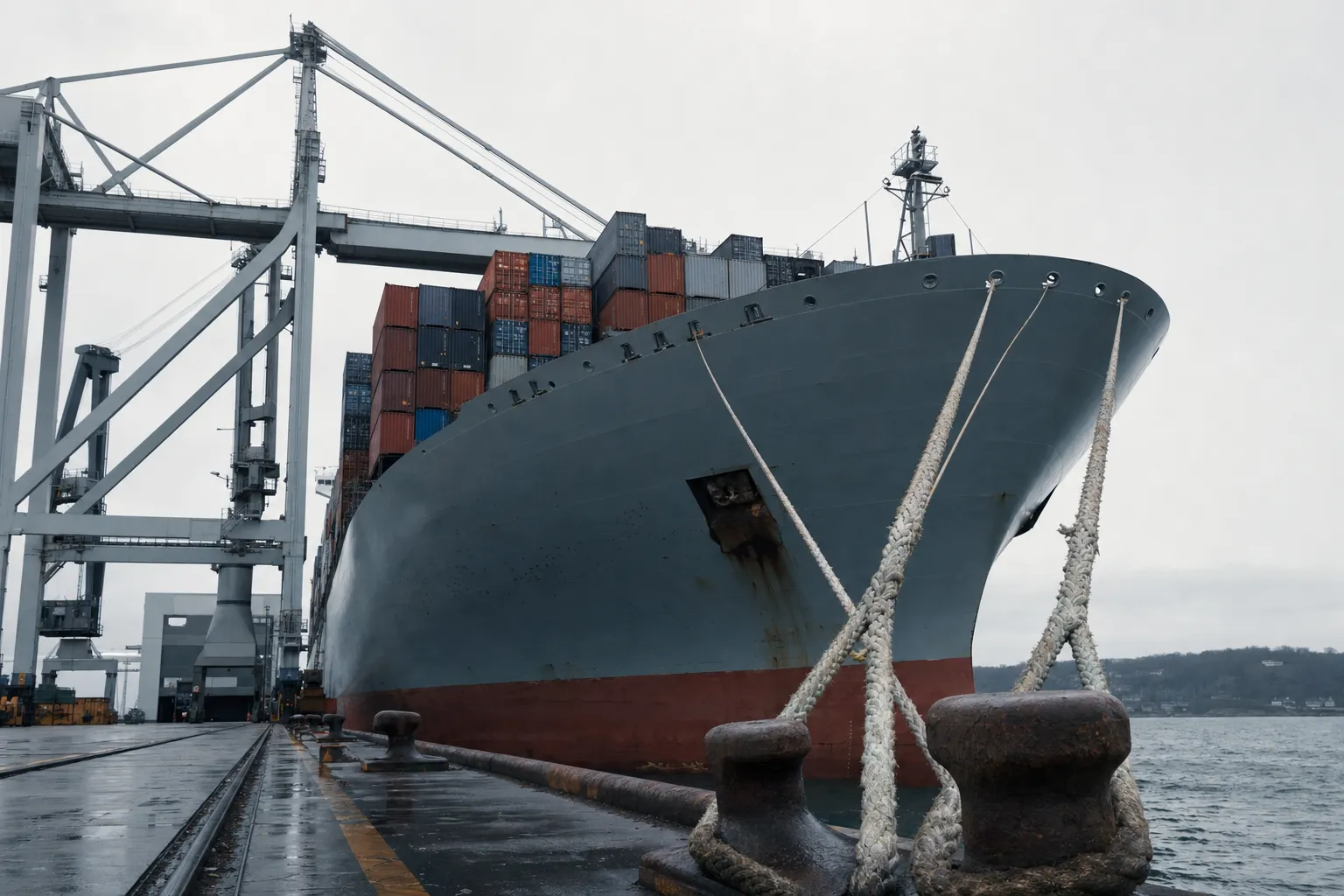
Illustrative: the ship is the carrier's asset, and its bill of lading names its own customer.
None of this makes an NVOCC booking a worse choice. For LCL cargo, for volumes that cannot fill a box, and for shippers who want one document and one point of contact across several carriers, the arrangement is the reason the cargo moves at all. What it changes is the direction of your claim: you pursue the party that issued the document you hold, and that party pursues the line.
Incoterms do not change this. The ICC describes its rules as clarifying "the tasks, costs and risks involved in the delivery of goods from sellers to buyers" (ICC Incoterms) — between seller and buyer, that is, not between you and your carrier. A CIF or FOB term can decide who books the carriage and who insures it. It does not decide who answers for a torn tarpaulin in a terminal yard. Those are two different contracts, and mixing them up is how a shipment ends up with insurance bought by one party, carriage contracted by another, and nobody holding the document that governs the loss.
Responsibility follows the document, not the title
Set the four roles against the same five questions and the map becomes usable. The answers below describe the default position; your trading conditions can move them, which is exactly why they are worth reading before the booking rather than after the damage.
Question | Carrier (VOCC) | NVOCC | Forwarder (as agent) | Broker |
|---|---|---|---|---|
What it promises | To carry the box on a named vessel between ports | To carry it the same way, using space it has bought | To arrange, document and coordinate as instructed | Freight broker: an introduction to truck capacity. Customs broker: to prepare and file the entry in the importer's name |
Document it signs | Master bill of lading to its customer | House bill of lading to the shipper | Instructions, booking confirmations, sometimes a receipt | Freight broker: usually none of its own. Customs broker: the entry, in the importer's name |
Who it answers to | The holder of its bill of lading | You, and in turn the line | You, for the quality of the arranging | Whoever paid for the introduction, or the importer on the entry |
What it does not owe | The cargo beyond the terms of its bill | The vessel's schedule or the port's productivity | The carrier's performance, or the cargo's condition | Custody of the goods, or carriage |
The question that exposes it | "Whose name is on the master bill?" | "Will you issue the bill I hold?" | "In what capacity do you sign this line?" | "Which document names you as a party?" |
What it promises
Carrier (VOCC)
To carry the box on a named vessel between ports
NVOCC
To carry it the same way, using space it has bought
Forwarder (as agent)
To arrange, document and coordinate as instructed
Broker
Freight broker: an introduction to truck capacity. Customs broker: to prepare and file the entry in the importer's name
Document it signs
Carrier (VOCC)
Master bill of lading to its customer
NVOCC
House bill of lading to the shipper
Forwarder (as agent)
Instructions, booking confirmations, sometimes a receipt
Broker
Freight broker: usually none of its own. Customs broker: the entry, in the importer's name
Who it answers to
Carrier (VOCC)
The holder of its bill of lading
NVOCC
You, and in turn the line
Forwarder (as agent)
You, for the quality of the arranging
Broker
Whoever paid for the introduction, or the importer on the entry
What it does not owe
Carrier (VOCC)
The cargo beyond the terms of its bill
NVOCC
The vessel's schedule or the port's productivity
Forwarder (as agent)
The carrier's performance, or the cargo's condition
Broker
Custody of the goods, or carriage
The question that exposes it
Carrier (VOCC)
"Whose name is on the master bill?"
NVOCC
"Will you issue the bill I hold?"
Forwarder (as agent)
"In what capacity do you sign this line?"
Broker
"Which document names you as a party?"
Read down the last row and you have an audit script. Read across the second row and you have the reason disputes are so often circular: four documents, four different counterparties, and a cargo owner asking a question about the cargo.
Where the map breaks on project cargo
Everything above assumes a shipment: a box, a port pair, one carrier. Project cargo breaks the assumption, because the unit of responsibility stops being the shipment and becomes the piece.
A nine-tonne skid is not a commodity. It has dimensions, a centre of gravity, lifting points, possibly an out-of-gauge footprint, and a route that has to be surveyed before anyone can say it will fit through the last kilometre to site. Each of those facts is settled by a different contract: the flat rack or the breakbulk booking, the crane at the port of discharge, the road permit, the escort, the storage in between, the crane window at the receiving site. A forwarder can coordinate all six of those without becoming the carrier for any of them — and that is a legitimate way to run a project, provided everyone knows it.
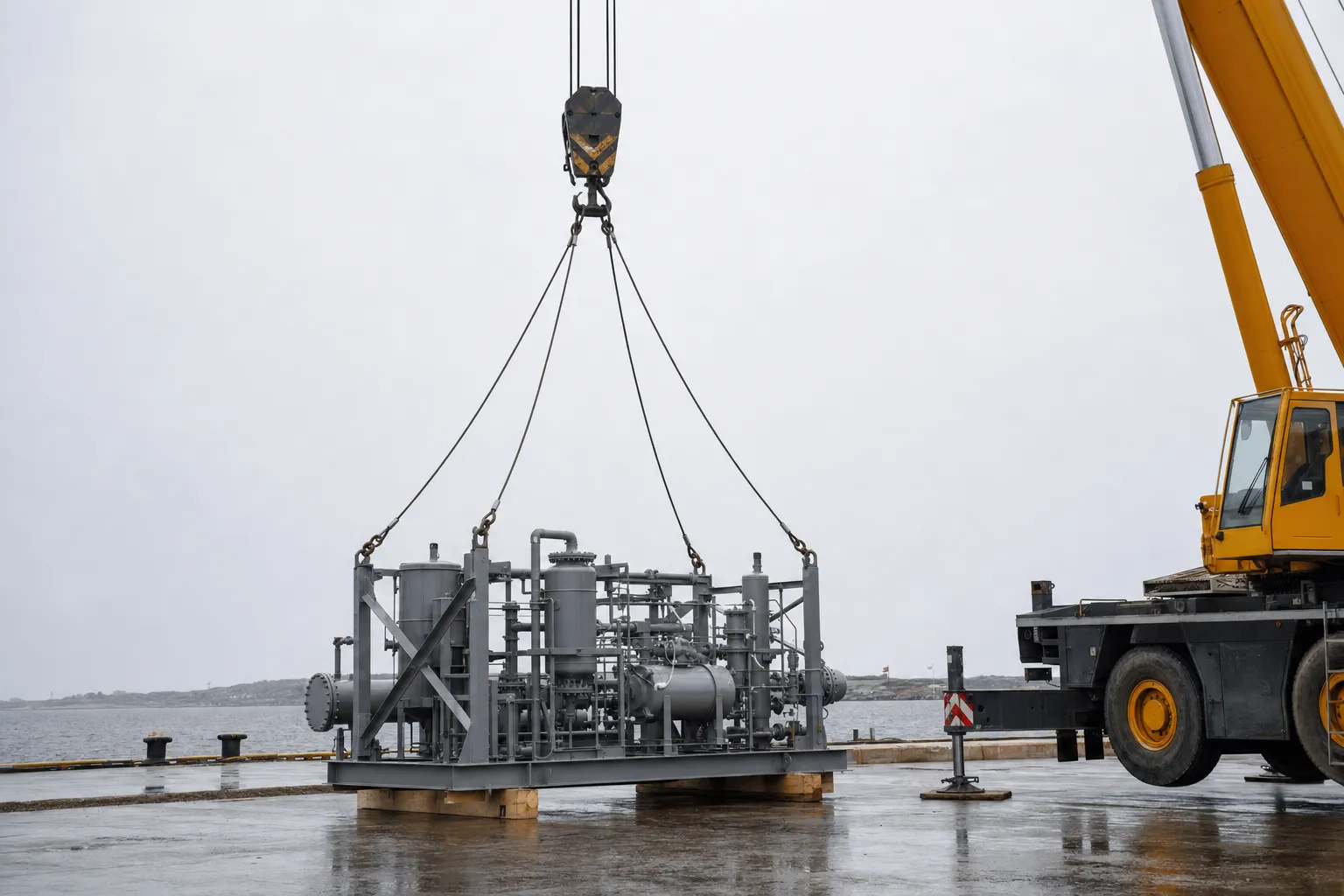
Illustrative: between the quay and the pit, this piece passes through three different custodians.
The failure mode is subtler than a missing document. It is a shipment that was contracted as a shipment and executed as a project. The quotation priced a port-to-port move; the site needed a crane; the crane was arranged verbally by someone who was helping; the crate was stored in a yard for a fortnight because the foundation was not ready. Nothing in that sequence is dishonest, and the responsibility for each handover is real — but only if the handovers were written down somewhere. Overweight and oversized cargo covers the equipment side of that decision; the point here is contractual. Every handover point is a place where custody changes, and custody is what a claim is actually about.
This is also where "who is responsible" gets answered before the move rather than after it. Splitting the project into shipments changes how many handovers exist; the sequencing decision and the responsibility map have to be made together, or the second one gets discovered during the first claim.
When something goes wrong, reconstruct the chain instead of arguing about it
Take an invented case, offered as an illustration and not as a client story. A crated machine leaves a Chinese plant, is loaded onto a flat rack, discharged at an Indonesian port and trucked to a site. At the site the crate's frame is cracked and one mounting bracket is bent. Cargo was signed for at the gate without a note.
Four steps will get you further than any phone call.
First, collect every document that names a party. The house bill, the master bill, the delivery note, the packing list, the survey report if one exists, and the booking confirmation. Put them side by side. You are looking for two things: which document you hold, and which party that document names as the contracting carrier.
Second, read the liability clause of the document you hold, not the wording of the quotation. Quotations describe scope and price. The bill of lading describes what the carrier owes when the cargo is damaged, what it is excluded from, and how long you have to notify. Time bars in carriage documents are short, and they run whether or not you are still gathering evidence.
Third, identify who had custody at the moment of damage. Cracks in a crate frame can happen at the plant, in the yard, under the crane, or on the truck. Handover records — gate passes, tally sheets, photos with timestamps — are what turn a suspicion into a claim, and their absence is what turns a claim into a negotiation.
Fourth, check whose insurance responds, and on whose behalf it was bought. Cargo insurance follows the cargo; carrier liability follows the bill of lading; a forwarder's own liability cover follows the forwarder's error. They are three different policies, and a shipper who assumed the forwarder's cover extended to the cargo usually discovers the gap at this exact moment. If the cargo is held at the border rather than damaged, the sequence changes but the logic does not — a hold has its own paper trail.
Document | Who it names | What it proves |
|---|---|---|
House bill of lading | You as shipper, the NVOCC as carrier | Who contracted to carry your cargo |
Master bill of lading | The NVOCC as the line's customer | Why the shipowner is not your counterparty |
Gate pass or tally sheet | The party receiving the goods | Who had custody at that handover |
Survey report | The surveyor and the parties present | The condition at the moment it was recorded |
House bill of lading
Who it names
You as shipper, the NVOCC as carrier
What it proves
Who contracted to carry your cargo
Master bill of lading
Who it names
The NVOCC as the line's customer
What it proves
Why the shipowner is not your counterparty
Gate pass or tally sheet
Who it names
The party receiving the goods
What it proves
Who had custody at that handover
Survey report
Who it names
The surveyor and the parties present
What it proves
The condition at the moment it was recorded
Seven questions to settle before the booking
Each question below maps to one of the four roles, and each has an answer you can check on paper before any cargo moves.
- Which document will I hold at the end — a master bill or a house bill? This decides who your carrier is.
- Who issues it, and in whose name was the booking made? A booking in the forwarder's name is a different contract from a booking in yours.
- Whose trading conditions are on the back of this quotation, and which clause makes you a principal? Ask for the clause, not an assurance.
- Who has custody at each handover, and what record proves it? Plant gate, origin port, vessel, discharge port, yard, site.
- On the Indonesian side, who is the importer of record on the declaration? If it is not your entity, understand whose liability you are borrowing.
- Which parts of this move are separately contracted? Crane, port handling, road permit, storage, survey — each is its own promise.
- If the cargo is damaged in a yard, whose insurance responds first, and what is the notification window?
If you are already holding quotations and cannot answer question one for each of them, the quotes are not yet comparable in the way that matters. Comparing them on scope and document is the next step; comparing totals before that is comparing two different jobs.
Where we sit
We are a forwarder and a coordinator. We do not own vessels, containers or trucks, and we do not operate the ships that carry your cargo: the lines that run them are the carriers, and the bills of lading they issue are theirs. What we do is arrange the parts — ocean and air bookings, the Indonesian-side clearance coordinated with the licensed importer and the broker it appoints, inland movement and site delivery — and tell you, before you book, which document in the chain carries our name and what it obliges us to do.
That is a narrower promise than "we handle everything", and it is the one we can keep. If you are mapping responsibility across a project with several handovers, the project logistics section collects the articles that go with this one.