
Six quotations for one project shipment are rarely six prices for the same job. Knowing how to compare freight quotes means comparing the jobs first and the totals second — because the distance between the numbers is usually a distance in scope, not a difference in margin.
Type the question into a search engine and you land in the American less-than-truckload market. The top result, a guide to accurate freight quotes from the freight data company DAT, describes a quotation as factoring "weight, distance, freight class, and accessorial charges" — a vocabulary that assumes a domestic road network, a published class table, and a journey a truck can finish in a day. None of those four inputs decides a project shipment moving from a Chinese port to a site outside Surabaya. The guides are not wrong. They answer a question about a market where the freight moves on roads inside one country, and the rate is quoted against a table everyone shares.
Project cargo has no shared table. A nine-tonne skid with a lifting frame is not a class of goods; it is a piece with dimensions, a centre of gravity, a set of lifting points, and a route that has to be surveyed before anyone can promise it will fit. So the useful skill here is not finding more quotes. It is making the quotes you already have comparable — and knowing which parts of a quotation are not prices at all.
This article prints no freight rate, no duty figure, no tax amount and no percentage, and it promises no clearance or delivery date. Every scenario in it is illustrative — not a client case and not a quotation. Nothing here is customs, tax or legal advice, and nothing here makes us the importer of record: on the Indonesian side we assist and coordinate with the licensed importer and the broker it appoints.
Why the cheapest quote is usually the smallest one
A lower total is almost always evidence of a narrower job, and there are only four ways to narrow it. Each one is worth recognising on sight.
The scope stops earlier. One quote runs from your supplier's gate to the site; another starts when the container is already at the port. Both are honest. Only one covers the trucking you will otherwise buy separately, at a price you cannot compare because you never competed it.
The cargo was described as simpler than it is. If your request mentioned a machine and the quotation priced a machine, nobody has priced the lifting frame, the out-of-gauge dimensions or the crane window at the receiving end. The quote is not cheap; it is unfinished.
The price belongs to a moment. Freight markets move, and UNCTAD's Review of Maritime Transport 2025 is subtitled "staying the course in turbulent waters" for a reason. A quotation with no stated expiry is not a stable price. It is a price someone will renegotiate when the market moves, and you will be the one absorbing the correction.
The risk sits outside the price. Storage when the site is not ready, examination at the border, a crane that waits, packing that has to be rebuilt — none of these are in a total that never mentioned them. They are not hidden fees either. They were simply never priced, which is a different problem with the same invoice.
Put those four together and the order of work becomes obvious. Compare what each quote covers before you compare what each quote costs. The total is the last line you read, not the first.
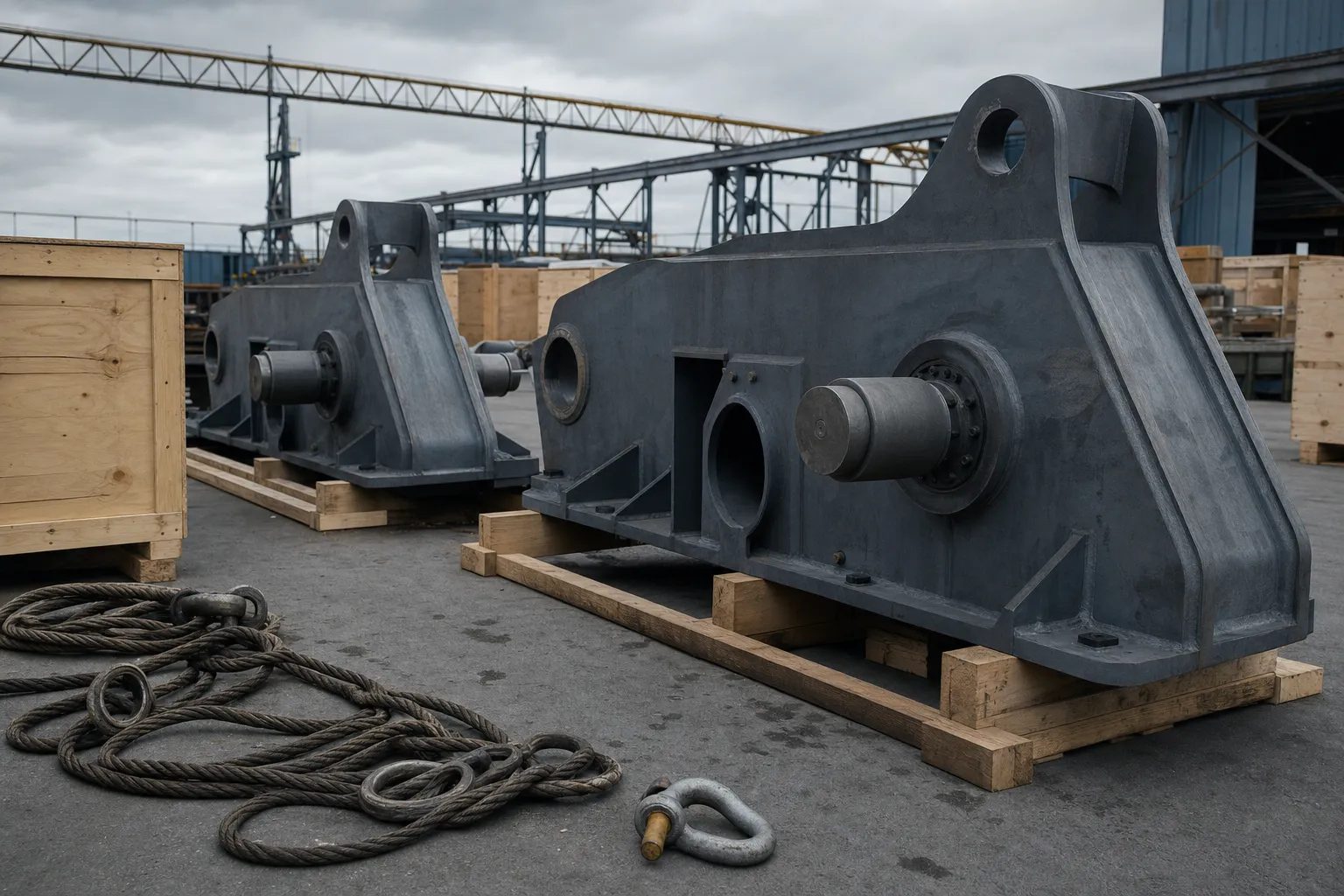
Illustrative: the cargo description decides the quote more than any negotiation does.
Write the cargo down before you ask for a price
A quotation is an answer, and an answer is only as comparable as the question behind it. Most of the gap between two project quotes is created before either supplier opens a rate sheet, in how the cargo was described.
Send the same written brief to every candidate. Not a phone call, not a photograph of a nameplate with "approximately" attached — a document, so that each supplier answers the same question.
What to record | Why the quotation depends on it |
|---|---|
Every piece, with length, width and height as packed, including pallets, crates, skids and any protruding frame | Volume, container fit, lifting plan and whether the piece is out of gauge |
Gross weight per piece and total, from a weighbridge or the manufacturer's data, not an estimate | Which unit the price is applied to, and whether a standard container is legal to load |
Lifting points and centre of gravity, marked on a drawing | Crane selection at both ends, and whether a standard spreader can pick it up |
Whether it can be stacked, rotated or laid down | Container loading, flat rack lashing, and whether the cheapest arrangement is permitted |
Product description and HS code, with the state of the goods (new, used, disassembled, sample) | Which documents the entry needs, and whether a licence or permit applies |
Who will import, and under which registration | Whether the shipment can be declared at all in the structure you have in mind |
The delivery point, with access, ground conditions, gate width and unloading equipment | The inland leg, and whether a crane or a forklift has to be arranged separately |
The window you actually need, and the trade term the sale is written on | Which routing is available, and who is responsible for each leg |
Every piece, with length, width and height as packed, including pallets, crates, skids and any protruding frame
Why the quotation depends on it
Volume, container fit, lifting plan and whether the piece is out of gauge
Gross weight per piece and total, from a weighbridge or the manufacturer's data, not an estimate
Why the quotation depends on it
Which unit the price is applied to, and whether a standard container is legal to load
Lifting points and centre of gravity, marked on a drawing
Why the quotation depends on it
Crane selection at both ends, and whether a standard spreader can pick it up
Whether it can be stacked, rotated or laid down
Why the quotation depends on it
Container loading, flat rack lashing, and whether the cheapest arrangement is permitted
Product description and HS code, with the state of the goods (new, used, disassembled, sample)
Why the quotation depends on it
Which documents the entry needs, and whether a licence or permit applies
Who will import, and under which registration
Why the quotation depends on it
Whether the shipment can be declared at all in the structure you have in mind
The delivery point, with access, ground conditions, gate width and unloading equipment
Why the quotation depends on it
The inland leg, and whether a crane or a forklift has to be arranged separately
The window you actually need, and the trade term the sale is written on
Why the quotation depends on it
Which routing is available, and who is responsible for each leg
Two entries on that list decide more than the rest, and both are routinely left vague.
The importer. Indonesia's entry is built on the importer's own identity: the registration and the licence belong to the importing entity, and the International Trade Administration's country guide to Indonesian import requirements treats both as conditions of entry, with documents filed ahead of arrival rather than produced at the quay. That is why the question belongs in the brief. A supplier pricing a shipment without knowing which entity will declare it is pricing something that may not be declarable as described. What has to be agreed before the first booking covers that conversation in full; the point here is narrower — the answer changes the quote, so it belongs in the brief.
The delivery point. "Jakarta" is not an address. A site with a weighbridge, a hardstanding and a forklift is a different job from a site where the last kilometre is a village road and the crane has to be booked for a fixed window. Quotes that look far apart usually diverged here.
The five lines that decide comparability
If you only get five things right, make them these: the largest piece's dimensions as packed, the total gross weight, whether the cargo fits a standard container, who the importer will be, and the exact delivery point. Two quotes that agree on those five are comparable enough to argue about. Two that do not are not quotes for the same shipment, whatever the totals suggest.
Normalise the scope: where a quote starts and stops
Scope is the part of a quotation that is never written on the summary line, and it is where most comparisons fail. Ask every candidate to mark each line below as inside the price, billed separately, or not applicable — in writing, in the same order.
The line | What it covers | The question to ask |
|---|---|---|
Origin handling and trucking | Collection from the supplier, loading, and transport to the origin port or airport | Does the price start at my supplier's gate or at the terminal? |
Export declaration | The export side formalities in the country of origin | Who lodges it, and is it in this price? |
Main carriage | The ocean or air leg itself | Is this direct or does it tranship, and is the connecting leg inside the price? |
Origin port charges | Terminal handling, documentation and any local fees at the loading port | Are these inside the freight or invoiced separately? |
Destination terminal charges | What the terminal at the arrival port charges to release the cargo | Who pays these, and are they fixed or estimated? |
Import entry and clearance | Lodging the declaration, responding to queries, attending examination | Is clearance in scope, and through which entity? |
Inland haulage and delivery | Transport from the arrival port to the site | Is delivery to site included, or only to the port? |
Unloading at site | Crane, forklift or labour to take the cargo off the vehicle | Who provides it, and is waiting time priced? |
Cargo insurance | Cover for loss or damage in transit | Is cover included, whose policy is it, and at what declared value? |
Contingency | Storage, demurrage or detention, examination, rework | Which of these are inside the price, and which are billed as incurred? |
Origin handling and trucking
What it covers
Collection from the supplier, loading, and transport to the origin port or airport
The question to ask
Does the price start at my supplier's gate or at the terminal?
Export declaration
What it covers
The export side formalities in the country of origin
The question to ask
Who lodges it, and is it in this price?
Main carriage
What it covers
The ocean or air leg itself
The question to ask
Is this direct or does it tranship, and is the connecting leg inside the price?
Origin port charges
What it covers
Terminal handling, documentation and any local fees at the loading port
The question to ask
Are these inside the freight or invoiced separately?
Destination terminal charges
What it covers
What the terminal at the arrival port charges to release the cargo
The question to ask
Who pays these, and are they fixed or estimated?
Import entry and clearance
What it covers
Lodging the declaration, responding to queries, attending examination
The question to ask
Is clearance in scope, and through which entity?
Inland haulage and delivery
What it covers
Transport from the arrival port to the site
The question to ask
Is delivery to site included, or only to the port?
Unloading at site
What it covers
Crane, forklift or labour to take the cargo off the vehicle
The question to ask
Who provides it, and is waiting time priced?
Cargo insurance
What it covers
Cover for loss or damage in transit
The question to ask
Is cover included, whose policy is it, and at what declared value?
Contingency
What it covers
Storage, demurrage or detention, examination, rework
The question to ask
Which of these are inside the price, and which are billed as incurred?
The bottom two rows are the ones that decide the real comparison, and they are the two most quotations leave blank. A price that excludes storage is not wrong — storage is genuinely hard to price in advance. But an exclusion is a commercial term in its own right: it belongs on the quotation, where it can be compared, not on an invoice three months later.
Two decisions sit above this table and change who is responsible for each row. The first is the trade term the sale is written on: the ICC's Incoterms rules are what allocate delivery, cost and risk between you and your supplier, so a quote that ignores your term is quoting someone else's shipment. The second is whether the move is structured as DDP, DDU or single clearance, which decides whether the import side is inside the price or beside it. Neither question is about money. Both change the number.
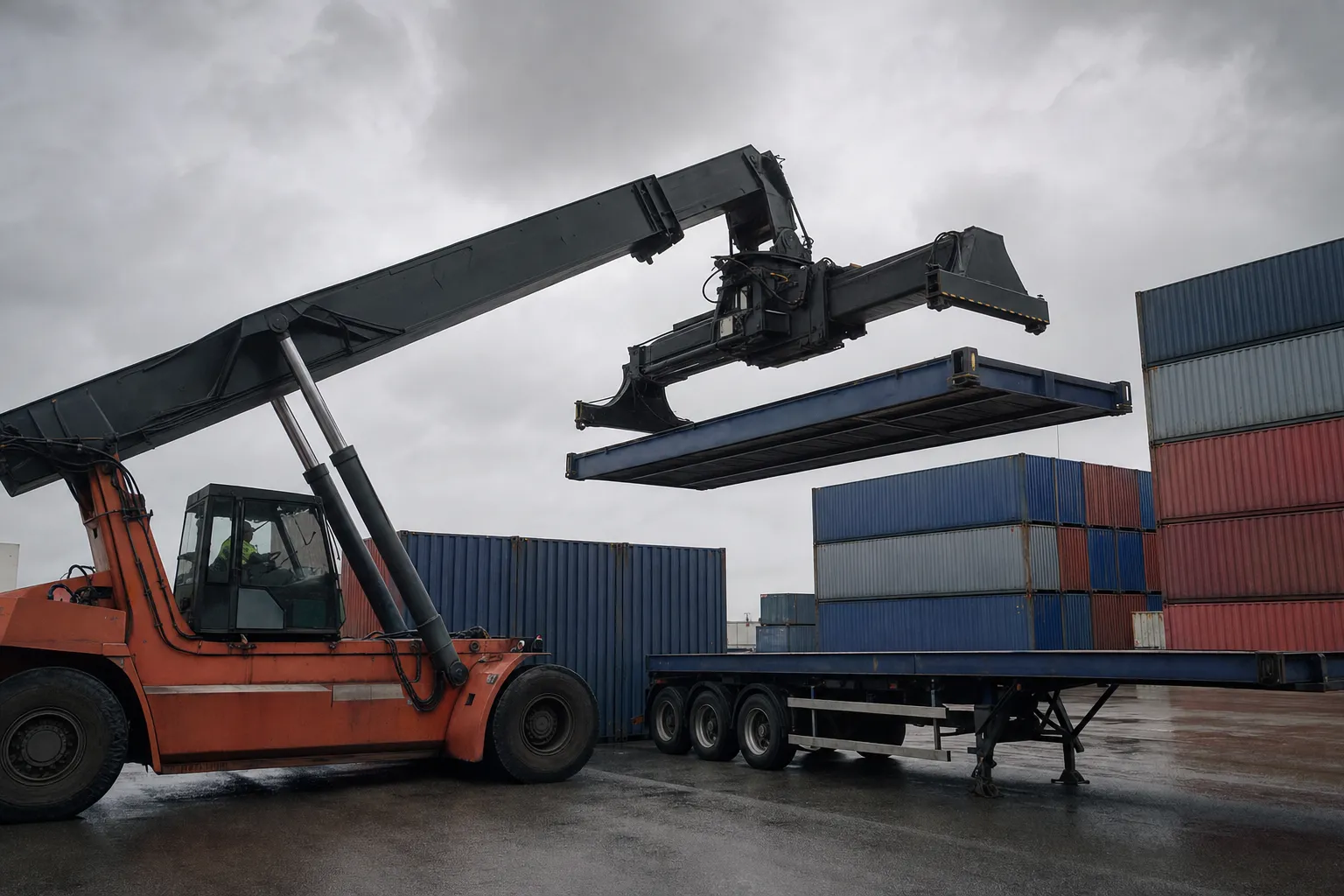
Illustrative: the same move, priced from two different starting points.
Weight, volume and the unit the price is built on
Even with identical scope, two quotes can be arithmetically incomparable, because freight is priced on different units depending on how the cargo moves. A full container is priced per container. Consolidated cargo is priced on a revenue ton — whichever is greater, the weight or the space the cargo occupies. Air freight is priced on a chargeable weight derived from a density convention. Breakbulk and heavy lift are often priced per piece, per lift, or per shipment.
If one supplier priced your cargo per container and another priced it per revenue ton, the two totals describe different commercial arrangements, and the cheaper one may simply be the one that assumed your cargo would fit. Ask, in writing: which unit is this price applied to, and which figure did you use for my cargo?
That second half of the question is the one that catches people. The billed quantity comes from the dimensions and weights you supplied, and those are usually the supplier's estimate rather than a measurement. A crate that adds a frame, a pallet that overhangs, a machine that cannot be stacked — each one changes the billed quantity without changing the cargo. How chargeable weight is calculated explains the conventions mode by mode; the comparison rule is simpler: make every supplier state the quantity it priced, then check they all used the same one.
There is a threshold question underneath this, and it is worth settling before you collect quotes at all. Below a certain volume and weight, consolidation is the cheaper structure; above it, a container of your own usually is, and the crossover depends on your cargo's density rather than its value. A supplier that quotes both structures without being asked has understood the shipment. One that quotes only the structure it prefers has answered a question you did not ask.
Surcharges that only appear on project cargo
Every freight market has surcharges. Project cargo has a set that general guides never mention, because the guides were written for cargo that fits in a standard trailer.
- Heavy lift and crane hire, at one end or both. The lift is a separate service with its own equipment, its own operator and its own waiting charges.
- Out-of-gauge handling. A piece that does not fit the internal dimensions of a container travels on a flat rack or an open top, or as breakbulk, and the equipment is priced differently from a box.
- Lashing, securing and surveying. Project cargo is usually surveyed before loading, and the survey is a cost with a name.
- Standby and waiting time. A crane booked for a window that the cargo misses is still a crane you pay for.
- Port congestion and peak-season adjustments. These move with the market and are usually quoted as an adjustment rather than a fixed line.
- Document amendments. A corrected packing list or a changed consignee after the declaration is lodged is work someone has to do twice.
- Permits and escorts on the inland leg. Whether a load needs one depends on its dimensions and the route, and the answer is confirmed per shipment rather than assumed.
The point is not that these charges are unreasonable. They are the price of the cargo you actually have. The point is that a quote without them is not a cheaper quote — it is an incomplete one, and the missing lines will arrive later, when you have less room to negotiate. Overweight and oversized cargo covers how the equipment choice follows from the dimensions.
Ask one question about all of them at once: which of these are inside your price, which are billed as incurred, and what triggers each one? A supplier that can answer line by line has priced your shipment. A supplier that answers "all included" has either priced it carefully or not read it.
Exclusions, and the money that arrives after arrival
The most expensive words in a quotation are the ones that describe what happens when something goes wrong, because that is where the exclusions live.
Storage and demurrage begin when cargo sits longer than the terminal allows. Detention begins when equipment is held longer than the carrier allows. Examination begins when the border decides to look, and it carries its own costs — moving the container, opening it, repacking it, and the days it spends waiting. Rework begins when packing turns out to be inadequate for the handling it received. Each one is a real cost with a real owner, and the owner is usually the importer, whether or not the quotation said so.
Why cargo gets held at Indonesian customs sets out the triggers; the comparison lesson is that a quote should state who bears these costs when they occur, not just that they are excluded. "Excluded" without an owner is an argument waiting to happen.
There is a second exclusion that matters more on project cargo than on consumer goods: abandonment. If a shipment cannot be cleared, or the cost of recovering it exceeds its value, the cargo can end up stored, re-exported or destroyed, and someone pays for all three. Nobody puts that in a quotation. It is worth asking whether the supplier has seen it happen and what was done — not because the answer is comfortable, but because the answer tells you whether you are talking to an operator or a booking desk.
Illustrative: waiting is free until it isn't, and the invoice names the importer.
Validity, liability and insurance: three terms that change the number
Three lines in a quotation are not costs at all. They are conditions, and each one can move the effective price more than a negotiation will.
Validity
A freight price is a price for a window, not a price forever. Ask for the expiry date in writing, and ask what voids it early: space on a specific sailing, equipment availability, a fuel adjustment, a currency movement, a change in the cargo. A quotation that says "valid until" without saying "void if" is half a term.
This is a place where a supplier can be concrete, and the concreteness is itself a signal. On our own quotations, a routine sea freight offer holds to the Friday of the week it is issued, and an air freight offer is confirmed at the rate available on the day of booking. Those are not generous terms; they are honest ones, and they tell you when to expect the number to move.
Liability
The party you pay is not always the party that is liable, and the limit of that liability is almost never the value of your cargo. A carrier's liability is governed by the contract of carriage and the rules behind it; a forwarder acting as an agent is liable for its own service under its terms, not for the cargo as an insurer would be. The International Trade Administration's description of forwarders is that of an agent acting for the exporter: arranging carriage, consolidating cargo, preparing documents and tracking the move. An agent in that sense does not take title to the goods. That is precisely the role which does not carry cargo risk. The forwarders' own federation, FIATA, represents national associations in some 150 countries; having a federation does not turn an agent into a carrier.
So when a quotation is silent on liability, the silence is not neutral. It means the default applies, and the default is a limitation. If the cargo is worth more than the limitation, the difference has to be covered somewhere else — which is the next line.
Insurance
Ask three questions and write the answers down: whose policy covers this shipment, at what declared value, and who files the claim if a crate arrives crushed. The three answers are usually "the forwarder's", "the invoice value", and "nobody knows", and each one is a decision you can still change.
The trade term matters here too. Under the ICC rules, some terms require the seller to arrange cover and others do not, and the level of cover required differs between them. A quote that includes insurance without saying what it covers is a line item, not a protection. Choosing a freight forwarder goes further into what to demand as evidence at this stage.
How to compare freight quotes on one page
Most of what is above collapses into a single table. The full cargo description does not compress into a cell — that is the document you send before anyone quotes — but the first row records what each supplier actually priced from it. Print the table, or copy it into a spreadsheet with one column per supplier, and fill it in the same order for every quote. The order matters: a row you cannot fill is a finding, not an inconvenience.
The line to record | What "good" looks like | Quote A | Quote B | Quote C |
|---|---|---|---|---|
Cargo and importer basis | The packed dimensions and weights actually priced, and the entity that will declare | |||
Scope boundary | A stated start point and end point, in named places | |||
Billed quantity and unit | The figure priced, and the unit it is applied to | |||
Surcharges | Each one listed, inside or as incurred | |||
Exclusions and triggers | Named, with who bears each cost | |||
Validity | An expiry date and the conditions that void it | |||
Liability basis | Which party, under which terms, with what limit | |||
Insurance | Whose policy, what value, who claims | |||
Transit statement | Start, end, mode and exclusions — not a single figure |
Cargo and importer basis
What "good" looks like
The packed dimensions and weights actually priced, and the entity that will declare
Quote A
Quote B
Quote C
Scope boundary
What "good" looks like
A stated start point and end point, in named places
Quote A
Quote B
Quote C
Billed quantity and unit
What "good" looks like
The figure priced, and the unit it is applied to
Quote A
Quote B
Quote C
Surcharges
What "good" looks like
Each one listed, inside or as incurred
Quote A
Quote B
Quote C
Exclusions and triggers
What "good" looks like
Named, with who bears each cost
Quote A
Quote B
Quote C
Validity
What "good" looks like
An expiry date and the conditions that void it
Quote A
Quote B
Quote C
Liability basis
What "good" looks like
Which party, under which terms, with what limit
Quote A
Quote B
Quote C
Insurance
What "good" looks like
Whose policy, what value, who claims
Quote A
Quote B
Quote C
Transit statement
What "good" looks like
Start, end, mode and exclusions — not a single figure
Quote A
Quote B
Quote C
A blank cell is the most useful thing on the page. It tells you which supplier has not thought about the shipment, and it gives you the one question worth asking before you talk about money at all.
Eight questions to send with the worksheet. These are about the document, not the company — a different set from the ones you would ask when shortlisting a partner.
- What is the exact start point and end point of the price you have given me, and which entity will declare the import?
- Which unit is the price applied to, and what quantity did you use for my cargo?
- Which surcharges are inside the price, which are billed as incurred, and what triggers each?
- Which costs are excluded, and who bears each of them if it occurs?
- What is the expiry date, and what would void the price before then?
- If my cargo is damaged or lost, which party is liable, under which terms, and who files the claim?
- Is insurance included; if so, whose policy, at what declared value, and what does it not cover?
- What is your transit statement for this routing, including its start, end and exclusions?
Then, and only then, put the totals side by side. An invented illustration of why the order matters — not a client case and not a quotation: one supplier prices the move from the origin terminal with clearance and delivery inside the price; another prices it from the supplier's gate and stops at the arrival port, with clearance and delivery excluded. The second total looks lower. It is lower because it is a smaller job, and the two lines it left out are the two you cannot buy cheaply at short notice. Filling the worksheet takes an hour and settles the argument before it starts.
Where we sit
We are Yanchao, an asset-light coordinator on the China–Indonesia lane, and we say so plainly: no vessels, no terminals and no warehouses of our own. The work is assessment before anything is booked, integration of the carriers and Indonesian-side partners a shipment needs, coordination of the sequence from export through entry to delivery, and a single accountable window for the file. On the Indonesian import side we assist and coordinate with the licensed importer and the broker it appoints; we do not declare in your name and we are not the importer of record.
Our standard quotation names what it contains — origin handling, the ocean leg, destination clearance and delivery — and says plainly that duty and any third-party costs arising from an examination sit outside it. Every line is itemised so that it can be compared with someone else's, which is the only reason to itemise it.
If you are holding three quotes and cannot tell which one is complete, the useful thing to send is the profile rather than a request for a fifth quotation: the pieces and their packed dimensions, the weights, the state of the goods, the entity that will import, and the address the cargo has to reach. What happens after the signature — sequencing, site readiness, the documents that travel with the cargo — is covered by the other project cargo guides in this section.