
Project cargo planning is not a schedule. It is six written allocations of obligation — the cargo envelope, the scope split, the named place and handover point, what starts the clock, one document set, and the exception path — and those six decide whether a first shipment arrives at a site that can receive it.
Ask several forwarders what project cargo planning involves and you will get versions of the same sequence: survey the route, measure the cargo, book the vessel, clear it at the destination, deliver it to site. None of that is wrong. It is the visible half of the work — the half that happens after the decisions have already been made.
A first project cargo shipment is not planned by building that sequence. It is planned by writing down six allocations of obligation, because the sequence only holds if someone has already answered who measures, who books, who declares, who unloads and who pays when a piece arrives different from the drawing. Where those answers stay in an email thread, they get renegotiated at the worst possible moment: at the port, with the cargo already landed.
This article quotes no freight rate, duty rate, tax figure, percentage or currency amount, and promises no clearance, sailing or delivery date. Every example in it is illustrative — not a client case and not a quotation. Nothing here is legal, tax or customs advice: what a given arrangement permits for your entity and your goods is decided by Indonesia's authorities and by the licensed parties you appoint, not by a sales term or by this page.
Project cargo planning is a set of agreements, not a schedule
The schedule is the output. The agreements are the input, and they are duller than the schedule, which is why they get skipped on a first project: nobody has run one before, so there is no earlier dispute to learn from and no template to inherit. That is the difference between project cargo logistics and a container booking, and it is not a difference in distance.
Three properties make that difference real.
It is indivisible: a module cannot be re-cut to fit a smaller crane or a different trailer, so the equipment follows the cargo rather than the other way round. It is early: the vessel class, the discharge port and the inland route are committed long before the goods exist in physical form, so the plan is made against drawings and packing lists. And it is consequential: when an ordinary consignment slips, someone rebooks; when a module slips, a commissioning date moves, and the cost of that lands on whoever failed to sequence it — a contract question before it is a logistics question.
So the useful question in a first-project conversation is not "how long will it take". It is which of the six decisions below has an answer, in writing, and who gave it.
Six things that get decided whether or not you write them down
Every project cargo planning exercise carries the same six decisions, whatever the cargo. If you do not write them down, they still get made — by default, by whoever is closest to the problem when it appears.
Decision | Who usually ends up answering it | What a usable written answer looks like |
|---|---|---|
1. The cargo envelope | Supplier, with your engineering team | Every piece dimensioned as it will actually travel — outer packing included — plus weight, centre of gravity and lifting points, and an agreed allowance for what may change at packing |
2. The scope split | Whoever writes the purchase order | A line-by-line allocation: collection, export handling, main carriage, destination clearance, duties and import charges, inland movement, unloading. Each line has one owner |
3. The named place and the handover point | You, as the receiving party | A full address, the exact point the carrier's responsibility ends, and what happens to the cargo at that point — including who brings lifting equipment |
4. What starts the clock, and what is excluded | Forwarder, accepted by you | The trigger event named explicitly (booking confirmation, cargo ready, vessel departure), the exclusions listed, and the conditions under which the interval is re-set |
5. One document set | Supplier, you and the forwarder, jointly | Invoice, packing list, bill of lading and any certificate describing the same goods, quantities and weights — with the tariff classification agreed before, not after |
6. The exception path | Nobody, by default | Who is called first, who decides, who authorizes extra cost, and how quickly each of those happens |
1. The cargo envelope
Who usually ends up answering it
Supplier, with your engineering team
What a usable written answer looks like
Every piece dimensioned as it will actually travel — outer packing included — plus weight, centre of gravity and lifting points, and an agreed allowance for what may change at packing
2. The scope split
Who usually ends up answering it
Whoever writes the purchase order
What a usable written answer looks like
A line-by-line allocation: collection, export handling, main carriage, destination clearance, duties and import charges, inland movement, unloading. Each line has one owner
3. The named place and the handover point
Who usually ends up answering it
You, as the receiving party
What a usable written answer looks like
A full address, the exact point the carrier's responsibility ends, and what happens to the cargo at that point — including who brings lifting equipment
4. What starts the clock, and what is excluded
Who usually ends up answering it
Forwarder, accepted by you
What a usable written answer looks like
The trigger event named explicitly (booking confirmation, cargo ready, vessel departure), the exclusions listed, and the conditions under which the interval is re-set
5. One document set
Who usually ends up answering it
Supplier, you and the forwarder, jointly
What a usable written answer looks like
Invoice, packing list, bill of lading and any certificate describing the same goods, quantities and weights — with the tariff classification agreed before, not after
6. The exception path
Who usually ends up answering it
Nobody, by default
What a usable written answer looks like
Who is called first, who decides, who authorizes extra cost, and how quickly each of those happens
Two rows carry most of the risk, and neither is the one people worry about.
Row three is where first shipments fail quietly. "Delivery to site" is not a place; it is a set of conditions — a gate wide enough for the trailer, ground that bears the load, a crane or forklift with the reach and capacity, someone authorized to sign when the truck arrives. If the receiving plan assumes equipment that lives at another plant, the shipment ends on the road.
Row six is the row with no natural owner, so it gets written last, if at all. The test is simple: name the person who will decide, on a Saturday, whether to pay for a crane that was not in the plan. If the answer is "we will figure it out", that is the decision — made by default.
Row two deserves its own note, because "we handle everything" is the most common way a scope split disappears. What a door-to-door scope actually prices, and where it stops is worth reading before a first purchase order is issued, not because the answer is unusual but because the boundary is.
Whose side of the border the import job falls on
For a shipment into Indonesia, the largest single allocation is not the freight. It is who stands behind the import declaration.
A project shipment meets a customs framework that does not care what the cargo is worth to the project: the entry is lodged in the name of an importer established in the country, which answers for the conditions attached to the goods and settles what the entry attracts (the customs directorate's own FAQ on imports for use). US Commercial Service guidance on Indonesian import requirements points the same way on the documentation side, listing an Import Identification Number (API) and the appropriate import licence among what that importer must hold (Indonesia — import requirements and documentation, published November 2025). What a module adds to that is a split the identity rules do not resolve: the commissioning contract, the site lease and the payment can sit with three different parties, so the entity named on the entry has to be the one that can still produce the documents on the morning the sections arrive.
So the planning question is concrete: which Indonesian entity will be named, and does it hold what the goods require?
What has to be settled | Whose answer it is | What it changes |
|---|---|---|
The term on the purchase order — FCA, DAP, DDP or an arrangement of your own | You and your supplier, at order stage | Who performs and pays for the import formalities. The ICC Academy's explainer of DAP against DDP turns on exactly this (DAP or DDP under Incoterms 2020) |
Who is the importer of record | You, or an Indonesian party you appoint | Whose name, licence and record the entry is filed against, and who answers for it afterwards (who may hold that declaration) |
Whether the goods are prohibited, restricted or quota-controlled | The licensed party, checked against the current list | Whether the cargo may enter at all, before any transport question is worth answering (how to check restricted status) |
The tariff classification | The declaring party, confirmed with the authority | What the entry is assessed on, and whether the documents describe the goods the way the border will read them (how classification is decided) |
The term on the purchase order — FCA, DAP, DDP or an arrangement of your own
Whose answer it is
You and your supplier, at order stage
What it changes
Who performs and pays for the import formalities. The ICC Academy's explainer of DAP against DDP turns on exactly this (DAP or DDP under Incoterms 2020)
Who is the importer of record
Whose answer it is
You, or an Indonesian party you appoint
What it changes
Whose name, licence and record the entry is filed against, and who answers for it afterwards (who may hold that declaration)
Whether the goods are prohibited, restricted or quota-controlled
Whose answer it is
The licensed party, checked against the current list
What it changes
Whether the cargo may enter at all, before any transport question is worth answering (how to check restricted status)
The tariff classification
Whose answer it is
The declaring party, confirmed with the authority
What it changes
What the entry is assessed on, and whether the documents describe the goods the way the border will read them (how classification is decided)
Three notes on reading that table.
The Incoterm is not a level of service. Incoterms 2020 allocates tasks, cost and risk between a seller and a buyer. It says nothing about which vessel, which route, or how carefully a module is secured. Two quotations can carry the same term, the same destination and completely different plans.
Risk has to sit somewhere between the two of you, and the term only decides where it sits until the cargo is handed over. A marine cargo policy, a single-shipment certificate and a carrier's own liability limit are three different protections, and a project piece is usually worth more than the carrier's limit will answer for. Before the booking, settle four things in writing: who insures the main carriage and who insures the inland leg, the point at which each cover starts and stops, whether the cover describes the actual piece rather than a generic commodity, and whether the receiving site's contractor policy is expected to respond once the handover is signed.
"The forwarder has a licence" is not an answer to the importer question. It can be true and still leave the question open, because the licensed party, the authorized party and the party that answers for the declaration afterwards may not be the same entity. Confirm in writing which is which, and confirm it with the licensed party rather than a sales contact — before the vessel is booked, because it decides which documents the supplier has to produce.
Restricted status, or LARTAS, is checked before booking, not after. A first project is usually where a company discovers that one component in an otherwise ordinary shipment needs an approval nobody applied for. That discovery is cheap in a pre-shipment review and expensive on the quay.
On the Indonesian side we assist and coordinate: we do not lodge the declaration ourselves and we are not the importer of record on your shipment. Who does that, and on what registration, is settled with the party entitled to act.
The cargo decides the equipment, and the equipment decides the month
The physical envelope is the second big allocation, and the one where an early decision saves the most money.
Four properties of a piece set the equipment class: its dimensions as packed, its weight, its centre of gravity, and where it may legally be lifted. Those four decide whether it travels in a flat rack, on a break bulk or heavy lift deck, or on a multi-axle trailer for the inland leg — and they are what a route survey is actually for: bridge heights, road widths, load limits, overhead lines, and the turning geometry at the gate of the site that will receive it.
This is also where a first-time plan most often over-promises, because equipment availability is not a schedule. A heavy lift or break bulk booking is made against a vessel's advertised range and a confirmed laycan; it moves when the vessel's rotation moves, and it does not move to suit a factory readiness date. On a container the interval between booking and sailing is comparatively stable, which is why people who have only shipped containers assume the same of project cargo. It is not the same. The honest formulation is a conditional range: from a confirmed booking, the sea leg runs on the vessel's schedule; before a booking is confirmed there is no interval to quote, only a sequence of steps that have to happen first.
Two consequences follow.
Out-of-gauge is a design decision, not a nuisance. Whether a module travels as a break bulk piece or is built to fit a flat rack changes the fabrication, the lifting points and the documentation; deciding it late means paying for both versions. How flat racks and open tops extend the container envelope is the boundary between the two approaches.
Readiness cuts both ways. The cargo has to be ready on the date the equipment arrives, and the site has to be ready on the date the cargo arrives. A plan that only sequences the first is half a plan. For a production line, "can the building accept this module" belongs in the same conversation as "which vessel can lift it" — what an imported production line has to satisfy before it ships covers the preparation upstream of the booking.
Documents that have to describe one consignment
Classification and consistency are separate problems that produce the same symptom: cargo held while someone works out what it is.
The consistency problem is mechanical. The commercial invoice, the packing list and the bill of lading have to describe the same goods, in the same quantities, at the same weights, in the same units. A packing list that counts crates while the invoice counts pieces, a weight taken before crating and repeated after, a description that names a component on one document and the finished machine on another — each of these is small, and each is a reason for a border officer to stop and ask.

The classification problem is earlier and harder. The HS classification — the tariff line the entry is assessed under — decides what the entry attracts and which conditions attach to the goods, and for project cargo it is rarely obvious: a machine arriving in sections may be classified as a machine or as its parts, depending on how the shipment is structured and declared. Agree it with the declaring party before the invoice is issued, not after the cargo lands — the invoice is the document everyone else then has to match.
One more rule catches equipment suppliers: solid wood packaging has to meet the international standard for wood packaging material, which is what the IPPC mark on a crate actually certifies (ISPM 15, the regulation of wood packaging material in international trade). Crates built on site from untreated timber are a common, avoidable hold, and the fix costs a conversation rather than a re-fabrication.
What a pre-shipment review checks is the step where these three problems are caught while they are still cheap: classification, document consistency and admission requirements, reviewed together against the goods rather than the paperwork alone.
What the receiving site has to agree to
The destination is the half of a first project that gets planned last, and the half where project managers usually have least control, because the site belongs to someone else: a contractor, a landlord, an EPC package owner.
Six things have to be agreed with whoever holds the site, and each is a physical constraint rather than a formality.
- Access. Gate width and height, the turning circle for a multi-axle trailer, and whether the route inside the estate was ever designed for this weight.
- Ground bearing. A module set down on a slab specified for a forklift is a problem nobody wants to own; the load has to go where the ground can carry it.
- Lifting capacity at arrival. Crane or forklift, with the reach and capacity for the actual piece rather than the piece on the drawing.
- Storage, when arrival and installation do not coincide. Space that is secure, drained and out of the traffic path, and an agreed answer to who pays while the cargo waits.
- The handover event. Who inspects, against what, and who signs. The site handover is the moment responsibility changes hands; without it, damage found on day three has no documented starting point.
- The receiving sequence. Which piece is needed first, which can wait, and whether the site can accept the shipment in the order the vessel delivers it.
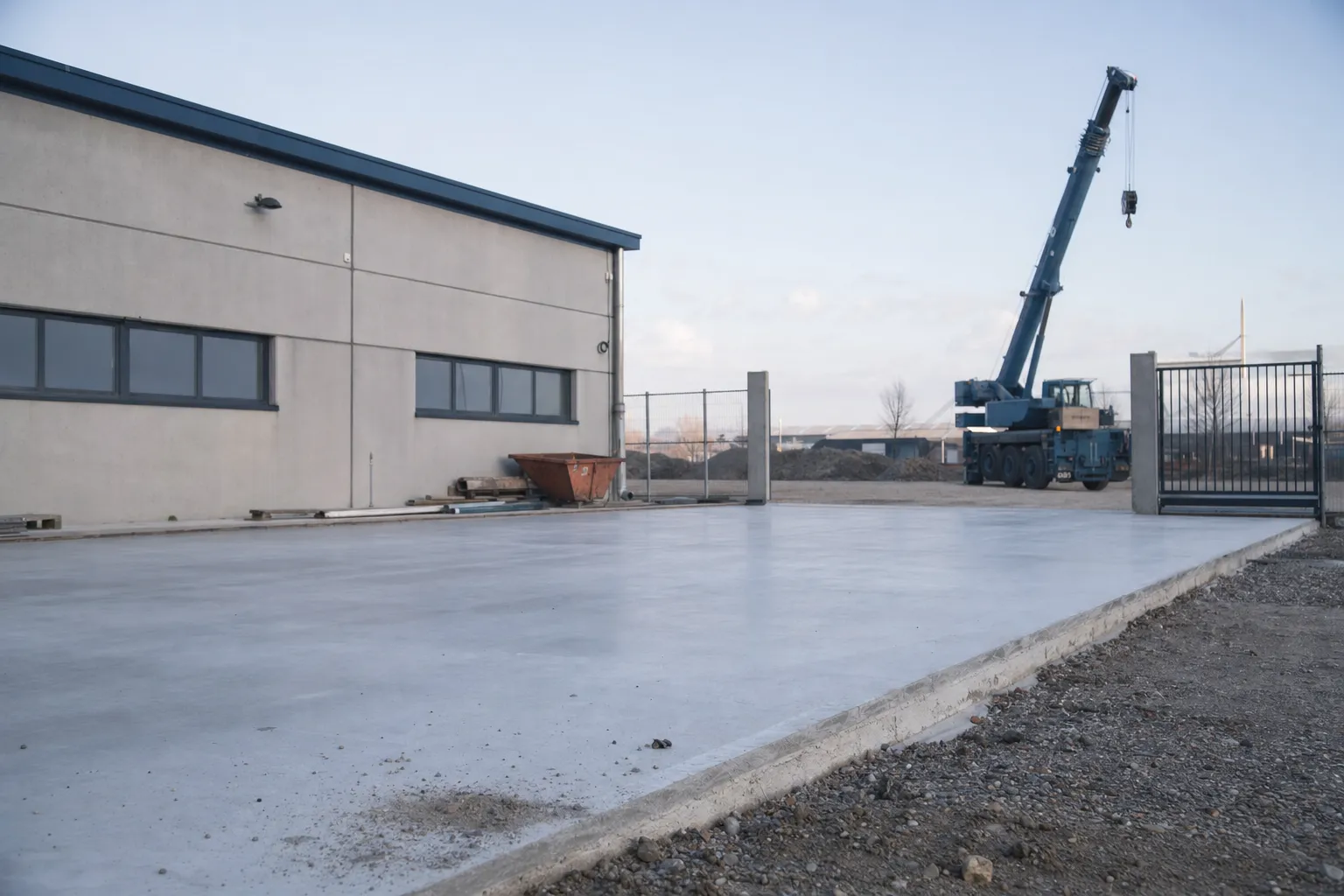
That last point is where batching stops being a shipping decision and becomes a site decision: one shipment arriving before the site can store it is worse than two arriving when they are needed. What matters here is that the receiving side is a party to the plan, with answers, not a destination on a booking.
What no plan can promise
A project plan is a sequence with owners, not a promise with dates. Most project cargo planning effort goes into compressing the interval; the honest work is defining what the interval depends on. Three things move independently of your planning.
The vessel's rotation moves, and a heavy lift or break bulk booking follows it. The customs channel an entry lands in is decided at the border, on the documents and the goods, not at booking. Weather and port congestion affect the discharge and the inland leg in ways no forwarder controls. A plan presenting a delivery date as a commitment is describing its own confidence, not your shipment.
What can be committed to is narrower and more useful: the sequence, the owner of each step, the conditions attached to each interval, and the decision path when one step runs long. That is also what makes an exception manageable — a plan with named owners produces a phone call, a plan without them produces a dispute. Why cargo gets held at the Indonesian border is usually a story about a document or an approval that was never in the sequence at all.
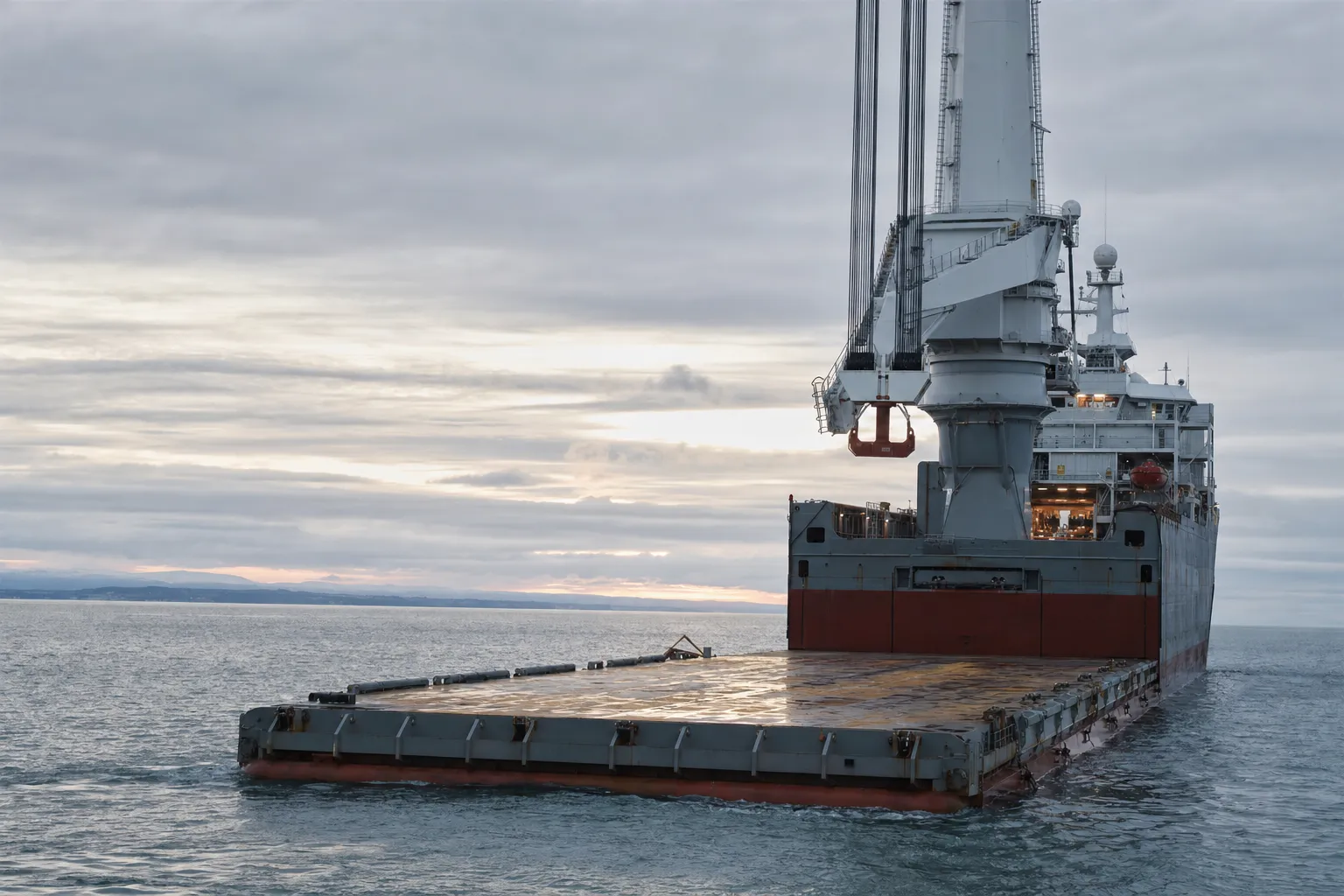
An invented first shipment, planned twice
What follows is a constructed illustration. It is not a client case, and it is not a quotation.
An Indonesian manufacturer buys a production module from a supplier in Guangdong. The module is built in three sections and assembled on site. Assume the purchase order says delivery to the factory, the cargo is ready in the month the supplier promised, and nothing goes wrong with the goods themselves.
Planned by sequence. The forwarder measures the sections at the supplier's yard, books a sailing, collects the cargo and nominates a discharge port. The entry is lodged in the buyer's name. The vessel arrives, the sections are discharged, and the inland carrier quotes for three flat racks. That quote counts from a collection date the forwarder assumed and excludes waiting time at destination, so the days the sections spend in the yard are billed and unowned. At the factory gate the largest section does not fit the turning circle, and the crane on site has the capacity but not the reach. The sections wait at a yard while a bigger crane is hired. Nothing failed technically; three of the six decisions were never written down, and the ones that bit were rows three, four and six.
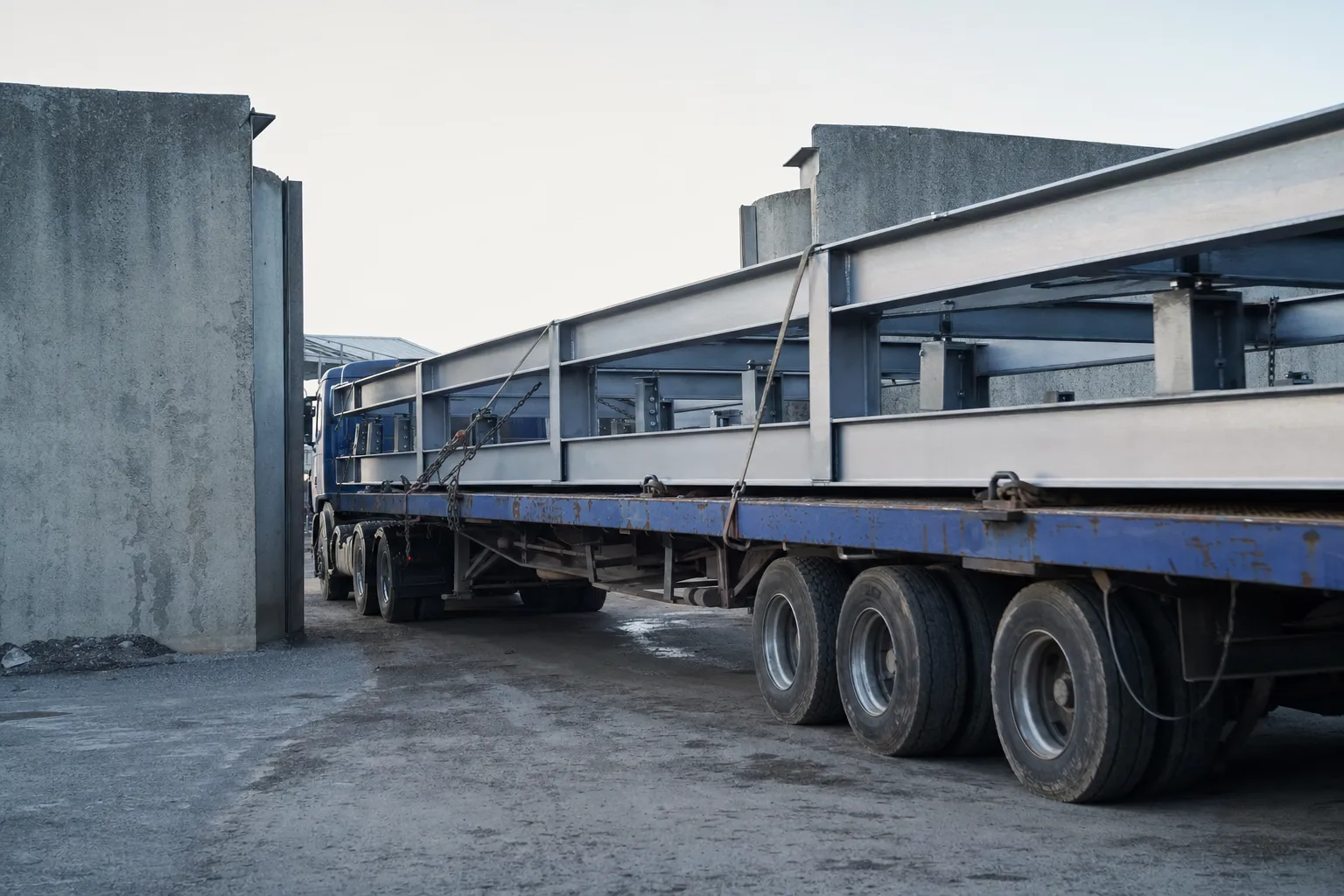
Planned by agreement. The same shipment, with the six rows answered before the booking. The envelope is fixed with outer packing included, and the supplier confirms the lifting points on the drawing. The scope split names who books the vessel, who files the entry and who unloads. A site visit produces a measured gate width and a crane plan, so the third section is scheduled last because it is the one that needs the crane. The document set is issued from one description and one classification. And the exception path names the person who can authorize a bigger crane on a Saturday — so when the vessel's rotation slips, that person moves the crane booking instead of the argument starting.
The difference between the two versions is not effort. It is six written decisions, taken while they were still cheap — which is what project cargo planning actually consists of.
Where we sit
YANCHAO coordinates project cargo from China to Indonesian sites; we do not own the vessels, containers, terminals or warehouses involved, and the collection, the sailing, the clearance, the storage and the local trucking are performed by partners at both ends. What we do is hold the six decisions together: read the cargo against the equipment, check that the documents describe one consignment, keep the Indonesian side with the parties entitled to act, and make sure the receiving site has agreed to what is about to arrive.
We assist and coordinate on the Indonesian import side rather than declaring on your behalf. Where the entry has to be lodged, it is lodged by an Indonesian entity entitled to do it, and the commercial invoice, the packing list and the transport documents have to describe one consignment for any of it to work.
If a first project shipment is approaching, the useful starting point is the cargo list with dimensions and weights as packed, the intended site and its access constraints, who will import, and the term on the purchase order — send those four inputs and the first review starts there. Project logistics coordination covers how those threads are held together in practice. Anything that turns on an authority's decision, a product approval or a restricted-goods check is confirmed after review rather than on a standard turnaround, because that is the honest way to answer it.
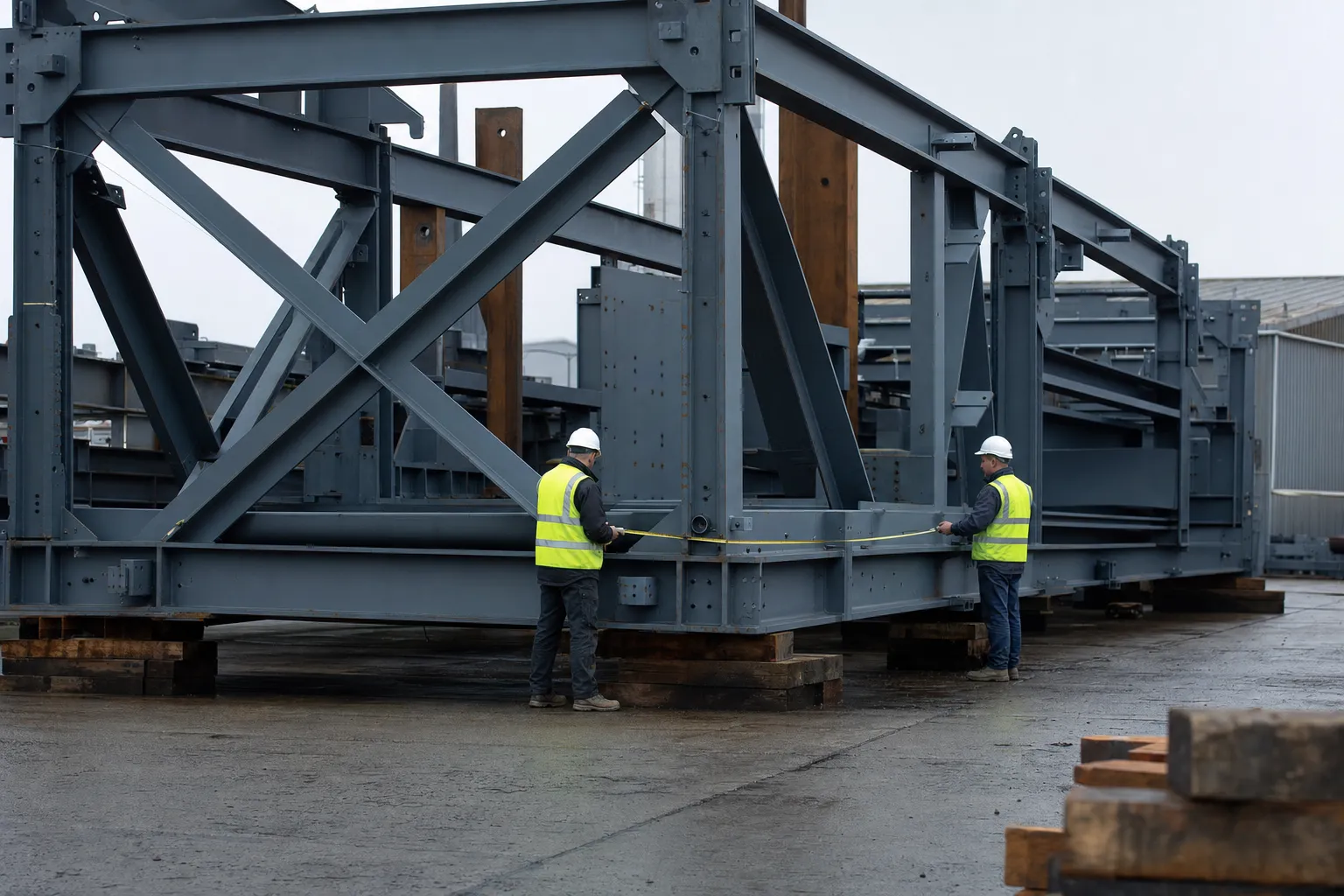
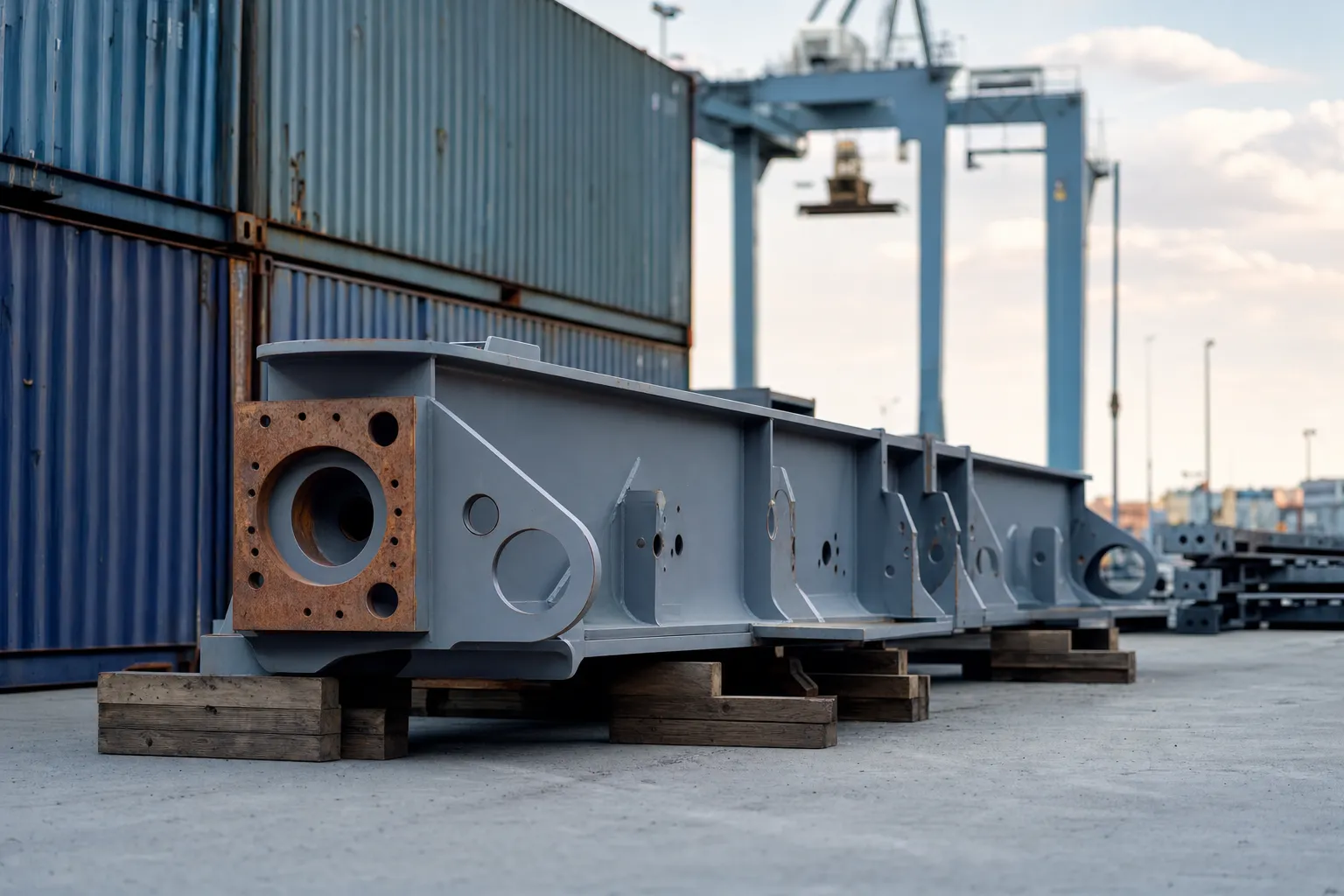
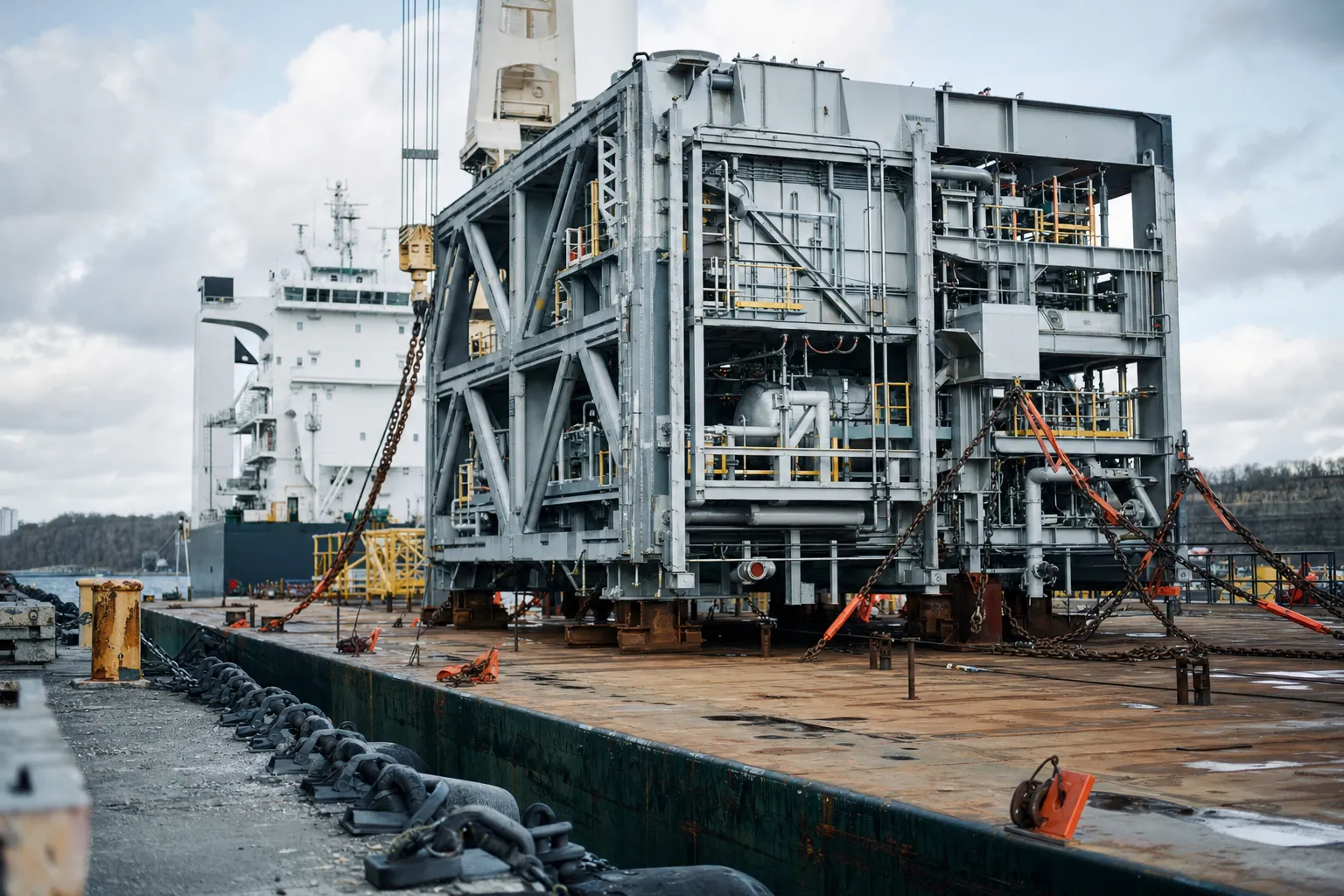
Photographs here are illustrative: a module being measured in a yard, a machine being crated, a break bulk piece in a port laydown area, a module lashed to a deck, a vessel holding offshore at dusk and a site prepared to receive equipment — not client cargo, facilities or personnel, and no ownership of any vessel, container, terminal or warehouse is claimed. The example in this article is a constructed illustration, neither a client case nor a quotation.