
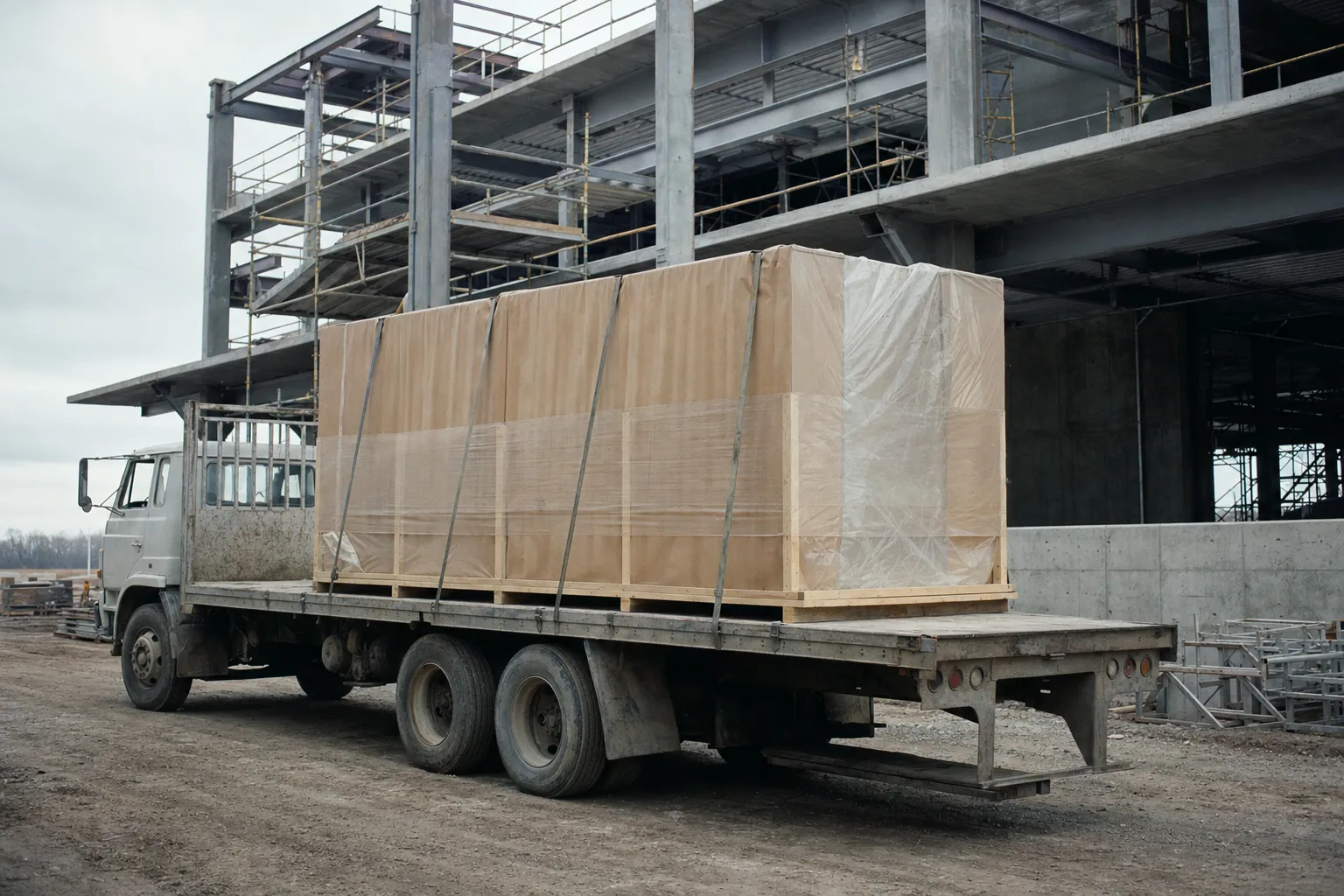
A booking is a set of promises about a ship. The supplier promises a ready date, the carrier promises a slot, the forwarder promises that the documents will agree. None of them promises that the gate will be open when the vehicle arrives, that the forklift works, or that the person standing at the site office is allowed to sign for anything.
That is the gap this page is about. Construction site delivery is usually discussed as a leg of transport — a distance, a vehicle type, a window. In practice a delivery ends in a place that has its own rules, its own hours and its own definition of "received", and none of those are in the booking.
This page quotes no prices. It contains no rate, tariff, tax figure, percentage, compensation amount, free-time count or promised deadline, and every situation described is hypothetical: these are not client cases and they are not quotations. What your site will accept, who carries a cost created at the gate and what a signature is worth are settled by your contract, the site's own rules and the terms agreed for that shipment — never by this page. Nor is it legal advice: the customs sequence referred to below is stated as at November 2026, and the procedure that governs your cargo is the one applied to your declaration.
Construction site delivery is accepted, not merely arrived
Freight language hides this. "Delivered" sounds like a state the cargo reaches, in the way that "shipped" is a state the cargo reaches. But shipping is an event with a document behind it, and delivery is a judgement made by someone standing next to the cargo.
Four parties decide whether a shipment moves on a given day: the shipper who made it ready, the carrier who moved it, customs who permitted it to leave the customs area, and the site that will or will not take it. The first three are in the chain commercially. The fourth is in the chain physically, and is almost never written into the plan — because everyone assumes the site is the customer's problem. It is. That is exactly why it needs a line in the plan rather than an assumption.
Two adjacent questions are worth separating first. When cargo may leave the terminal, and what it costs to leave it sitting there, is a commercial clock covered in planning delivery after customs release. What a door-to-door arrangement includes is a scope question, and the honest answer is that it usually ends where the cargo is handed over, not where it is installed. This page is the third question: whether the place at the end of the journey can physically take what is coming.
The facility is not the address
A delivery address identifies a company. It does not describe a gate. Between the two sit the constraints that decide whether the last leg happens today or next week, and every one of them is answerable in advance by someone at the site.
What has to be confirmed | The question that actually settles it | Who can answer it |
|---|---|---|
The last kilometre of road | Can a laden vehicle of the size we are sending reach the gate without reversing into a live road — and is there a low bridge, cable or arch on the way in? | The haulier, together with the site's own transport contact |
Vehicle-to-gate interface | What did the last delivery arrive on, and will this gate and this yard accept that vehicle empty, let alone loaded? | Site logistics, not the sales contact |
Ground at the unloading point | What point load will the trailer, the crane's outriggers or the forklift put on the surface, and what is that surface rated for? | The site engineer — bearing capacity is a design fact, not an opinion |
Unloading equipment and crew | Who lifts the cargo off, with which machine, and is that machine and its operator free on the day? | The site plant office |
Overhead and side clearance | What is the height and width at the gate, under the canopy, and under any line crossing the yard? | Measured on site, not quoted from memory |
Where the cargo stands afterwards | Which laydown area is it going to, and what is already in it? | The site planner |
Who may accept it | A name, a deputy, and whether either of them can accept a partial delivery | The consignee's own written instruction |
The last kilometre of road
The question that actually settles it
Can a laden vehicle of the size we are sending reach the gate without reversing into a live road — and is there a low bridge, cable or arch on the way in?
Who can answer it
The haulier, together with the site's own transport contact
Vehicle-to-gate interface
The question that actually settles it
What did the last delivery arrive on, and will this gate and this yard accept that vehicle empty, let alone loaded?
Who can answer it
Site logistics, not the sales contact
Ground at the unloading point
The question that actually settles it
What point load will the trailer, the crane's outriggers or the forklift put on the surface, and what is that surface rated for?
Who can answer it
The site engineer — bearing capacity is a design fact, not an opinion
Unloading equipment and crew
The question that actually settles it
Who lifts the cargo off, with which machine, and is that machine and its operator free on the day?
Who can answer it
The site plant office
Overhead and side clearance
The question that actually settles it
What is the height and width at the gate, under the canopy, and under any line crossing the yard?
Who can answer it
Measured on site, not quoted from memory
Where the cargo stands afterwards
The question that actually settles it
Which laydown area is it going to, and what is already in it?
Who can answer it
The site planner
Who may accept it
The question that actually settles it
A name, a deputy, and whether either of them can accept a partial delivery
Who can answer it
The consignee's own written instruction
Every row is cheap to answer before the vessel sails and expensive to discover afterwards. Route examination and access to the final site belong in the planning stage of a project movement, not in the week of arrival. A general overview of project cargo operations is explicit about the first of those: the transportation route examination is mandatory for safe handling, because the dimensions of a project cargo can exceed what a bridge or overpass will carry and what trees or buildings along the way will clear, and route surveys with risk assessments for the heavy haulage appear among the capabilities expected of the transporter appointed to do the haul. The same overview treats distances and accessibility from the terminal to the construction site as the primary determinants when the project logistics terminal is chosen (Journal of Shipping and Trade, The study of project cargo logistics operation). Put together, those two points are the argument of this section: what the site end of the journey requires is settled at the planning table, and a constraint found there is a constraint found while the plan can still be changed.
One row deserves its own paragraph, because it is the one buyers most often get wrong. The vehicle the forwarder can supply and the vehicle the site can receive are two different facts. A site that has always taken box trucks may have no way to receive a forty-foot trailer, and the constraint is not the road — it is the turning circle inside the gate, the width between the fence and the excavation, and whether the vehicle can leave without reversing through the unloading area. If the cargo is heavy or out of gauge, the number of vehicle configurations that can serve the site shrinks further, and the permit question starts to matter as much as the route; the mechanics are in overweight and oversized cargo.
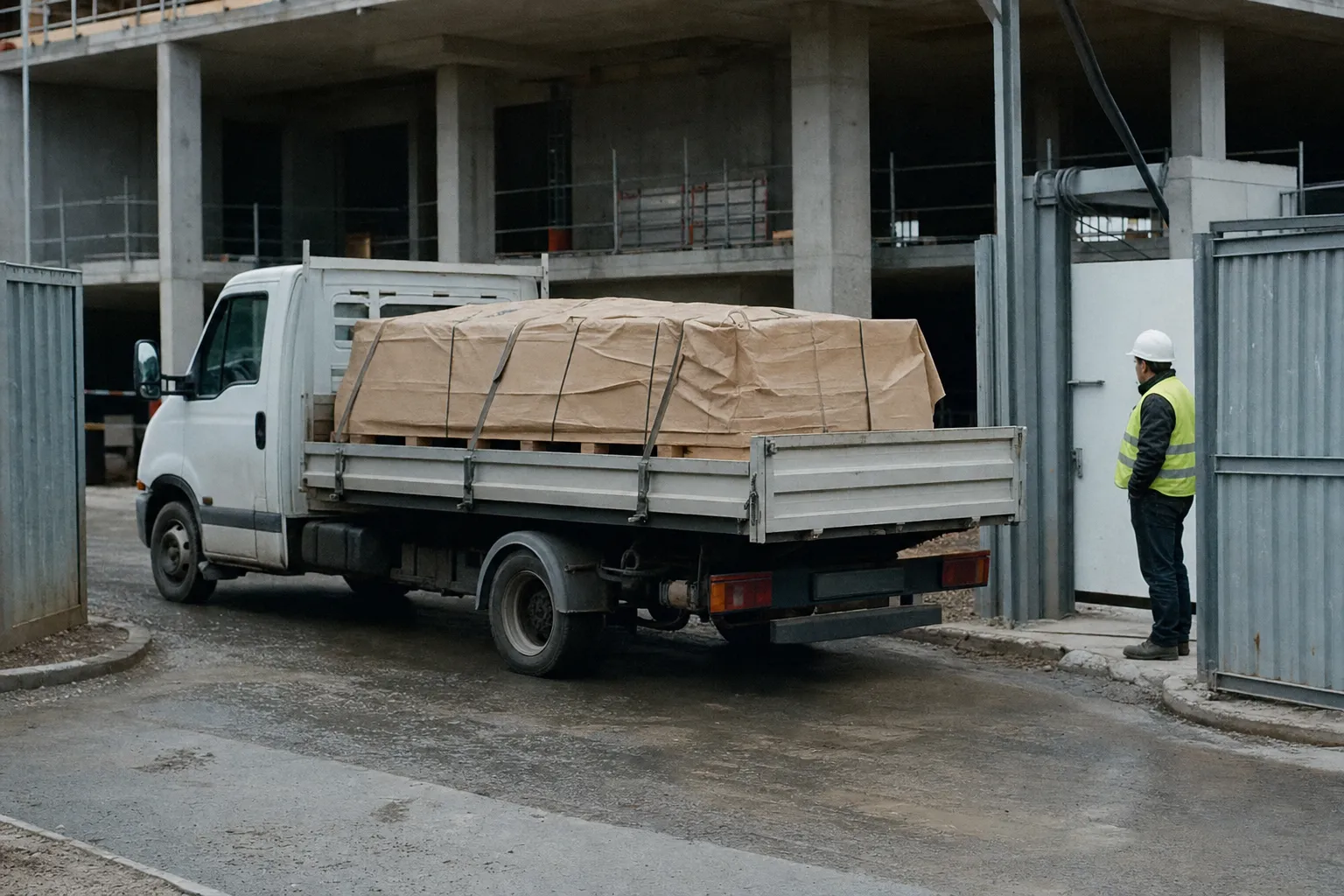
Illustrative photograph. It shows a generic vehicle and a generic site entrance, not a client shipment or a client facility.
Who signs, and what the signature proves
Every delivery ends with a piece of paper and a name. What that name means is where most disputes begin.
A driver's signature confirms that the driver handed over what the driver believed was loaded. A receiving clerk's signature confirms that the clerk counted something. Neither confirms that the cargo is undamaged, complete or the right cargo — unless the document says so, in which case it becomes the evidence a later claim is argued on. On the Indonesian side the delivery note is commonly the surat jalan; its function is the same everywhere, and its value depends entirely on what was written on it before the pen moved.
Four things separate a receipt from a record:
- Time in and time out. A clock time at both ends turns a vague "waiting" into a fact.
- Count and identity, not just quantity. Package marks, crate numbers and the count against the packing list and the bill of lading — three documents that should describe the same cargo.
- Condition described, not judged. "One crate dented on the lower left corner, strapping intact, contents not inspected" survives; "damaged" does not, because nobody can tell afterwards what it meant.
- Capacity of the signatory. Whether the person was authorised to accept the whole consignment, part of it, or nothing without a supervisor.
Who holds that authority is a decision the consignee has to make explicitly, with a deputy named — because the one person who can sign is sometimes on a plane. A site that cannot nominate a signatory in advance will nominate one at the gate, under pressure, and the resulting document will be thin.
The same evidence logic governs what happens after a bad handover: photographs of the crate face, the seal and the load as received are what a later damage, shortage or loss claim is built on. Taking them at the moment of receipt costs a minute. Reconstructing them three weeks later does not work.

Illustrative photograph. No document, name or figure in it is real, and it does not depict a client transaction.
The site's day is not the freight schedule
Freight runs on a schedule built around vessels. A site runs on a schedule built around work fronts, weather and labour. The two rarely meet, and the delivery is where they collide.
Three site realities cause most of the friction. Unloading is not a passive activity: it needs people who are already busy pouring concrete or erecting steel, and those people are not standing by for a truck. The working day in Indonesia is reshaped by public holidays and religious observance in ways a shipping calendar does not reflect, so a week that looks ordinary on a booking screen can lose a day at the gate. And many sites concentrate deliveries into a narrow early window to keep the access road clear during working hours, which means the queue at eight in the morning is the queue, and arriving at ten is not a smaller version of it.
The practical consequence is that a delivery needs a window and a fallback window, and both need an owner. A window agreed by the sales contact and not by the gate is not a window. Neither is one nobody can move when the vessel is late.
Outside the main Jakarta delivery area the picture changes again, because the vehicle, the road and the number of parties involved all change with it; that is covered in last-mile delivery in Jakarta and beyond.
Induction, PPE, and the driver who cannot read the rules
A construction site is a controlled workplace, which means the truck driver and the rigging crew are visitors to somebody else's safety system. UK construction guidance is consistent about two things, and it is cited here as one worked example rather than as a rule that travels: every worker on site receives an induction specific to that site, and vehicle movements on site are planned rather than improvised (UK Health and Safety Executive, Site rules and induction). Both principles transfer to an Indonesian site even though the regulation behind them does not.
In practice those two principles become a short list to confirm with the site, in writing:
- What PPE is required at the gate, and whether the driver and any accompanying crew must bring it or will be issued it.
- Whether the driver is escorted or unescorted. An escort changes the delivery time, and an unescorted visitor is expected to understand the site's rules unaided.
- Who banks the vehicle — directs it, stops it, positions it — and whether a banksman must be present for reversing or for any lift. Improvised reversing is the classic site vehicle accident, and the root cause is usually planning rather than the driver (HSE, Traffic management on site).
- Which language the induction is delivered in. This is routinely missed on the China–Indonesia route: the driver may speak Mandarin, the site supervisor Indonesian, the freight coordinator English. Guidance on site induction explicitly notes that translations of site rules for non-English-speaking workers should be considered, and a driver who has not understood the induction has not had one.
None of this is bureaucratic decoration. A driver refused entry at the gate does not create an incident; he creates a waiting vehicle, a missed slot and a delivery that has to be re-planned — quietly, and at someone's expense.
Release, storage and site: the order of three decisions
For imported cargo there are three decisions, and they are usually taken in the wrong order.
The first is release: cargo may not be removed from the customs area until the release approval has been issued for that declaration. That is a permission, not a pickup, and the detail of how the clock behaves around it belongs to the terminal-side page linked above.
The second is the route out of the terminal. There are three, and each makes a different demand on the site.
Route | What it needs from the site | What happens if the site slips |
|---|---|---|
Direct from the terminal to the site | The site ready on the day of release — gate, crew, equipment and space, all at once | The vehicle waits at the gate, or leaves with the cargo still on it |
Through a warehouse or freight station first | A release instruction per lot, and a decision about which packages the site wants first | The cargo is sorted and held in a partner facility instead of standing on your site; safe, and not installed — see how cargo is sorted after arrival |
Into a bonded logistics centre, duty deferred | A clear statement of when the goods will leave and what will be done to them there | The deferral continues and the site schedule is untouched, though the commercial clock is not — the mechanism is in PLB Indonesia: how duty deferral works |
Direct from the terminal to the site
What it needs from the site
The site ready on the day of release — gate, crew, equipment and space, all at once
What happens if the site slips
The vehicle waits at the gate, or leaves with the cargo still on it
Through a warehouse or freight station first
What it needs from the site
A release instruction per lot, and a decision about which packages the site wants first
What happens if the site slips
The cargo is sorted and held in a partner facility instead of standing on your site; safe, and not installed — see how cargo is sorted after arrival
Into a bonded logistics centre, duty deferred
What it needs from the site
A clear statement of when the goods will leave and what will be done to them there
What happens if the site slips
The deferral continues and the site schedule is untouched, though the commercial clock is not — the mechanism is in PLB Indonesia: how duty deferral works
The third decision is the one this page is about, and it should be taken first, not last: whether the site can receive at all, and on which day. Working backwards from the site's readiness makes the other two decisions cheap. Working forwards from the vessel's arrival makes them urgent, and urgency does not improve a plan.
Splitting the shipment is a site decision
For a plant, a production line or a multi-vendor project, delivery is not one event but a sequence. How that sequence is cut is usually treated as a freight question — container fill, vessel schedule, consolidation economics. It is at least as much a site question, because the site's laydown space and its installation order decide which cut actually works.
The rule that survives contact with real projects is that the site does not need everything on day one, and early arrival is not the same as progress. Cargo that arrives before it can be installed occupies space needed for the next delivery, gets moved twice, and is exposed to weather and to other trades working around it. The sequencing logic — what belongs in which shipment, and what holds when one slips — is set out in splitting a project into shipments.
What to write into the split, before it is booked:
- Which packages each phase carries, by crate or item reference, so the site can plan laydown against a list rather than a hope.
- Which phase is site-critical — the one whose delay stops a crew — and which phases are merely convenient to have early.
- What happens to a phase that arrives early. Either the site has somewhere for it, or it waits in a partner facility. Deciding this at booking time is a planning choice; deciding it at the gate is a negotiation.
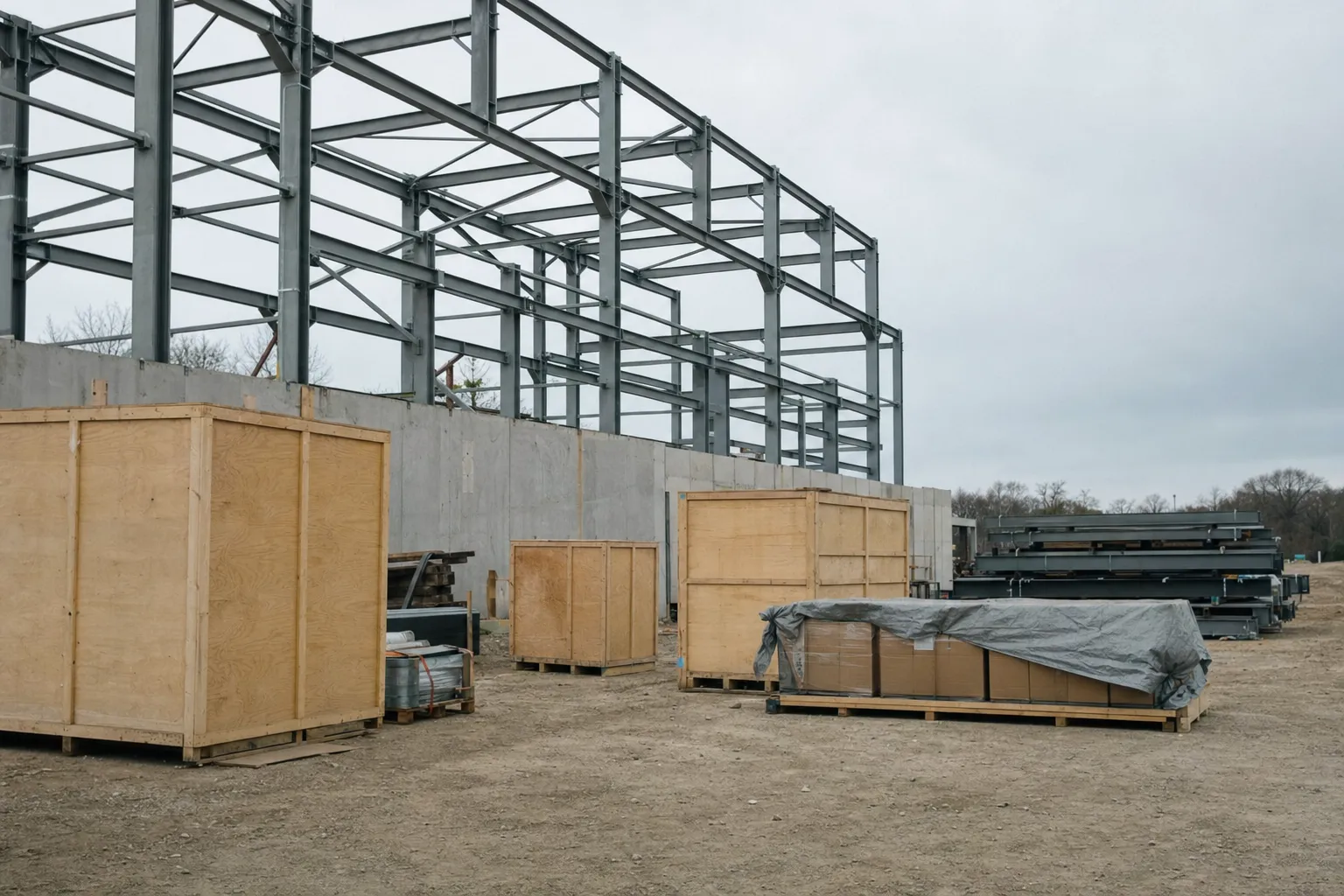
Illustrative photograph. It shows generic crates on generic ground, not a client site or a client consignment.
When the truck cannot be unloaded
The failure modes are few and predictable, which is the good news: a framework agreed in advance covers almost all of them.
What goes wrong | How it looks on the day | What has to exist in advance |
|---|---|---|
No unloading equipment on site | The vehicle arrives, the crane or forklift is committed elsewhere | A named machine and operator, confirmed the working day before |
The wrong vehicle was sent | It cannot enter the gate, turn in the yard, or reach the unloading point | Vehicle type agreed with the site, not chosen by the haulier alone |
The gate is shut on arrival | The driver waits outside a barrier with no one to ask | A window, a fallback window, and a phone number that is answered |
The load is refused at receiving inspection | Crates opened, count disputed, cargo rejected | A receiving routine and a damage-recording format agreed beforehand |
Only part of the consignment is accepted | Half in, half still on the vehicle | A written instruction on what a partial receipt means for the remainder |
No unloading equipment on site
How it looks on the day
The vehicle arrives, the crane or forklift is committed elsewhere
What has to exist in advance
A named machine and operator, confirmed the working day before
The wrong vehicle was sent
How it looks on the day
It cannot enter the gate, turn in the yard, or reach the unloading point
What has to exist in advance
Vehicle type agreed with the site, not chosen by the haulier alone
The gate is shut on arrival
How it looks on the day
The driver waits outside a barrier with no one to ask
What has to exist in advance
A window, a fallback window, and a phone number that is answered
The load is refused at receiving inspection
How it looks on the day
Crates opened, count disputed, cargo rejected
What has to exist in advance
A receiving routine and a damage-recording format agreed beforehand
Only part of the consignment is accepted
How it looks on the day
Half in, half still on the vehicle
What has to exist in advance
A written instruction on what a partial receipt means for the remainder
Two questions have to be answered before any of these happen, because both are commercial and neither can be settled at the gate.
The first is who decides to divert. If the site will not take the cargo, someone has to authorise moving it to a warehouse or a bonded centre, and that authorisation has to come from the party who owns the commercial consequence. A driver cannot make that decision and a gate clerk certainly cannot.
The second is who carries the cost of the delay — the vehicle standing, the slot lost, the storage that begins. That is a contract question, settled by what was agreed for the shipment and where the named place sits in your trade term; the ICC's Incoterms rules allocate cost and risk between seller and buyer according to the rule chosen and the place named in it (ICC, Incoterms 2020). Two offers that both say "delivered" can put that cost on different parties. We publish no figure for it, because the figure depends on the operator, the site and the day.
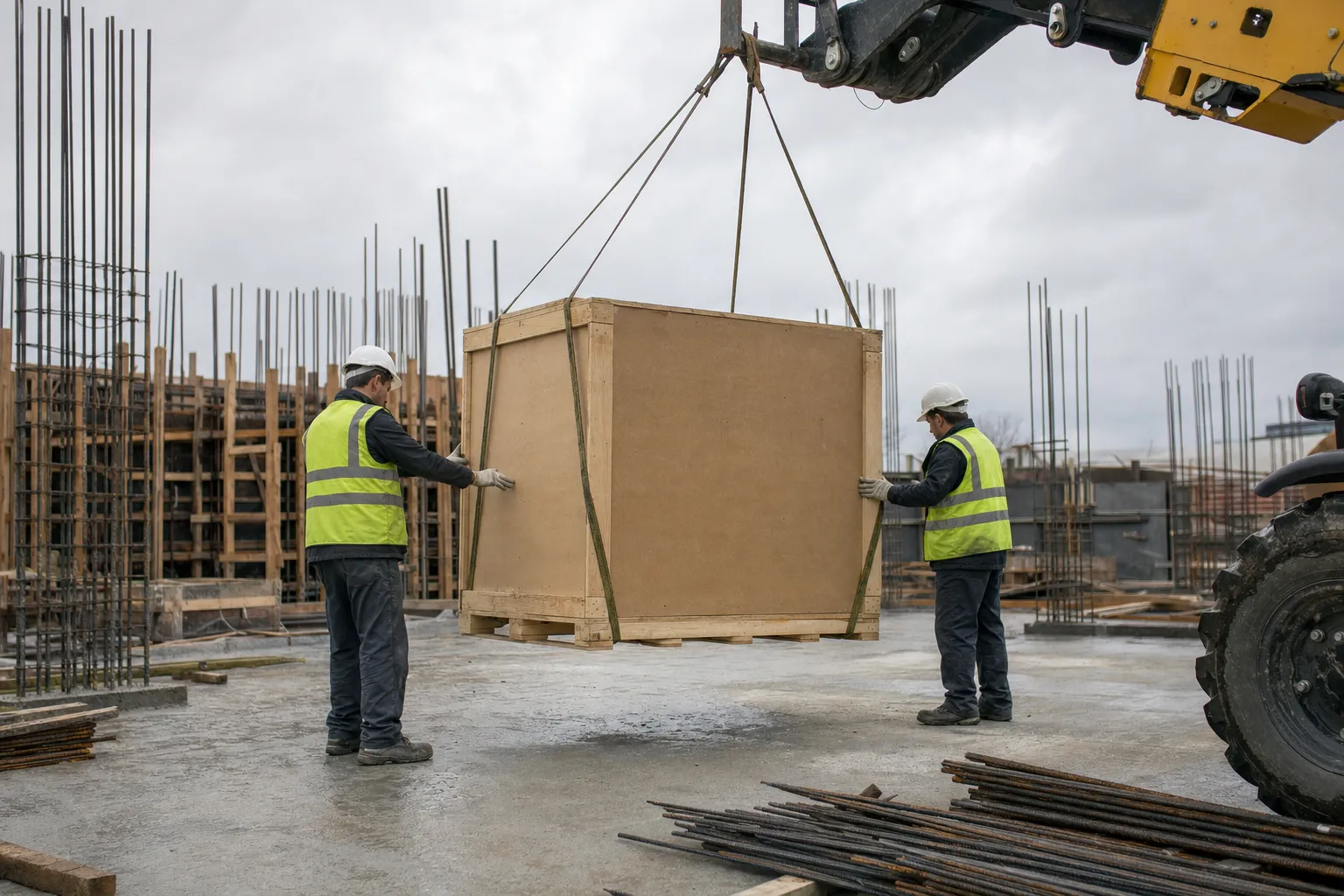
Illustrative photograph. The equipment, the crate and the site are generic; no operator or facility shown is ours.
What we coordinate, and what stays with the site
Our part of this is coordination around the sequence above: confirming receiving conditions with the site before the cargo sails, aligning the delivery window with the release, booking inland haulage and re-booking it when the release moves, and holding cargo in a partner facility when the site is not ready. We are a forwarder and a coordinator, not an asset owner: no vessel, terminal, container, truck or warehouse behind this page is ours, and the capacity that turns up at your gate belongs to a partner.
On the Indonesian import side, the declaration is filed by a licensed importer of record and the broker it appoints; our role there is to assist and coordinate, not to determine the customs outcome. The site itself belongs to the consignee or the EPC contractor, and its rules, its signatory and its safety system are theirs. What we can do is make sure the questions on this page reach the person who can answer them while the answers can still change something.
The other pages on this part of the route — scope, consolidation, sorting, bonded holding, last mile — are collected under warehousing and delivery.
Five things to settle before the vessel sails
If a shipment is already booked, these are worth asking now rather than at the gate.
- Can the site physically receive the vehicle we are sending, at the hour it will arrive, and has anyone at the site confirmed that in writing?
- What point load will be placed on the ground at the unloading point, and who has confirmed what that surface is rated for?
- Who lifts the cargo off, with which machine, and is that confirmed for that day?
- Who signs, who is their deputy, and what will the signed note actually record — time, count, condition, or only a name?
- If the site refuses the cargo, who authorises the diversion, and who carries what it costs?
A delivery that answers those five has a plan. One that does not has a hope — and a gate is a bad place to discover the difference.