
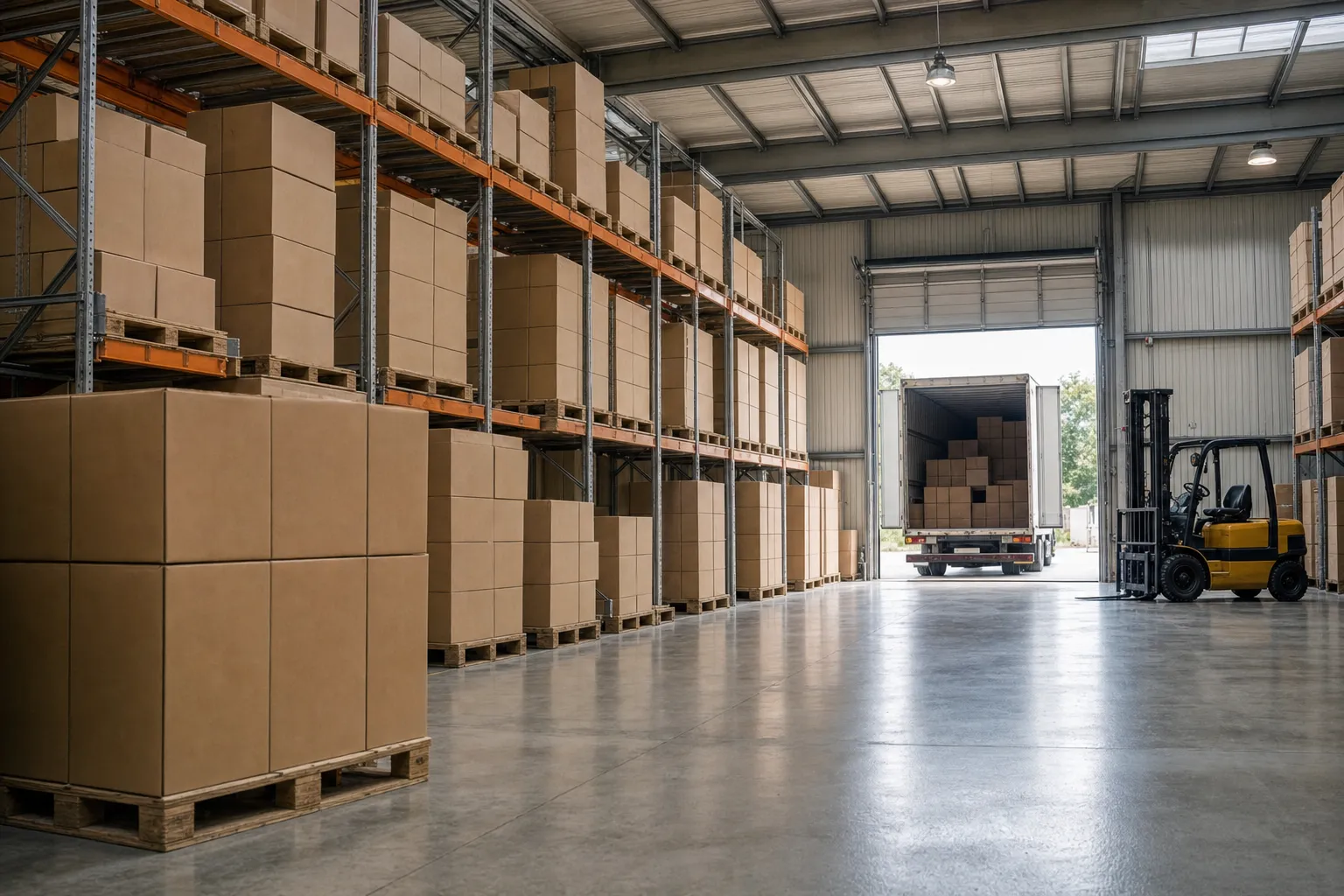
A PLB — Pusat Logistik Berikat, in English a bonded logistics center — is the one Indonesian storage regime built around a duty point rather than a duty rate. Goods arrive from outside the customs territory (daerah pabean), sit in a licensed area under customs supervision, and are not treated as imported goods while they are there. Duty falls due when a lot leaves for the domestic market, and only then.
That is one sentence, and most published explanations stop at it. The expensive part is what follows: what exactly is deferred, who is actually allowed to do the filing at each end, and which of the exit routes settles the deferral and which carries it forward.
One warning before the mechanism. The acronym names two unrelated things in Indonesia, and the second dominates a casual search: Pos Lintas Batas Negara, the land border crossing posts. This article is about Pusat Logistik Berikat, and nothing here applies to a border post.
Nothing on this page is a quotation. No rate, tax figure, percentage, duty amount or promised transit time appears in it, and every regulation article cited below was read in the ministry's own text. The situations described are hypothetical: they are not client cases and they are not quotations. What any particular facility will do for your goods is settled by that facility's license and operating rules and by the customs office supervising it — not by this page.
A customs area, not a warehouse with a delay
Indonesia's bonded-storage family is Tempat Penimbunan Berikat (TPB), and its members are not variations on one idea. The bonded zone (Kawasan Berikat) is the manufacturing member: goods are held there in order to be diolah atau digabungkan — processed into a product with a higher added value, including a change in its properties or function, or combined with other goods — before they are exported or entered for home use. The bonded warehouse (Gudang Berikat) is a storage member: goods are held there, the only work the customs service allows alongside the holding is a short fixed list — packing and repacking, sorting, kitting, fitting, cutting — and the storage window it describes runs two years, against the PLB's three. The PLB is the member built around holding and moving goods: stock arrives from abroad or from elsewhere in Indonesia, may be consolidated, relabeled, inspected or otherwise treated with what the regulation calls simple activities, and leaves again. What the PLB adds to the family is breadth rather than a different duty point: foreign-origin goods and goods from elsewhere in the customs territory in the same licensed site, ownership that can sit with the overseas supplier or with an importer rather than with the business running the site, three years rather than two, and release in slices with the assessment made at the exit.
Legally it is not a private warehouse with paperwork attached. A PLB is a customs area (kawasan pabean), under the full supervision of the Directorate General of Customs and Excise, with physical inspection performed selectively on the basis of risk (PMK 28/PMK.04/2018, Article 2). That single fact explains most of what the facility will ask of your cargo later.
The regime also comes in forms, and the form decides what the site may do. Eight are recognized (Article 4(1) of the same regulation): a PLB supporting large industry, one supporting small and medium industry, an air-cargo-hub PLB, an e-commerce PLB, a finished-goods PLB, a basic-commodities PLB, a floating-storage PLB and a commodity-export PLB. One form per site. A site that holds finished consumer stock is licensed differently from one that feeds a factory, and the difference shows up at the exit, not at the gate.
Three roles sit inside the arrangement, and buyers routinely collapse them into one. The Penyelenggara provides and manages the site. The Pengusaha PLB runs the storage business. A PDPLB is a separate business operating its own bonded logistics center inside someone else's site. Which of the three you are dealing with decides who signs what. Where this article says the operator, it means the Pengusaha PLB or the PDPLB — the two that carry the storage business — never the Penyelenggara.
The deferral is a duty point, not a discount
On entry from outside the customs territory, goods receive three treatments at once: import duty is suspended, excise is exempted, and import taxes are not collected (PMK 272/PMK.04/2015, Article 24(1)). The import taxes in question are the ones that make up the bill at any Indonesian border — import VAT, luxury-goods tax where it applies, and income tax article 22 on imports; in Indonesian usage the group is the PDRI. What each of those is, and how they stack, is set out in what makes up Indonesia's import charges; the point here is that the PLB suspends all of them together, not one of them.
Now the part that is almost never stated. When the goods leave for the domestic market, duty is computed on the customs value, the classification and what the regulation calls pembebanan — the charge that applies to those goods — all three fixed at the moment of release, not at the moment of arrival (Article 21(2)(a) of PMK 272/PMK.04/2015, reissued as part of the 2018 amendment). Import taxes follow the rate in force when the import declaration is registered and the value at the time of release (Article 21(2)(c) of the same article). Two things therefore move while your stock sits: the tariff position and the valuation basis.
Read the deferral as a question about when the assessment happens, not only about when the money leaves your account. A classification that looked settled at booking can be read differently at release; a price list that moves moves the base. Neither direction is knowable at the port.
Release is deliberately granular: the customs service describes partial release as available, with charges settled according to the quantity released. A container need not be entered at once — it can be drawn down as orders arrive, each release its own assessment. That is the mechanism behind the cash-flow story: not a lower bill, but a bill that arrives later, in slices.
What it is not: a reduction, an exemption, or a way to pay less in total. Every unit that enters the Indonesian market from a PLB eventually carries the same charges as one entered directly. The gain is timing and optionality — per lot, you decide whether to enter the goods, move them to another bonded place, or send them onward — and that is worth something only if the goods actually move.
What the deferral does not cover
Five limits, each of which is a mechanism rather than a warning.
It does not defer importability. Entry into a PLB is not an import, so nothing about whether the goods may enter Indonesia is settled when they arrive — with one exception that is not a scheduling matter at all. Goods prohibited from import or export may not be brought into a PLB in the first place (Article 30(b)). It is restrictions, not prohibitions, whose requirements can wait. Release is an import: the charges fall due then (Article 21(1)), and goods may only be released to a place within the customs territory once the requirements of Indonesian import law have been met — the condition the regulation states in terms when it deals with goods released after their storage period (Article 33(2)). The license question is answered at the exit, by whoever is releasing. A shipment that cannot be imported does not become importable by waiting.
It defers the timing of restrictions, not their content. The customs service describes entry as carrying a suspension of restriction provisions, and states that restriction requirements can be satisfied while the goods are stored — which is why inspection by the relevant technical agency inside the PLB is itself one of the permitted simple activities (Article 3(9)). That is a scheduling benefit of real value when a permit is weeks away. It is not a route around the requirement, and it does not make a product that Indonesia will not admit into the domestic market admissible. Which products carry restrictions, and how to check one, is covered in LARTAS: how to check whether your product is restricted.
It does not stop the clock. Goods may be stored for a maximum of three years from the date of entry (Article 3(7)). The period can be extended for goods used in oil and gas operations, mining, certain industries, or other industries with the approval of the head of the supervising customs office (Article 3(8)) — a list, not a general discretion. At the wall, the regulation offers five resolutions: re-export, transfer to another bonded storage place, transfer to a free zone, transfer to a special economic zone, or transfer to another designated economic area. For foreign-origin goods there is a sixth: settle duty, excise and import taxes and release to a place within the customs territory. Miss all of them by more than thirty days and the license of the Pengusaha PLB or of the PDPLB is frozen until the stock is dealt with (Article 33(5)). The deadline is theirs, which means it becomes yours earlier than you expect.
It does not permit manufacturing. The permitted list is deliberately mundane, and it is a list of simple work rather than a definition of what a site may become: among them repacking, sorting, quality control, kitting, packing, assembly, consolidation and provisioning of goods destined for export, repair and reassembly, maintenance including painting for strategic industries, blending, Indonesian-language labeling, excise banding, auctions of capital goods of foreign origin, exhibitions of imported goods, technical-agency inspections to satisfy import restrictions, and inspection for a certificate of origin (Article 3(9)). A process that produces goods with different characteristics or functions is manufacturing, and manufacturing inside a suspended-duty area is what a bonded zone is for. If your plan involves changing the product, the PLB is the wrong instrument.
It does not move the compliance risk off the facility side. Every movement in and out requires approval before it happens, and the Pengusaha PLB and the PDPLB are obliged to ensure that the movements comply with the customs rules (Article 20A(2)). Liability sits in the same place. While goods are, or should be, inside the PLB, the Pengusaha PLB or the PDPLB is liable for the duty, excise and import taxes owed on them, and where a PDPLB cannot meet that liability, the Penyelenggara must (Article 29(2)–(3)). Compliance failures therefore land on the license and on the balance sheet at once. That is why a well-run PLB polices its tenants' paperwork harder than an ordinary warehouse polices its customers' — not out of temperament, but because the license and the liability are both its own.
Who files what, and why nothing is a PIB on arrival
This is the section most buyers need and least often get, because the answer splits a shipment into two declarations filed by two different parties at two different moments.
Every entry and every exit must be notified to customs at the supervising office (Article 31(1)). The notifications are not interchangeable.
The entry notification — the customs notification of the entry of imported goods for storage in a bonded logistics center — is filed from the facility side rather than by the importer: the Penyelenggara, the Pengusaha PLB or the PDPLB may submit it (Article 31(4)). Not by you, and not by your supplier. The cargo arrives, and the facility declares it into the bonded area. No import declaration is lodged at that point, because no import has occurred. The entry notification also has a second life in tax procedure: an importer applying for a tax-exemption certificate (Surat Keterangan Bebas) may use it as one of the documents that application requires, because the tax rules equate it with a bill of lading or an airway bill (Article 24A(2) of the 2018 amendment) — which is why a finance team sometimes finds a bonded entry document where it expected a transport document, and should not read that as a general substitution.
The release notification is submitted by the party releasing the goods, and the regulation lists four possible filers: the Penyelenggara, the Pengusaha PLB, the PDPLB, or a business entity outside those three (Article 31(5)). In the ordinary case it is the importer, or the customs broker acting for it, drawing a lot for the domestic market. The PIB belongs here, not at the port. What a PIB contains and how it is structured is covered in what a PIB actually is; the mechanism point is that the importing identity is fixed at release, and everything the PIB asserts — importer, classification, value — is asserted about goods that are already in the country.
That has a consequence worth acting on early. The party who will release the goods must be able to import, and must be the party the rest of the documents describe. If the importer of record is going to be a different entity from the one that arranged the shipment — a local distributor, a project company, a joint-venture vehicle — that has to be settled before the goods sail, because the alternative is correcting documents on cargo that is already sitting in a bonded area accruing storage. Who that party is, and what being it entails, is set out in who is the importer of record in Indonesia.
Where the goods may go, and what each route settles
The exits are a closed list, not a menu you can improvise from. For foreign-origin goods the regulation enumerates where they may be released (Article 20(1)), and each destination has its own settlement.
Exit route | What happens to the deferral | Typical use |
|---|---|---|
Release into the domestic market, in whole or in part | Duty, excise and import taxes settled on that quantity; import requirements met; a PIB registered | Stock drawn down against orders |
Transfer to another bonded storage place | Suspension continues; the movement is notified | Rebalancing stock between facilities |
Into a bonded zone, special economic zone, free zone or other designated area | The receiving area's regime applies | Feeding a factory or a designated project |
Export | Export procedures apply; no import for home use occurs | Goods sold onward outside Indonesia |
Return to the supplier | Export procedures, as above | Unsold or rejected stock |
Nothing before the storage period ends | The Article 33 resolutions, then the license consequence | The outcome nobody plans for |
Release into the domestic market, in whole or in part
What happens to the deferral
Duty, excise and import taxes settled on that quantity; import requirements met; a PIB registered
Typical use
Stock drawn down against orders
Transfer to another bonded storage place
What happens to the deferral
Suspension continues; the movement is notified
Typical use
Rebalancing stock between facilities
Into a bonded zone, special economic zone, free zone or other designated area
What happens to the deferral
The receiving area's regime applies
Typical use
Feeding a factory or a designated project
Export
What happens to the deferral
Export procedures apply; no import for home use occurs
Typical use
Goods sold onward outside Indonesia
Return to the supplier
What happens to the deferral
Export procedures, as above
Typical use
Unsold or rejected stock
Nothing before the storage period ends
What happens to the deferral
The Article 33 resolutions, then the license consequence
Typical use
The outcome nobody plans for
The building does not choose the route. The goods and the buyer do — a licensed facility can execute any of these, and cannot make one of them lawful that is not. Where the buyer's question is really about who clears and who carries the risk under different commercial terms, that belongs to a different decision and is worked through in DDP, DDU or single clearance.
Illustrative image. Not a client facility.
Ownership can sit with someone else
Three lawful ownership positions exist for goods in a PLB (Article 6(1) of the 2018 amendment): they may be owned by the Pengusaha PLB or the PDPLB, by a supplier outside the customs territory, or by an importer or exporter inside it. The middle one is the commercially interesting one.
It means stock can be held in Indonesia while it is still the overseas supplier's property — consignment inventory, in the ordinary sense, under a bonded regime rather than a distribution agreement. A distributor can hold goods it has not bought yet. A supplier can stage stock close to a market without booking a sale, and without the buyer funding duty on inventory it may not take.
That structure carries a status question the regulation raises itself. Where a PLB or a PDPLB stores goods owned by a supplier outside the customs territory, how the position of that PLB or PDPLB as a permanent establishment (Bentuk Usaha Tetap) is determined turns on the supplier's jurisdiction: the applicable double-tax treaty where that jurisdiction has one with Indonesia, and Indonesian income-tax law where it does not (Article 6(2) of the 2018 amendment). Whether consignment stock leaves anyone with a taxable presence is therefore a question for your tax adviser, on the treaty text and the facts — a storage license does not answer it, and neither does this page.
What does not follow is that anyone can take the goods out. For a finished-goods PLB, release into the domestic market may only be carried out by companies named in that site's operating license, and only where they meet a tax-compliance test — compliant taxpayer status, low-risk VAT registration, authorized economic operator status, or a fiscal certificate (Article 20B). Who may put goods in is broader than who may take them out, and the gap between the two is where feasibility studies go wrong.

Illustrative image. Not a client facility.
The controls you will actually meet
A buyer who expects a normal warehouse will be surprised by four things.
Approval before movement. Entry and exit require approval from the customs official or the customs system before they happen (Article 20A(1)), and notifications are submitted electronically through the customs data-exchange system, with a manual fallback only where that system is unavailable (Article 31(7)–(8)). Fast-moving businesses can be authorized to notify periodically rather than per movement (Article 31(6)) — a real operational difference between facilities, and worth asking about.
Approval also starts a clock. Goods that have received release approval must leave the PLB within thirty days of that approval, and where the window lapses, the next customs notification filed by the same party will not be processed until the position is regularized (Article 34(3)–(4)). Partial release is available, but each approved lot still has to physically move: the instalment rhythm is not entirely the buyer's to set.
Inspection on risk. Physical inspection is selective and risk-based (Article 2(3)), and the supervising office may inspect the premises at any time (Article 32(3)). The results feed the evaluation of the license held by the Penyelenggara, the Pengusaha PLB or the PDPLB (Article 32(4)).
Stripping on entry. Goods entering a PLB must be devanned from the container (Article 18), with exceptions for liquids and gases and for other goods approved by the head of the customs office on the basis of the company's risk profile. This is the single most under-discussed practical fact about PLBs: the cargo does not stay in the box. If your packing, labeling or unit load was designed to remain sealed until final delivery, that has to be reconciled before booking, not after devanning.
Illustrative image. Not a client facility.
Systems that are conditions of the license. Traceable, online, real-time inventory records and continuous camera coverage are obligations attached to specific roles, not optional extras. The Penyelenggara has to provide camera coverage the customs office can reach in real time, with recordings going back at least seven days (Article 27(1)(e)); the Pengusaha PLB and the PDPLB have to record movements in an inventory system that is real-time, online and traceable, and provide their own camera coverage on the same terms (Article 28(1)(d)–(e)). The customs service lists both among the conditions for a site to be designated a PLB (DGCE: Pusat Logistik Berikat), and monitoring extends to the volumes handled and the suppliers and buyers behind them (Article 16(2)). A facility that cannot tell customs where a specific lot is at a given hour is not compliant, whatever its yard looks like.
One caution about the procedural layer. Which declaration form is used, which channel a declaration clears through, and how far a fast-moving business may spread its reporting are set by customs-service procedure below the ministerial level, not by the regulation cited above, and that procedure has been revised since it was issued — most recently by PER-21/BC/2025, the second amendment to the bonded-movement procedures that began at PER-7/BC/2021. The mechanics in this section survived those revisions; the form numbers and the counter-level practice have moved. Confirm them with the office supervising your facility before you build a schedule on them.
Judging whether a PLB fits your flow
Six questions, in the order they usually decide the answer.
Is the deferral worth the handling? Every movement in and out is a handling event, and the storage is paid for. Compare the cost of holding and double-handling against the value of deferring charges on stock you have not sold — with your own figures, since no honest article can supply them.
Can your restriction be completed inside Indonesia while the goods sit? A permit that will be issued in-country is a good fit. A permit that cannot be issued at all is not a timing problem.
Can your release party import, and is it the party named where it must be? If the answer depends on a license that has not been issued, the PLB buys time — but only if the license is genuinely in progress.
Is this finished stock or a production input? Finished stock for sale fits a PLB. Inputs that will be transformed into a different product belong to a bonded zone, where manufacturing is the point.
Does your sale cycle fit inside the storage period, with an extension you can actually obtain? Three years is generous for consumer stock and short for a capital project. The extension categories are specific.
Who owns the goods while they sit, and what does that do to your books, your insurance and your right to move them? Consignment changes who carries the inventory and who can instruct the facility. That should be written down, not assumed.

Illustrative image. Not a client facility.
A hypothetical, to show the shape rather than a number. Not a client case and not a quotation. An importer has a technical registration in progress and a supplier ready to ship. Rather than hold the shipment at origin until the registration lands, the goods move, enter a PLB, and are inspected there by the agency that has to approve them. The registration arrives; the importer releases the first lot against orders and leaves the rest in bond. Nothing about the charges changed. What changed was that the cargo was already in the country when the permit issued, and the decision about how much to enter was made month by month rather than at the port.
What we coordinate, and what stays with you
The bonded facilities in this article are not ours. They belong to licensed operators, and the filings described above are made by those operators and by the importer or its customs broker. On our side the work is coordination: booking the movement, assembling the document set both ends will be asked for, keeping the operator and the broker working from the same version of the shipment, and saying early when a release depends on something that has not been issued yet. We do not act as importer of record and we do not hold a license on your behalf.
The decisions stay where they belong. Which facility, which form of PLB, who imports, when each lot is released — those are the buyer's, and they are cheaper to make before the first container than after the third.
If you are weighing a PLB for a China–Indonesia flow, the useful first message is short: what the goods are, what permit position you hold today, who will be the importer at release, and when you expect to sell. That is enough to say whether a bonded center is the right instrument for this shipment, or whether the deferral you actually need is somewhere else in the chain. Section-level context for the rest of the journey, including the other articles in this cluster, is on the warehousing and delivery index; the bonded and warehousing options we coordinate through partner facilities are described on the warehousing and bonded logistics service page.