
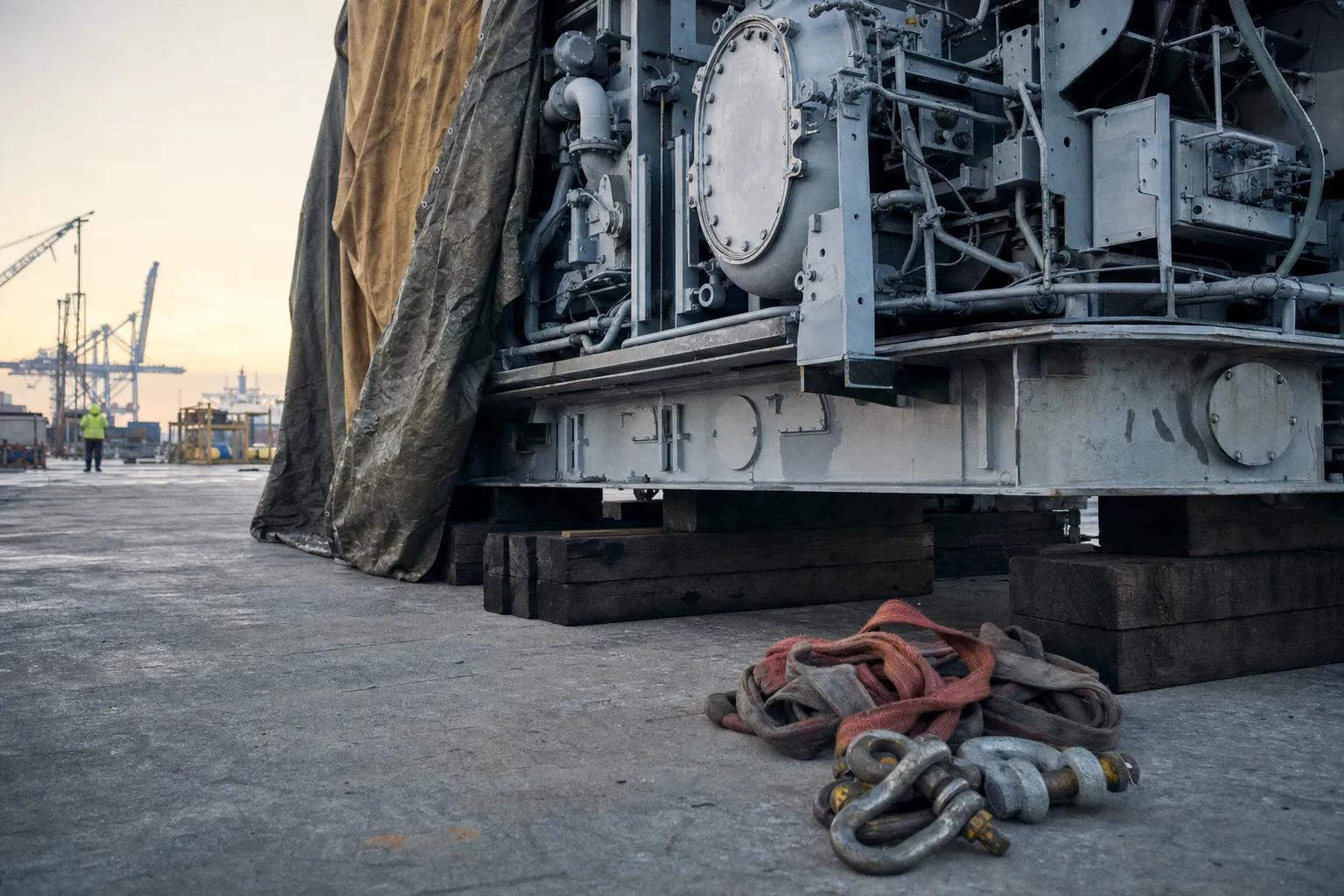
A production line has one name on the contract and forty crates on the dock. Before anyone can put an HS code against it, somebody has to answer a smaller and harder question: how many separate things are we declaring? That count is a judgment about the equipment, not a line on an invoice, and it has to be made before the packing list is signed.
The pre-shipment classification of equipment is that step — the point where a machine, its sections, its control system, its spares and the parts the supplier bought in stop being "one project" and become a set of declared objects, each with its own reasoning. Do it late and the mistake does not stay in the paperwork. It travels into the permit application, the packing drawing, the lifting plan and the order in which the site receives cargo, and it surfaces at the border, where fixing it is slowest.
This article prints no tariff rate, no duty figure, no tax amount and no percentage, and promises no clearance or delivery date. Every scenario in it is illustrative — not a client case and not a quotation. Nothing here is customs, tax or legal advice, and nothing here makes us the importer of record: on the Indonesian side we assist and coordinate with the licensed importer and the broker it appoints, and the classification decision itself belongs to Indonesia's customs authority.
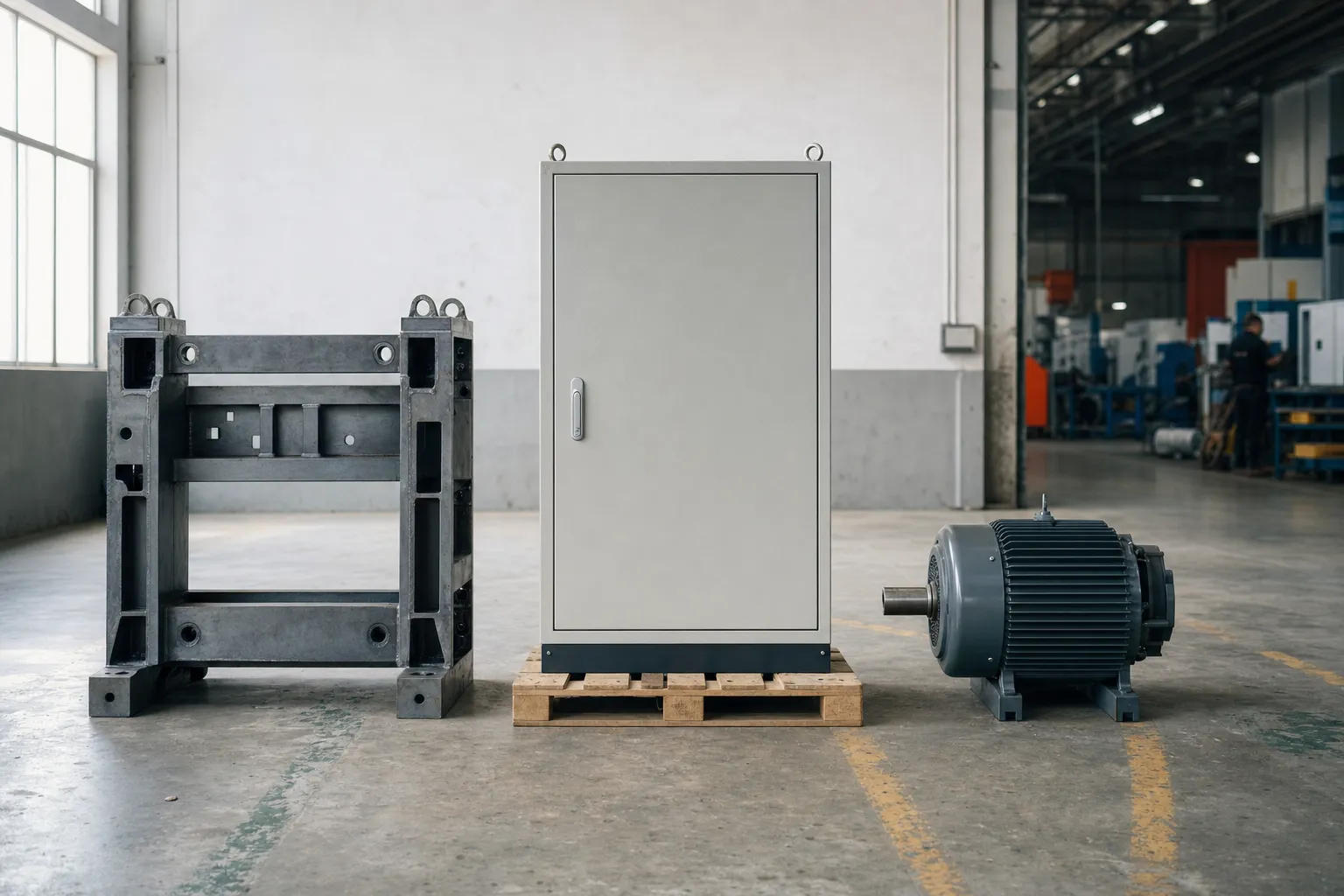
Illustrative: one installation, three objects that answer to three different sets of notes.
Three things are called classification before shipment — this is the fourth
Search the phrase and you will find four unrelated decisions wearing it. Only one of them decides whether your machine can enter.
The dangerous goods class. A machine carrying a lithium battery, a refrigerant charge, a fuel tank or hydraulic oil has a hazard identity for carriage — a UN class and packing group that decide how it may be packed, marked and handed to a carrier. It is a transport decision, it is owned by the carrier and the packing instruction, and it says nothing about what the goods are at the border.
The freight class. Freight class, and the NMFC scale behind it, is a domestic road-freight concept used to price less-than-truckload moves by density and handling. It does not exist on a China–Indonesia sea leg, and no amount of it will help an Indonesian entry.
The export control classification. Some exporting jurisdictions keep their own control lists, and a machine with a controlled capability may need a licence to leave. That is the exporting state's question, not the importing state's tariff.
The customs classification. The tariff line the entry is lodged under — the HTS in the United States, the BTKI in Indonesia, both built on the same Harmonized System — the one that decides which controls attach, how the goods are described, and what the declaration is measured against. Everything below is about this fourth thing, and only about the equipment case.
The distinction is worth thirty seconds because the four get confused in the same inbox. A buyer who has been asked for "the classification" by a carrier, by a factory and by a broker may be holding three different answers to three different questions, and the machine is not yet packed.
On equipment, the classification question is a count, not a code
For a single product with a part number, classification is mostly a lookup: read the specification, follow the headings, and the HS code follows. For an installation it is a partitioning problem — the same physical thing can defensibly be declared as one article, as five objects, or as forty crates, and the packing list will not tell you which. That is why a search for the machinery HS code tends to return a confident answer that does not survive contact with the equipment.
The partitioning is done by the goods. Five kinds of object come out of almost every equipment package, and each has its own test.
The object | What it is | The judgment that puts it there | If it lands in the wrong one |
|---|---|---|---|
The working machine | The line, press, filler or crane that does the job the contract bought — including when it travels in sections | It performs one function, and the sections together make that machine | Declared as parts, it loses its identity as a machine, and every control written for the machine disappears with it |
A machine with its own function | A coder, labeller or packer standing inside the line but able to work alone | It has a function of its own, in its own heading, even when it is bolted to the neighbour | Absorbed into the main line, it becomes invisible — including any approval attached to it |
Parts made for that machine | Frames, heads, dies, conveyors built only for this equipment | The machinery chapters' notes send such parts to the machine they belong to | Given a separate identity, you now have two entries that must agree about one object |
General-purpose components | Fasteners, standard motors, cable, valves, bearings | These are goods in their own right and keep their own headings | Folded into the machine, the machine's line absorbs goods it was never written for |
Spares and accessories | A start-up spares kit, wear parts, tools, an extra head | Everything beyond what completes the machine keeps its own identity | A service stock enters as capital equipment, and no one can find it later |
The working machine
What it is
The line, press, filler or crane that does the job the contract bought — including when it travels in sections
The judgment that puts it there
It performs one function, and the sections together make that machine
If it lands in the wrong one
Declared as parts, it loses its identity as a machine, and every control written for the machine disappears with it
A machine with its own function
What it is
A coder, labeller or packer standing inside the line but able to work alone
The judgment that puts it there
It has a function of its own, in its own heading, even when it is bolted to the neighbour
If it lands in the wrong one
Absorbed into the main line, it becomes invisible — including any approval attached to it
Parts made for that machine
What it is
Frames, heads, dies, conveyors built only for this equipment
The judgment that puts it there
The machinery chapters' notes send such parts to the machine they belong to
If it lands in the wrong one
Given a separate identity, you now have two entries that must agree about one object
General-purpose components
What it is
Fasteners, standard motors, cable, valves, bearings
The judgment that puts it there
These are goods in their own right and keep their own headings
If it lands in the wrong one
Folded into the machine, the machine's line absorbs goods it was never written for
Spares and accessories
What it is
A start-up spares kit, wear parts, tools, an extra head
The judgment that puts it there
Everything beyond what completes the machine keeps its own identity
If it lands in the wrong one
A service stock enters as capital equipment, and no one can find it later
Two consequences follow, and they are the reason this article exists.
The count is not the crate count. One machine in six sections is one object. Three machines crated together on one pallet are three. A packing list organised by how things fit is organised by the wrong criterion, and the mismatch is only visible when you put the two lists side by side.
The count is decided by function and completeness, not by value. A low-value control cabinet that only works with this line belongs with the line. A high-value spare head that the machine can run without does not.
The notes decide what the machine is: one machine, several, or one function
The rules that settle this are not in the invoice. They are in the notes that open Section XVI of the tariff nomenclature — the section covering machinery and electrical equipment, Chapters 84 and 85 — and those notes are binding parts of the system rather than commentary. The WCO's own account of how the Harmonized System is built explains why the notes carry that weight, and the notes themselves are published with the nomenclature rather than kept as guidance. The HS code for a machine is decided by what those notes say about it, not by the part number the supplier put on the drawing.
Four rules do almost all the work on complex equipment.
Parts go with their machine — unless they are goods in their own right. The parts note to the machinery section works in an order. A part that is itself a complete good described in a heading of the machinery chapters stays in that heading. Any other part suitable for use solely or principally with a particular kind of machine is classified with those machines. Everything left over goes to the residual parts headings. Read plainly: a purpose-built frame follows the press; a standard gearbox does not.
Composite machines are classified by their principal function. Where two or more machines are fitted together to form a whole, or one machine performs two or more complementary or alternative functions, the assembly is classified as if it consisted only of the component performing the principal function. This is the note that decides the argument between "one machine" and "two machines bolted together", and it is decided by what the assembly does, not by how many motors it has.
A functional unit is classified by the function it serves. Where a machine — including a combination of machines — consists of individual components, whether separate or connected by piping, transmission, cables or other devices, and those components are intended to contribute together to a clearly defined function covered by a heading of the machinery chapters, the whole is classified in the heading for that function. The accompanying explanatory material draws the boundary that matters commercially: components performing auxiliary functions, which do not contribute to the function of the whole, are outside it. A chiller that keeps the control room comfortable is not part of the line; a chiller that holds the process at temperature is.
An unassembled machine is still the machine — until there are extra parts. Machines are commonly shipped unassembled for transport. Rule 2(a) of the General Rules for the Interpretation — GRI 2(a), the rule that extends a heading to the complete article presented unassembled or disassembled — treats such a collection as the machine rather than as a set of parts. The explanatory note to that rule adds the clause that catches most equipment packages: components in excess of the number required for a complete machine are classified in their own headings. That sentence is the whole spare-parts problem in one line.
What is being declared | Which rule settles it | What comes out |
|---|---|---|
One machine that travels in sections | Rule 2(a), unassembled article | One line for the machine, not one per crate |
A line of machines bolted together | Section XVI notes on composite machines and functional units | One line, under the principal function |
The line plus its chiller and air package | Functional unit note, which excludes auxiliary functions | Components serving the function stay together; the rest do not |
Start-up spares beyond a complete machine | Rule 2(a), excess-components clause | Their own lines, in their own right |
One machine that travels in sections
Which rule settles it
Rule 2(a), unassembled article
What comes out
One line for the machine, not one per crate
A line of machines bolted together
Which rule settles it
Section XVI notes on composite machines and functional units
What comes out
One line, under the principal function
The line plus its chiller and air package
Which rule settles it
Functional unit note, which excludes auxiliary functions
What comes out
Components serving the function stay together; the rest do not
Start-up spares beyond a complete machine
Which rule settles it
Rule 2(a), excess-components clause
What comes out
Their own lines, in their own right
What is the HS code for spare parts of machinery? There is no single one. A part that completes the machine follows the machine. A part beyond that number does not, and no amount of quoting the machine's code will cover it.
How the rules are applied in sequence — and how a line is fixed in Indonesia's tariff book (BTKI) — is set out in how Indonesian tariff lines are decided. What matters here is narrower: on equipment, the unit is a question the notes answer, and the notes answer it per object.
What the unit decides downstream, and when it freezes
The reason to settle the count early is that five other decisions inherit it, and each of them is harder to unwind than the classification itself.
What inherits the unit | Why it moves with the unit | Latest point to settle it |
|---|---|---|
The admission route | Controls, licences and registrations attach to the tariff line, so a component that needs one is only visible once it has its own line | Before a permit or registration file is submitted — the application describes a line, not a project |
The packing specification | Sections of one machine must be packed so they can be identified and matched on site; a parts consignment is packed to a different logic | Before the packing drawing is approved, because crates get built to it |
The lifting and transport envelope | The envelope is per piece, but the plan is per unit: which pieces must travel together to arrive as one object | Before booking, since the split of pieces across sailings follows it |
The document convention | Invoice, packing list and transport document have to describe the same object in the same words | Before the commercial invoice is issued — rewriting it later touches the bank and the buyer |
The site sequence | An object that must arrive whole constrains when the site can start; a parts consignment can be staged | Before the first sailing, per what has to be agreed before the first booking |
The admission route
Why it moves with the unit
Controls, licences and registrations attach to the tariff line, so a component that needs one is only visible once it has its own line
Latest point to settle it
Before a permit or registration file is submitted — the application describes a line, not a project
The packing specification
Why it moves with the unit
Sections of one machine must be packed so they can be identified and matched on site; a parts consignment is packed to a different logic
Latest point to settle it
Before the packing drawing is approved, because crates get built to it
The lifting and transport envelope
Why it moves with the unit
The envelope is per piece, but the plan is per unit: which pieces must travel together to arrive as one object
Latest point to settle it
Before booking, since the split of pieces across sailings follows it
The document convention
Why it moves with the unit
Invoice, packing list and transport document have to describe the same object in the same words
Latest point to settle it
Before the commercial invoice is issued — rewriting it later touches the bank and the buyer
The site sequence
Why it moves with the unit
An object that must arrive whole constrains when the site can start; a parts consignment can be staged
Latest point to settle it
Before the first sailing, per what has to be agreed before the first booking
Read the right-hand column as a calendar, not a checklist. Most of the cost in this article's subject comes from discovering the count after the packing drawing is approved, when three of the five rows have already been decided by someone who never saw the technical file.
There is a second consequence, and it is the one that makes the exercise worth the argument. The line each object ends up in carries the duty that applies to it, and the penalty exposure that follows when a declaration is argued on the wrong facts — a post-clearance review reads the reasoning, not just the number. Neither is a figure this page will print. Both are decided by the same count.
Two of the rows deserve a word on their own.
The admission route is where the count stops being an abstraction. Indonesia attaches its prohibited-and-restricted regime, its technical requirements and its importer-side licensing to tariff lines. That is the mechanism the US Commercial Service's country guide to Indonesian import requirements summarises, and it is why a component that is restricted in its own right is invisible while it is folded into a machine's line — and why equipment importers end up surprised by a requirement that was always there. Entry data itself reaches the border through the systems of Indonesia's customs directorate, the Directorate General of Customs and Excise, which is where the line stops being a planning document. Machines also carry their own admission track — new or used, technical consideration, sector approvals — set out in what machinery import into Indonesia involves. Neither track is decided by this article; both are decided by the line.
The packing specification is where the count becomes physical. A machine shipped in sections needs each section crated so that the site can tell section three from section five after weeks at sea, and so that the crate can be opened without destroying the identification. A consignment declared as parts needs none of that, and gets none of it. Whoever writes the packing drawing is therefore implementing a classification decision, usually without being told that is what they are doing.
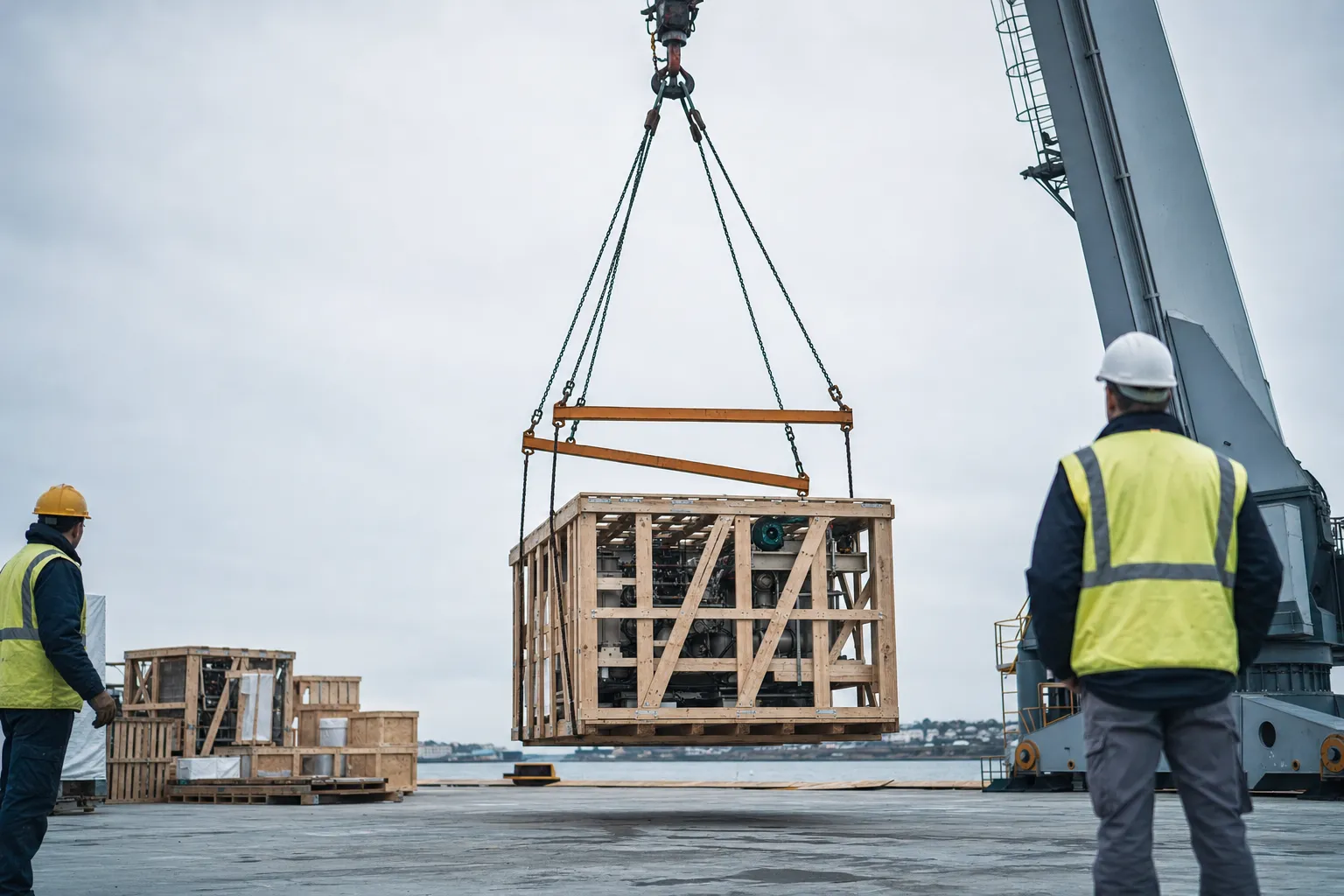
Illustrative: the unit was fixed before this crate was built, not after.
Where the equipment file runs out
Everything above assumes the facts exist. On real equipment packages they arrive in four languages and disagree.
A nameplate gives the maker, the model, the serial number and the electrical rating. It does not say which of two functions is principal, and it never mentions what the machine was supplied without.
A general arrangement drawing gives dimensions, sections and the interface points between them. It shows where the supplier chose to cut the machine for transport, which is a manufacturing convenience — not evidence that each cut piece is a separate article.
A scope of supply lists what the supplier is delivering, including items it bought in and never classified: the control system, the compressed-air package, the safety guarding, the commissioning spares.
A commercial invoice gives a trade name. On equipment it is usually the least informative document in the set and the one the entry is built from.
Put those four side by side and the gaps are predictable: which function is principal when the machine has two; whether a bought-in control system is used solely or principally with this machine or is a general-purpose article; whether the spares volume is in excess of what completes the machine; whether a section is part of the machine or a machine in its own right. None of those is answered by a drawing, and all of them are answered by the supplier's engineering function — which is why the request has to go to engineering and not to sales.
There is also a category of question that no document settles, and it is worth naming so that no one promises otherwise: what the authority will decide. Indonesia provides a route to ask before the declaration is made, and the determination that comes back applies to the goods as described — it is not a licence to change the machine afterwards. The declaration it precedes is the PIB, Indonesia's import declaration, which is where the reasoning has to survive on paper. What matters is the honest version: a pre-shipment classification is a documented, defensible position on the goods as described. It is not the authority's decision, and it does not survive a change in the goods.

Illustrative: the drawing shows where the machine was cut, not how many articles it is.
Four ways a machine gets split wrongly
The failures are not exotic. They are four habits, and each of them is cheap on the day it is chosen.
The habit | What it looks like on paper | What it costs later |
|---|---|---|
Inflation | The whole installation on one line: "production line, dismantled, one set" | It reads as decisive and hides every control attached to a component — the requirement appears at the border with no line to attach it to |
Shattering | Sections declared as "steel structures" or "machine parts" to avoid a heavy classification argument | The parts identity is inherited by the permit file, the packing spec, the insurance description and the site handover |
Absorption | A start-up spares kit and a bought-in control cabinet folded into the machine's line, because they arrived in the same container | Components in excess of a complete machine have their own headings; a service stock is now capital equipment on the entry and cannot be found in the inventory |
Relabelling | The invoice is rewritten to match a code someone found, instead of the code being argued from the goods | The document set now agrees with itself and disagrees with the machine, which is the version that survives an inspection |
Inflation
What it looks like on paper
The whole installation on one line: "production line, dismantled, one set"
What it costs later
It reads as decisive and hides every control attached to a component — the requirement appears at the border with no line to attach it to
Shattering
What it looks like on paper
Sections declared as "steel structures" or "machine parts" to avoid a heavy classification argument
What it costs later
The parts identity is inherited by the permit file, the packing spec, the insurance description and the site handover
Absorption
What it looks like on paper
A start-up spares kit and a bought-in control cabinet folded into the machine's line, because they arrived in the same container
What it costs later
Components in excess of a complete machine have their own headings; a service stock is now capital equipment on the entry and cannot be found in the inventory
Relabelling
What it looks like on paper
The invoice is rewritten to match a code someone found, instead of the code being argued from the goods
What it costs later
The document set now agrees with itself and disagrees with the machine, which is the version that survives an inspection
The third row is the one that surprises experienced buyers, because it is invisible in the accounts. A spares kit absorbed into a machine is not an accounting problem while the project is running. It becomes one at the first failure, when the part is needed, is not in the warehouse, and cannot be imported as a spare without a fresh entry that describes it as what it always was.
The fourth row is the most common and the most quietly expensive. Rewriting a description to fit a number produces documents that are internally consistent and factually wrong, and consistency of that kind is exactly what a review is designed to test.
Splitting the consignment is not splitting the classification
Equipment projects rarely ship in one go, and the split is where the unit decision is most often re-made by accident.
Three sailings do not create three machines. If the sections of one machine travel on three vessels, the object is still the machine; what multiplies is the paperwork — one entry per consignment, in the importer's name, describing that consignment's share of one object. What a split does to a project's obligations covers that duplication in detail. Here the point is narrower: the split changes the number of declarations only if it changes the number of objects, and that question was settled earlier.
The reverse also holds. Two machines that can work independently stay two objects even when they are crated together for a single sailing, and a supplier who ships them bolted to one skid has not made them one machine.
Site assembly sits on the boundary and is worth stating carefully. A machine that arrives in sections and is assembled on site is classified as the machine it is, not as the parts it arrived as — the assembly does not change what was imported. What can change after assembly is the set of obligations the installation attracts in service: commissioning checks, sector approvals, the technical file the operator has to keep. Those are real, and they are a different question from the tariff line. Treating them as the same question is how projects end up arguing about a permit in the week the crane is booked.
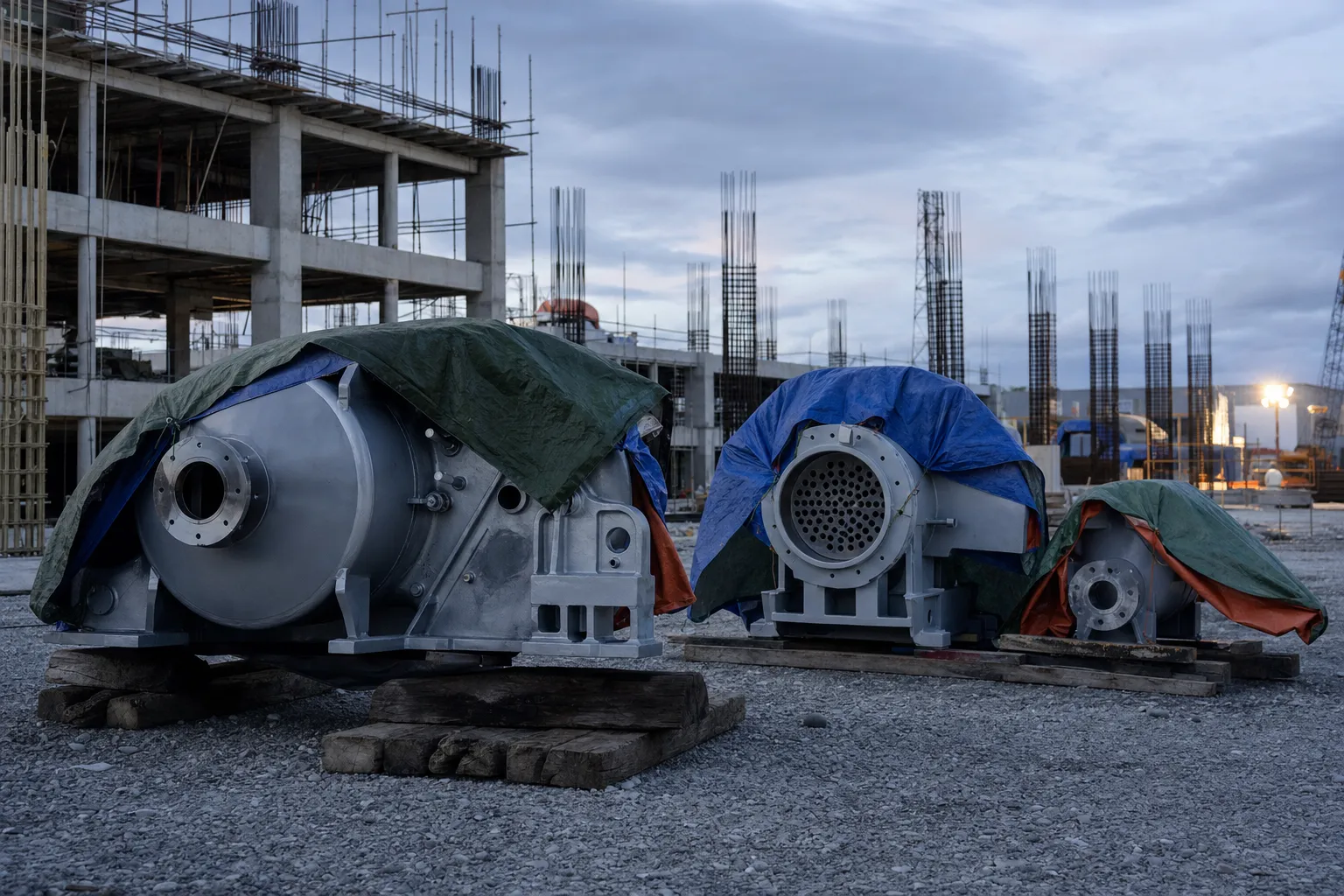
Illustrative: three deliveries, one object — the sequence is a planning question, the count is not.
A sequence to run before the packing list is fixed
Six steps, in this order, because each one consumes the output of the last.
- Build the object list from the engineering file, not the packing list. Start from the scope of supply and the general arrangement drawing and write down every object that could be declared: the machine, each machine inside it, purpose-built parts, bought-in components, spares. Expect the list to be shorter than the crate list and longer than the invoice.
- Apply the rules to each object and write one sentence of reasoning. Not a code — a sentence: this section performs the machine's function and completes it, so it travels as part of the machine. The HS code follows from that sentence; written the other way round, the sentence is whatever justifies the code someone already chose.
- Count the declarations you now have and put them beside the packing list. Every crate should belong to exactly one object, and every object should have at least one crate. Crates that belong to no object are the ones that will be argued about at the border.
- Send the object list to the admission side before any application is filed. A permit or registration is applied for against a line; if the object list is still moving, the application is describing something that may not exist.
- Freeze the description convention across invoice, packing list and transport document. One object, one set of words. The invoice should be able to support the description rather than being rewritten to fit it — the cross-reading that catches mismatches is set out in what a pre-shipment document review actually checks.
- Record what would change the answer. A section promoted to a separate machine, a spares volume that grows past what completes the machine, a component substituted during manufacture. Each of those re-opens the count, and the person who needs to know is whoever is holding the permit file.
The output of the sequence is one table, and it is short enough to keep current.
Candidate declared unit | Basis (which note or rule) | Fact still missing | Owner | Freezes at |
|---|---|---|---|---|
Line, six sections | Rule 2(a), unassembled article | Confirmation that no section is a machine in its own right | Supplier engineering | Packing drawing |
Inline date coder | Own function, own heading | Whether its controller is shared with the line | Supplier engineering | Permit application |
Control cabinet | Parts note: used solely or principally with this machine | Whether it is bought-in standard or purpose-built | Supplier engineering | Invoice |
Start-up spares kit | Rule 2(a), excess components | Itemised list, split by whether the machine can run without each item | Procurement | Booking |
Line, six sections
Basis (which note or rule)
Rule 2(a), unassembled article
Fact still missing
Confirmation that no section is a machine in its own right
Owner
Supplier engineering
Freezes at
Packing drawing
Inline date coder
Basis (which note or rule)
Own function, own heading
Fact still missing
Whether its controller is shared with the line
Owner
Supplier engineering
Freezes at
Permit application
Control cabinet
Basis (which note or rule)
Parts note: used solely or principally with this machine
Fact still missing
Whether it is bought-in standard or purpose-built
Owner
Supplier engineering
Freezes at
Invoice
Start-up spares kit
Basis (which note or rule)
Rule 2(a), excess components
Fact still missing
Itemised list, split by whether the machine can run without each item
Owner
Procurement
Freezes at
Booking
Three rows of that table are worth more than the fourth: the ones where the missing fact sits with the supplier rather than with you. Those are the ones that get answered last, and they are the ones that decide whether the packing drawing is right.
An invented installation, classified twice
A filling and capping line is sold as one installation. The supplier ships it as six sections across three sailings, with a date coder it bought in, a control cabinet built for the line, and a start-up spares kit. Nothing below is a client case and nothing below is a quotation; it is a constructed illustration.
Classified the fast way. Everything goes on one line: "filling and capping line, dismantled, one set", with the coder, the cabinet and the spares described as part of the set. The invoice is easy to write, the packing list matches it, and nothing needs to be argued about before booking.
The first sailing clears. The second does too. The third contains the coder and the spares kit and nothing else, and it is on that consignment that the description stops working: a consignment described as a dismantled line that contains no part of the line is not a description anyone can defend. By then the permit file has been built on a line that included the coder, the packing drawings have been approved against a set, and the spares are on the entry as capital equipment.
Classified by object. The same package yields four candidate objects, which resolve to three or four declared lines — the cabinet is the one that can go either way. The line, including its six sections, is one machine — it performs one function, the sections complete it, and the fact that it travels unassembled does not change that. The date coder is a machine with a function of its own and gets its own identity, which is also where any approval attached to a coder becomes visible. The control cabinet is declared with the line when it is used solely with that line and is not a standard article sold on its own; it takes a line of its own only when it is a bought-in standard article. The spares kit is split: items the machine needs to be complete stay with the line, and everything beyond that is declared as what it is.
The second version is more work in the week it is written, and it produces three consignments whose documents agree with each other and with the machine. It also produces something the first version cannot: a file that answers the question "why is it declared this way" without anyone reconstructing the reasoning from memory.
Where we sit
We are not the classifier, not the importer of record and not the broker. The classification decision belongs to Indonesia's customs authority, the entry is lodged by the licensed importer or the broker it appoints, and what a given arrangement permits for your entity and your goods is decided there rather than by a forwarder or a sales term.
What Yanchao does sits on either side of that decision and before it: reading the scope of supply and the packing plan against each other while the plan can still change, listing the facts that are missing and who holds them, keeping the invoice, packing list and transport documents describing the same object, and coordinating the Chinese and Indonesian ends so that the consignment that arrives is the one that was declared. Where the count is still open when a booking is being confirmed, that is the conversation to have first — the project cargo articles in this section cover the rest of the sequence.
If a line is already sold, already crated and already quoted, the useful thing to send is the scope of supply and the general arrangement drawing, not the invoice. The invoice describes what someone decided; the drawing shows what is actually going into the crates.