
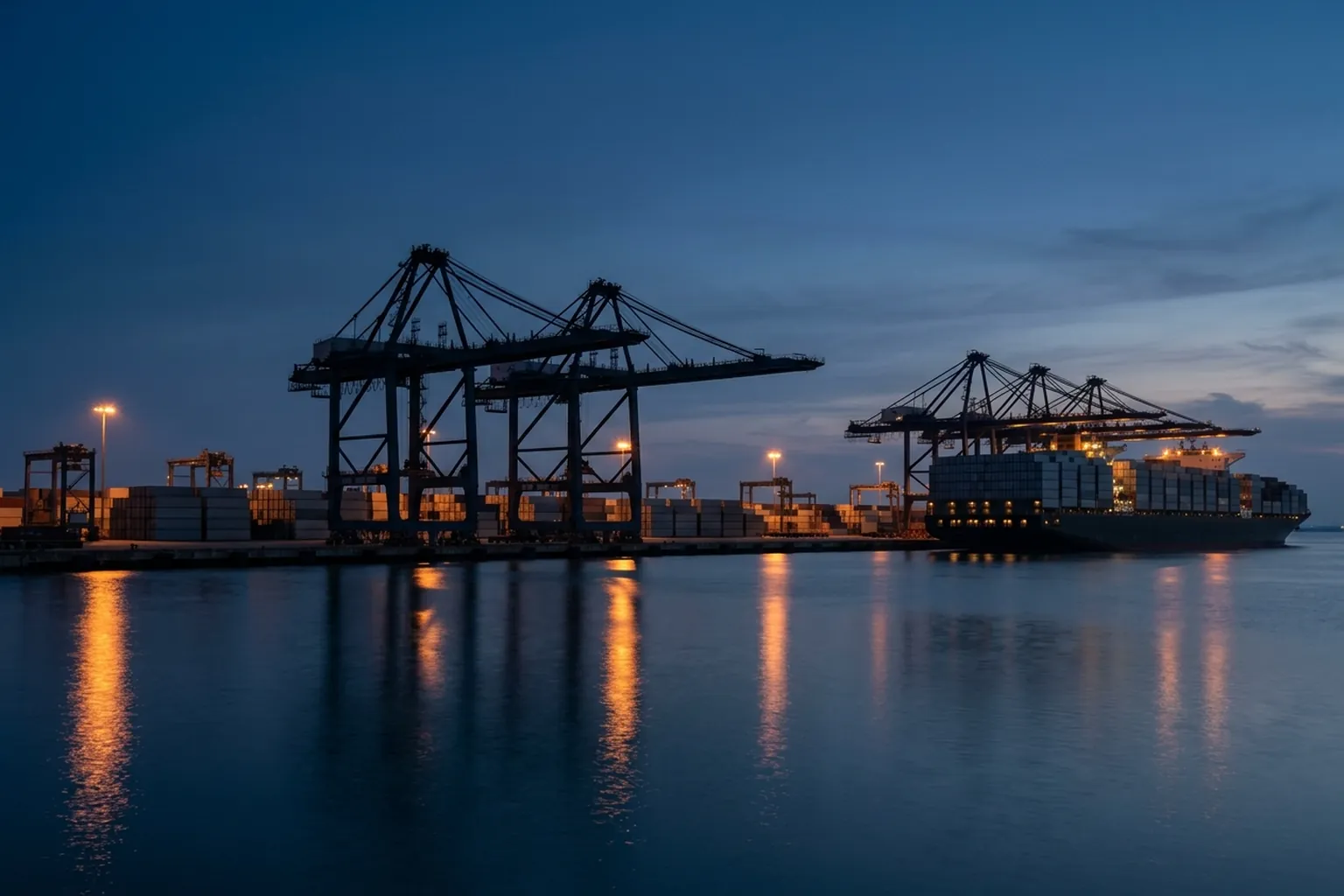
A port of loading is the port where your cargo is handed to the ocean carrier and loaded on board the vessel. An origin port is the wider decision behind that line on your quotation: which Chinese gateway your goods reach before the sea leg begins, and which road they travel to get there. Those two questions are usually answered together and in the wrong order. Shippers pick a city they have heard of, then discover the factory is far from it, the sailing is not weekly, or the cargo cannot be consolidated there.
China ports do not sort into a single best choice for Indonesia-bound cargo. There is a port that fits where your supplier is, which sailings serve the route, the form your cargo moves in, and the Indonesian gateway it has to reach.
Everything below is structural. No figure in this article is a customer case, and none of it is a quotation. Where an example is given, it illustrates a decision — it is not an offer and not a rate.
How to choose a Chinese origin port
You are not choosing one thing. You are settling four decisions that constrain each other, and the order matters because each narrows the next.
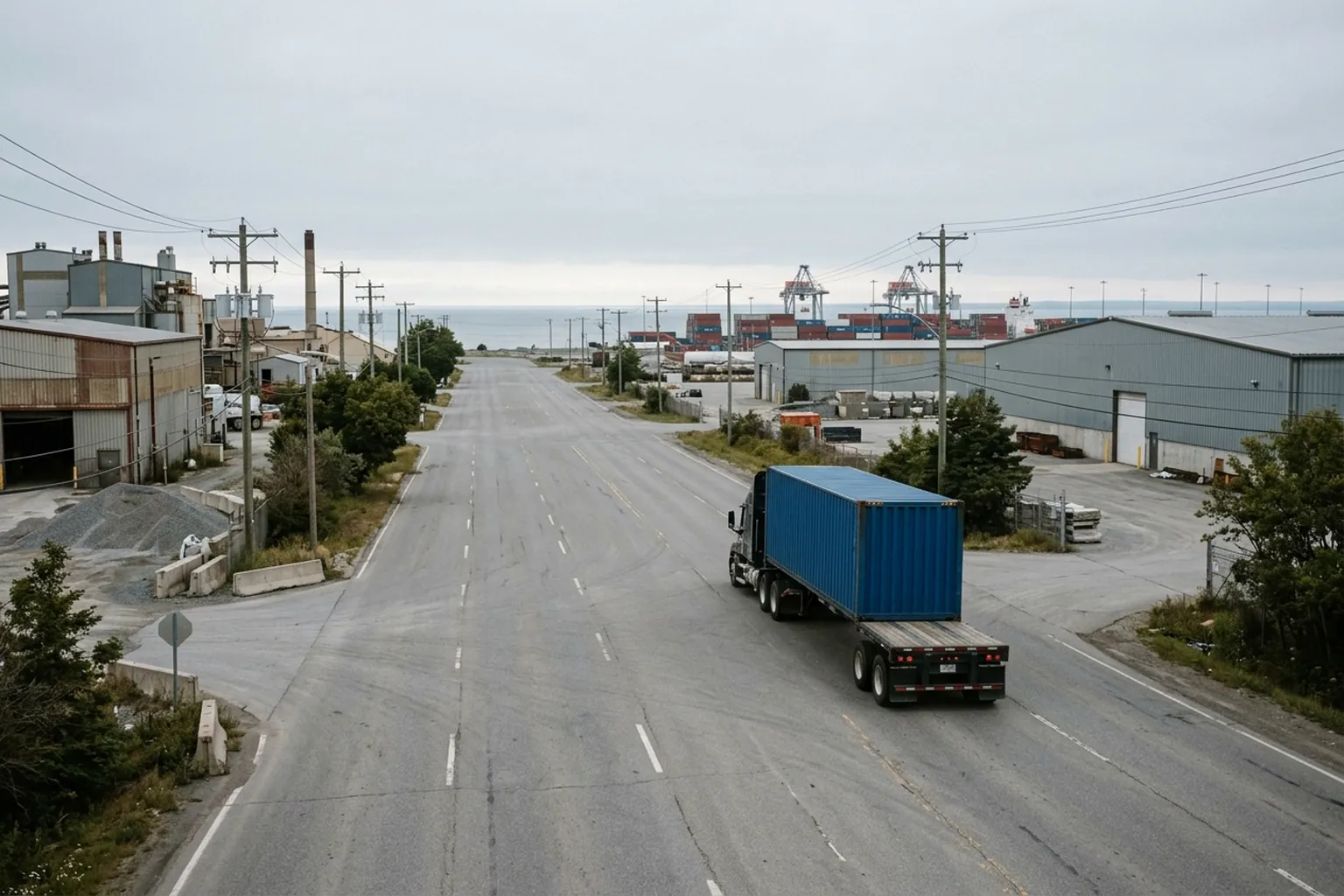
Where the cargo physically is. The inland leg from your supplier's factory, or from wherever the goods are consolidated, to the port gate. This is the leg you control least and pay for first.
Which service rotation can carry it. A port is only useful if a rotation calling Indonesia actually calls it, at a frequency you can plan around. Two ports on the same coast can differ sharply here.
The form the cargo moves in. Full container load and less-than-container load do not use the same facilities and do not need the same kind of port. A gateway with a strong consolidation base is a different answer from one built around large full-container volumes.
The Indonesian gateway it has to match. The origin port has to connect to the destination port your consignee, broker and inland delivery plan are built around. On the Indonesian import side we assist and coordinate with the parties involved rather than determine them; the importer's own arrangements decide that half.
Run those four in that order and the candidate list usually collapses to one or two ports. Run them out of order — pick a port first, then hunt for a sailing — and you spend the rest of the booking undoing the choice.
Who actually chooses the port
The origin port is not always the shipper's to pick freely, and the document that settles it is usually the sales contract, not the freight quotation.
Under the Incoterms rules published by the International Chamber of Commerce, terms that put the cargo on board at the origin port — FOB above all — leave the buyer arranging and paying for the main carriage. That normally makes the buyer the party who nominates the port of loading, with the seller delivering the goods to it. Under CIF and its relatives the seller contracts the carriage and therefore chooses the port, with risk passing at a different point. For an importer the consequence is blunt: if you bought CIF, the port was chosen for you, and your room to influence it sits in the negotiation rather than in the booking.
The second holder of the pen is whoever books. Freight forwarders and NVOCCs buy space from carriers and often consolidate several shippers onto one rotation. When that happens the port of loading is decided by where your cargo can be put onto a service that already exists, which may not be the port nearest your factory. That is a legitimate arrangement — it is how most small and mid-size importers get weekly departures at all — but it belongs in the quotation as a stated condition rather than arriving as a discovery.
So the first question about any origin port is not "is this a good port" but "who chose it, and can it still move".
Distance from your supplier decides more than the port's size
Ocean freight is priced and scheduled in a fairly standardised way across gateways. Trucking to a port is not. The inland leg depends on road distance from the actual pickup point, the traffic pattern on that corridor, container availability at the time, and whether the delivery address is a container yard or a consolidation station.
That last distinction drives the first real fork:
Facility | What happens there | Cargo form it serves |
|---|---|---|
Container yard (CY) | A full container is collected, or an export container is received and staged for the vessel | Full container load |
Container freight station (CFS) | Loose cargo from several shippers is received, consolidated into a container and stuffed under supervision | Less-than-container load |
Inland container depot | An off-dock staging point where containers are handled away from the quay | Either, by operator |
Container yard (CY)
What happens there
A full container is collected, or an export container is received and staged for the vessel
Cargo form it serves
Full container load
Container freight station (CFS)
What happens there
Loose cargo from several shippers is received, consolidated into a container and stuffed under supervision
Cargo form it serves
Less-than-container load
Inland container depot
What happens there
An off-dock staging point where containers are handled away from the quay
Cargo form it serves
Either, by operator
Distance is not measured from the city named on the port. A port name usually covers several terminal areas, and the gate you deliver to can sit well away from the city centre. A supplier in an industrial park on the western edge of one metropolitan area can be closer to a terminal in the neighbouring province than to the one carrying the port's name.
Two timing facts attach here, and both belong to your planning rather than to the port. The cargo-ready date is when the goods can actually be handed over, packed and documented. The cut-off is the deadline by which the container, or the loose cargo, must be at the terminal in the right state to make a given sailing. The gap between them is your slack. A short inland leg buys slack; a long one consumes it. Fix the cargo-ready date first and fit the port to it, not the other way round.
The seven main origin ports, and what to verify at each
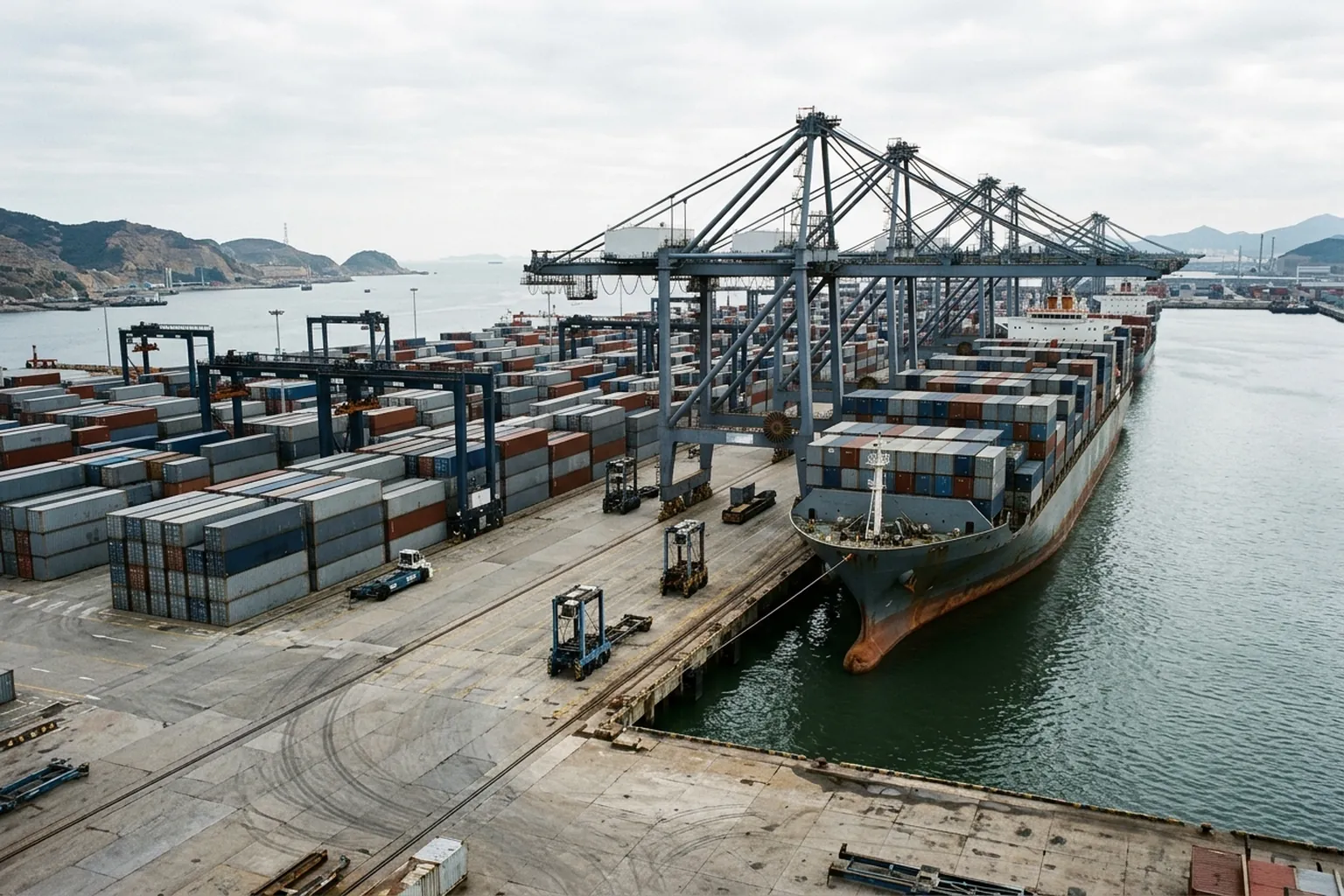
China's export gateway system is usually described in three coastal groups, and that grouping is the most useful first cut because it maps to where factories actually sit. The seven gateways are Tianjin, Qingdao, Shanghai, Ningbo, Xiamen, Guangzhou and Shenzhen — grouped below by the production region each serves. They are the ones we can book out of — a working set, not a ranking, and nothing here should be read as a recommendation to prefer one over another.
The Bohai Rim group — Tianjin and Qingdao. These serve north and north-east China: machinery, steel products, chemicals, and the industrial belt inland of them. Tianjin is the outlet for Beijing and the surrounding industrial region; Qingdao serves Shandong and the corridor behind it. For Indonesia-bound cargo they are the natural origin when the supplier is in the north, and an awkward one when the supplier is in Guangdong, because the inland leg becomes long and the cargo passes a nearer port on the way.
The Yangtze Delta group — Shanghai and Ningbo. The largest concentration of export infrastructure in the country, and the two names often function as one system: Shanghai's terminals and the Ningbo-Zhoushan complex sit a short feeder hop apart, and cargo can be routed through either. The Port of Shanghai and the Port of Ningbo-Zhoushan illustrate the pattern — very large, deep-water, and served by dense inland connections. For a supplier in Jiangsu, Zhejiang or Shanghai this group usually gives the shortest inland leg.
The south-east coast group — Xiamen, Guangzhou and Shenzhen. Xiamen serves Fujian; Guangzhou's ocean traffic has largely moved to Nansha; Shenzhen's terminals at Yantian and Shekou serve the Pearl River Delta manufacturing belt and the cross-border e-commerce corridor.
At each of them, the same short list of questions produces a usable answer:
What to verify | Why it changes the decision |
|---|---|
Which terminal, not just which city | One port name can cover terminals with different equipment, yard capacity and gate hours |
Whether your service calls it | A rotation naming the port is not the same as a vessel that berths there on the sailing you want |
Gate cut-off and documentation deadline | Set per terminal and per sailing, and they push the cargo-ready date back |
Whether a CFS exists for your cargo form | An LCL shipment cannot start at a gateway with no consolidation operation |
Equipment for the container you need | Non-standard boxes are less substitutable at short notice — see what each container type means for handling requirements |
Who collects the container inland | Forwarder or the shipper's own trucker; this decides who owns the risk on the road |
Which terminal, not just which city
Why it changes the decision
One port name can cover terminals with different equipment, yard capacity and gate hours
Whether your service calls it
Why it changes the decision
A rotation naming the port is not the same as a vessel that berths there on the sailing you want
Gate cut-off and documentation deadline
Why it changes the decision
Set per terminal and per sailing, and they push the cargo-ready date back
Whether a CFS exists for your cargo form
Why it changes the decision
An LCL shipment cannot start at a gateway with no consolidation operation
Equipment for the container you need
Why it changes the decision
Non-standard boxes are less substitutable at short notice — see what each container type means for handling requirements
Who collects the container inland
Why it changes the decision
Forwarder or the shipper's own trucker; this decides who owns the risk on the road
China's port system is also organised nationally, which is why the same categories appear in a commercial list of ports in China, in material from the China Ports and Harbours Association, and from the Ministry of Transport. Treat those as maps, not guidance: they tell you what exists, not which gateway fits your cargo.
Sailing frequency and rotation: reading the schedule
A port without a suitable rotation is a road to nowhere. This is the most common reason a sensibly chosen origin port stops working, and the least visible at quotation stage.
Three terms do the work. A service rotation is the published sequence of ports a set of vessels calls on a repeating cycle. Sailing frequency is how often that rotation calls your port — weekly, fortnightly, or on some other cadence. Transit is what happens between: a direct service loads at the origin port and discharges at the destination port on the same vessel, while a routing that introduces a transshipment or a feeder leg moves your container through an intermediate port first.
Frequency and directness trade off against each other. A large gateway will typically offer more sailings a week but a higher chance that the specific sailing you want involves a relay; a smaller gateway may offer fewer sailings but a cleaner single-vessel routing to one destination. Neither is better in the abstract. What matters is whether the pattern covers the dates your cargo is ready.
Two structural points are worth knowing. First, schedules are commercial information published by carriers, and exchange material of this kind is published by bodies such as the Shanghai Shipping Exchange. Ask which rotation, on which sailing, and confirm the cut-off against that specific vessel rather than against a general expectation. Second, very heavy or over-dimensional cargo shrinks the list of services that will take the booking at all, which in practice narrows the realistic origin ports.
A word on published transit times, including ones you will find in guides like this. On our own China–Indonesia lanes, sea and consolidated cargo are planned against a whole-journey reference of roughly 15–25 days, excluding public holidays and any red-channel clearance window. That reference is scoped to that traffic and that journey — it is not a full-container transit figure for every lane, and it is a conditional range for planning rather than a guarantee or a quotation. Note also where the clock starts, because a port-to-port figure and a door-to-door figure are not the same number, and a guide publishing one transit figure without saying which it is has told you very little.
FCL, LCL, and which ports are actually realistic
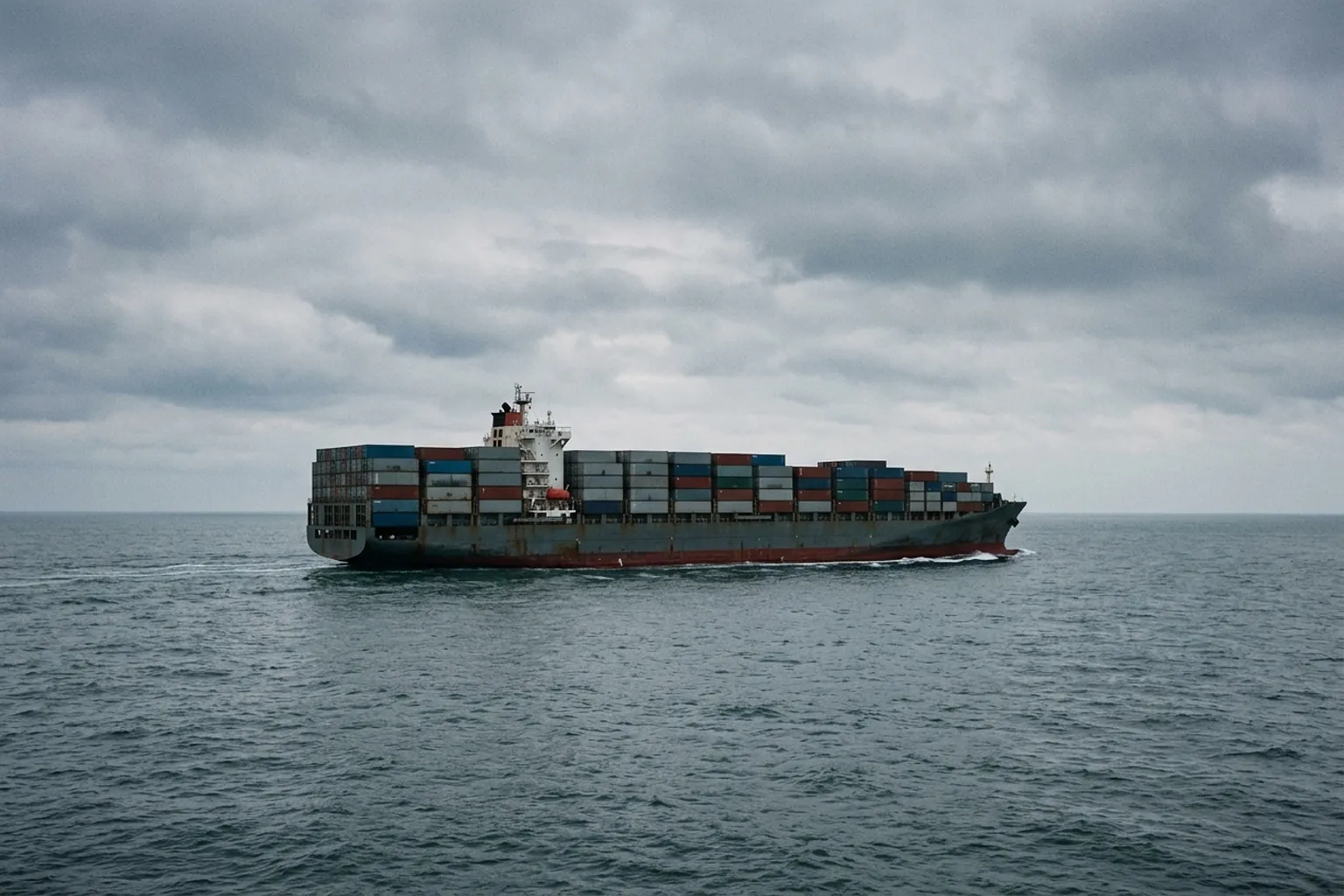
Cargo form eliminates ports faster than any other single factor. Full container load and less-than-container load need different facilities, and not every gateway has both at equal strength.
For full container load the origin requirement is a container yard with equipment and availability for the box you need, plus a rotation that will take it. The container is picked up, loaded at the supplier and returned to the terminal by cut-off. How FCL and LCL divide responsibility and cost is the structural explanation; the port-selection consequence is that large, well-connected gateways tend to be the safer bet for oversized or special equipment.
For less-than-container load the requirement is a consolidation operation — a freight station where loose cargo from multiple shippers can be received, documented and stuffed into a shared container. That capability is concentrated in specific places, which is why an LCL shipper in the interior often ships to a coastal consolidation point rather than to the geographically nearest port.
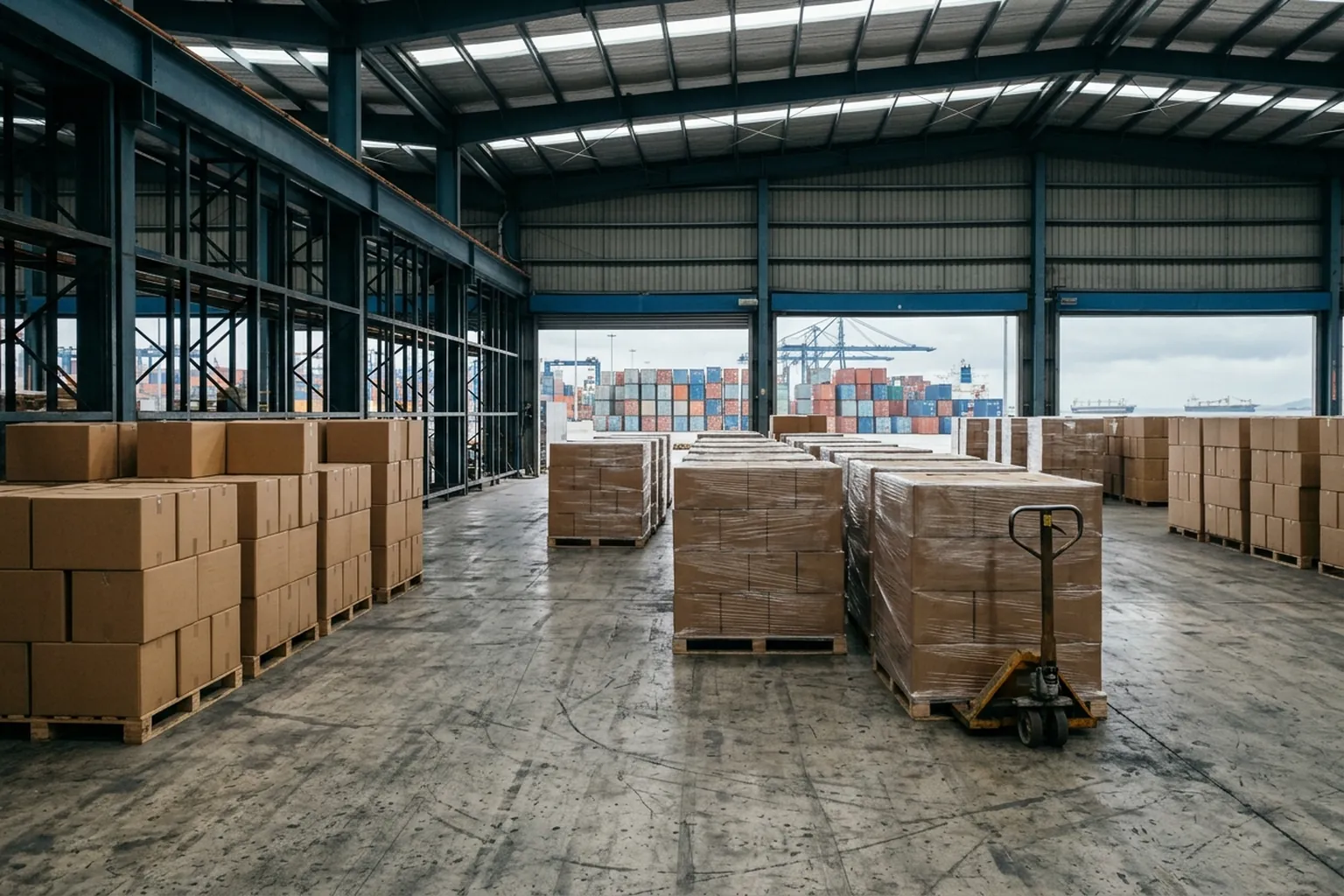
Two practical consequences follow. LCL cargo enters the plan earlier, because the shared container only leaves once it is full or the schedule forces the departure. And it is billed on volume, which is why how your cargo is measured in cubic metres sits behind almost every LCL decision. If the volume sits near the boundary between the two forms, the answer may change the port — and how sea and air freight differ on this route covers the mode question above it.
Origin-side charges scale with the port, not with the ocean rate
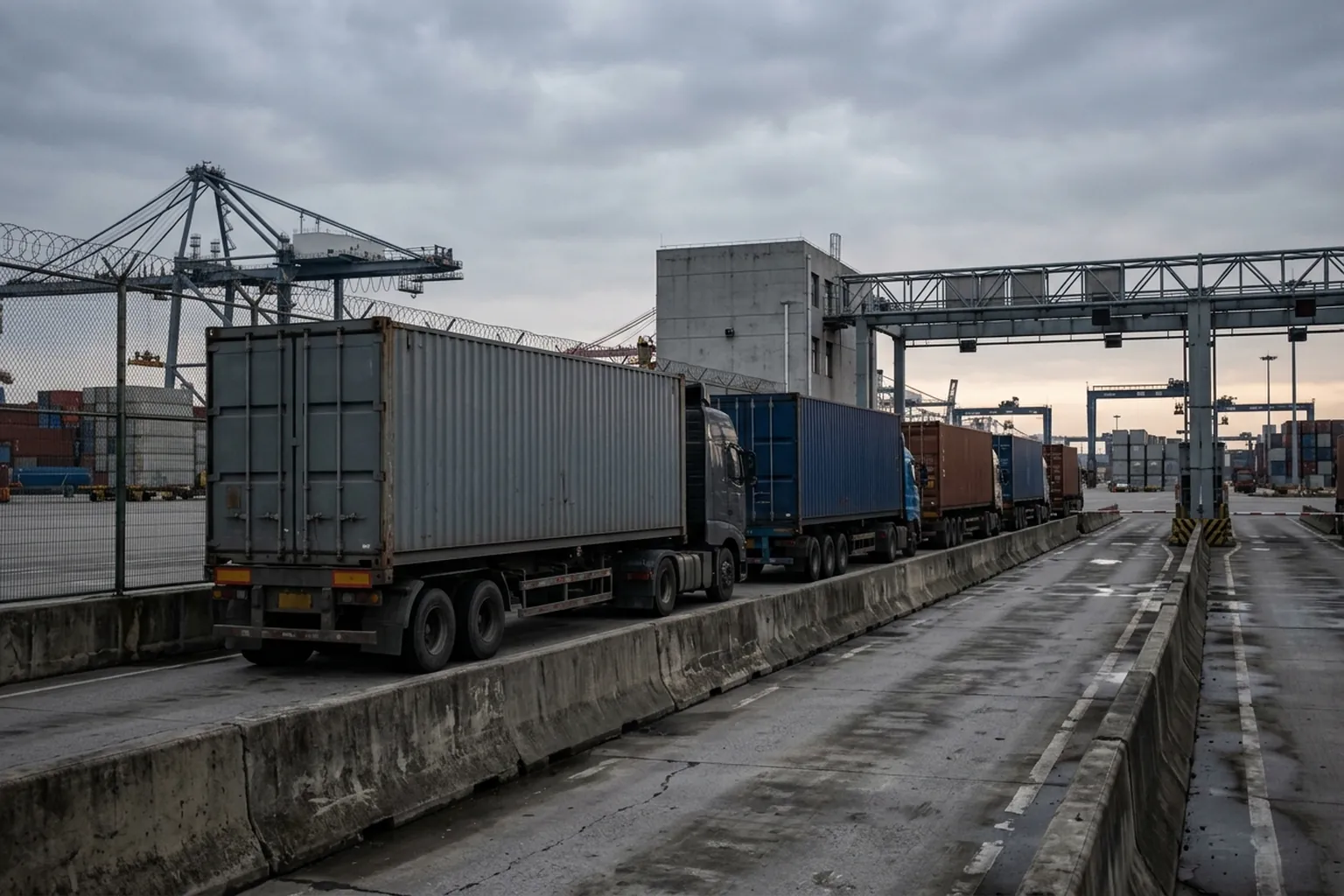
A quotation is not one number and does not come from one place. The part that attaches to the origin port — terminal handling at loading, documentation, and the inland haulage that gets the container there — is generated on the origin side, by entities operating there, and it varies with the gateway you chose.
The base ocean freight rate follows a lane and a booking window. The origin-side lines follow the physical reality at the gate you picked: how far the container travelled, what the terminal charges for handling it, whether documentation is routine, and whether the cargo needs special handling. Two quotations for the same goods on the same lane can therefore differ for a reason that has nothing to do with anyone's margin — they may be priced from different origin ports.
What actually drives the cost of shipping to Indonesia sets out how the rest of the structure fits together; this section is only the origin-side slice. Three questions close it usefully: which port is this priced from? Is inland haulage to that port inside the figure or billed separately? And does the origin handling shown correspond to the gateway named, or to a terminal the forwarder uses on the same coast? A quotation that answers those three can be compared honestly with another one.
Matching the origin port to the Indonesian gateway
The last constraint reaches the far end of the voyage, and it is why origin choices sometimes look counter-intuitive: the right origin port is the one that connects cleanly to the destination port the receiving side is set up for.
Indonesia's main ocean gateways for containerised imports include Tanjung Priok for the Jakarta region, the country's largest and busiest container port; Tanjung Perak for Surabaya and eastern Java; Tanjung Emas for Semarang; Belawan for Medan and North Sumatra; Makassar for Sulawesi; and Batam for the Riau islands. They are not interchangeable. A consignee set up for Tanjung Priok with a broker, a customs arrangement and an inland carrier in western Java is not served by a sailing into a port on the other side of the archipelago.
Two connections matter when weighing an origin port against that gateway. The first is service coverage: which Chinese gateways feed the Indonesian port you need, directly or through a relay. The second is frequency at the Chinese end for that specific pairing, which is not the same as frequency into Indonesia generally.
This is also where the two ends of a shipment meet the boundary between what we handle and what the importer handles. On the Indonesian import side the importer of record arranges importation; we assist and coordinate with the parties involved on that side. The origin half is where a forwarder's choice has the most direct effect, and it is the half worth settling first — because a destination mismatch cannot be fixed by choosing a better port in China. Our international freight service sets out the scope we coordinate on this lane.
A checklist you can run before you book
The four decisions compress into a list. Work down it in order; the answers narrow each other.
Dimension | What to confirm | Where the answer comes from |
|---|---|---|
Supplier location | Actual pickup address and its road distance to each candidate terminal — not to the port's city | Your supplier |
Cargo-ready date | The date the goods can be handed over, packed and documented | Your production or warehouse team |
Cargo form | Full container or consolidation; measured volume if LCL | Your packing list and the measurement behind it |
Container requirement | Standard or special equipment, and maximum unit dimensions and weight | Your packing details, measured after packing |
Rotation | Which services call the candidate port, on which sailing, with what cut-off | Your forwarder, or the carrier's published schedule |
Directness | Whether the routing is direct, or uses a transshipment or feeder leg | The same schedule |
Origin charges | What the origin port adds, and whether inland haulage is inside or outside the figure | The quotation, itemised |
Destination match | Which Indonesian gateway the consignee, broker and inland delivery are built around | The consignee and their broker |
Free time and equipment | How long the container and terminal space can be held, and who owns each clock | The carrier's terms and the quotation |
Supplier location
What to confirm
Actual pickup address and its road distance to each candidate terminal — not to the port's city
Where the answer comes from
Your supplier
Cargo-ready date
What to confirm
The date the goods can be handed over, packed and documented
Where the answer comes from
Your production or warehouse team
Cargo form
What to confirm
Full container or consolidation; measured volume if LCL
Where the answer comes from
Your packing list and the measurement behind it
Container requirement
What to confirm
Standard or special equipment, and maximum unit dimensions and weight
Where the answer comes from
Your packing details, measured after packing
Rotation
What to confirm
Which services call the candidate port, on which sailing, with what cut-off
Where the answer comes from
Your forwarder, or the carrier's published schedule
Directness
What to confirm
Whether the routing is direct, or uses a transshipment or feeder leg
Where the answer comes from
The same schedule
Origin charges
What to confirm
What the origin port adds, and whether inland haulage is inside or outside the figure
Where the answer comes from
The quotation, itemised
Destination match
What to confirm
Which Indonesian gateway the consignee, broker and inland delivery are built around
Where the answer comes from
The consignee and their broker
Free time and equipment
What to confirm
How long the container and terminal space can be held, and who owns each clock
Where the answer comes from
The carrier's terms and the quotation
Hand that list over as questions rather than requirements and you get a comparable set of answers back. Hand over a port name first and you get whatever the forwarder's available rotation supports.
Origin port questions importers ask
What is an origin port?
The port at the exporting end of a shipment, where cargo is handed to the ocean carrier and loaded on board. On a quotation it usually appears as the port of loading, and on a bill of lading as the place of receipt or the port of loading, depending on how the cargo was handed over.
What is the difference between a port of loading and a port of discharge?
The port of loading is where the cargo goes on the vessel at the origin end; the port of discharge is where it comes off at the destination end. They are paired by the service rotation rather than chosen independently — changing one usually changes the routing options for the other.
What are the main Chinese ports for export?
The gateways most often used for containerised exports sit in three coastal groups: the Bohai Rim (Tianjin, Qingdao), the Yangtze Delta (Shanghai, Ningbo) and the south-east coast (Xiamen, Guangzhou, Shenzhen). Which is right for a shipment is decided by the supplier's location and the available sailing, not by size.
Are the major sea ports in south China different from those in the north?
Yes, and the difference is which inland production region each serves rather than quality. South China's gateways serve the Pearl River Delta and Fujian manufacturing; the northern and eastern gateways serve the belts behind the Bohai Rim and the Yangtze. Cargo manufactured in one and shipped from the other usually pays for the inland leg twice.
Can I choose the port myself?
Usually, if you control the booking. Under the Incoterms terms that leave carriage with the buyer — FOB is the common one on import shipments — the port of loading is the buyer's to nominate. If the seller contracted the carriage, or your forwarder is consolidating your cargo onto an existing rotation, the port may already be fixed by the time you see the quotation. Asking who chose it is the way to find out.
Who pays the origin-side charges?
It depends on the sales contract and on who is the importer of record, which is why the same shipment can look different on two buyers' costs. The origin lines follow the port that was used. For Indonesia-bound cargo the import side involves the importer's own arrangements, which we assist and coordinate on rather than determine.
Share the pickup point, the cargo-ready date, the packing details and the delivery address through our contact page and we respond within two hours on working days, with a preliminary quotation normally provided within 48 hours once the documents are complete. Shipments involving special goods, complex clearance or project cargo are confirmed after review rather than on the standard turnaround. This article continues the mode, measurement and cost threads of our freight planning guides, which index the rest of this cluster.